
Thank you for reading or listening to The Realist Juggernaut. Independent journalism should be accessible to everyone.
New York is beginning with frontier AI developers, including the largest developers subject to enhanced disclosure and assessment requirements, alongside catastrophic-risk reporting, transparency rules, and data-center controls. The immediate rules are narrow. The government structure being built around them is not, and that distinction deserves close attention before artificial intelligence becomes another technology governed by layers of permanent bureaucracy.
Artificial intelligence has crossed a line in New York.
For years, the debate surrounding AI centered on development, competition, research, automation, jobs, cybersecurity, privacy, deepfakes, and the question of what machines may eventually become capable of doing. That debate has now entered a different stage. New York is constructing an institutional regulatory system around artificial intelligence, complete with registration, mandatory reporting, recurring risk assessments submitted to the state, financial penalties, a dedicated oversight office, and the ability to recommend additional regulation.
Governor Kathy Hochul made that direction unmistakable on September 21, 2026, announcing the next implementation phase of New York’s Responsible AI Safety and Education Act, known as the RAISE Act. Beginning in November, large frontier AI developers are being directed to register with New York State. Beginning January 1, 2027, covered companies will face formal compliance requirements administered through the newly created Office of Digital Innovation, Governance, Integrity and Trust, or DIGIT, housed within the New York State Department of Financial Services.
The current law does not regulate ordinary people using consumer AI systems in their homes, independent writers using generative tools, small businesses subscribing to commercial AI services, or hobbyists running ordinary local models. That distinction matters. The current requirements focus on frontier developers operating at the highest end of AI development, with additional obligations imposed on large frontier developers. Claims that New York has already imposed these rules on household AI users would be inaccurate.
The larger issue is what New York is building around that initial jurisdiction.
DIGIT is not a temporary committee assembled to study one statute. New York describes it as a central and authoritative governmental body for digital safety and technological governance. The state says the office will devise new approaches and provide consistent enforcement as technology develops. Its first stated focus is regulation of large frontier AI developers. The word first matters because the state’s own description leaves room for a wider future mission.
New York’s AI Program Extends Beyond the RAISE Act
The RAISE Act and DIGIT are only part of New York’s broader artificial-intelligence agenda.
Hochul’s 2026 State of the State places DIGIT inside a larger digital-governance program that includes proposed labeling requirements for AI-generated content, additional restrictions involving deceptive AI content in elections, expanded state-backed AI research capacity, and continued government adoption of artificial intelligence in other sectors.
The State of the State proposes legislation requiring AI-generated content to carry provenance information identifying its origins and creation. The administration describes that information as a digital record intended to help people distinguish authentic material from manipulated or manufactured content.
The same agenda proposes additional election-related restrictions. Hochul calls for legislation targeting non-consensual deepfakes during specified periods before elections and separate restrictions on false information concerning voting locations, dates, voter eligibility, registration status, and related election information.
At the same time, New York continues expanding its own AI infrastructure.
The State of the State describes Empire AI as a first-in-the-nation consortium of public and private research institutions and says the Empire AI Beta system is being installed alongside the existing Alpha system. According to the state, Empire AI Beta delivers roughly 11 times the AI training capacity of the Alpha system and is intended to support hundreds of researchers across participating institutions.
That combination really matters.
New York is not pursuing a single AI policy. It is building multiple layers at once: frontier-model regulation, centralized digital governance, synthetic-content rules, election-related AI controls, state-backed supercomputing capacity, research infrastructure, and government-sector AI adoption.
New York is not the first state to establish formal governmental structures around artificial intelligence. Texas established an Artificial Intelligence Division within its Department of Information Resources effective September 1, 2025, while California had already implemented a statewide GenAI governance framework covering state entities, including risk assessments, high-risk AI inventories, transparency, procurement, security, incident reporting, acceptable-use requirements, and workforce training. What distinguishes New York’s DIGIT structure is its broader stated mission: New York describes it as a first-of-its-kind central authority for digital safety and technological governance, with regulation of large frontier AI developers as its first focus.
Hochul reinforced that point in Monday’s announcement. After laying out the implementation of the RAISE Act, her office stated that she is exploring additional steps in the coming months to strengthen New York’s AI safety laws and regulations. Hochul said that as AI continues evolving, she will continue working on additional measures intended to protect New Yorkers.
That does not prove that Albany intends to regulate privately owned AI systems in people’s homes. It does establish something important: New York does not regard the RAISE Act as the end of its AI regulatory program.
It regards it as a beginning.
Under the present framework, large frontier developers must establish and publicly disclose frontier AI frameworks explaining how they manage catastrophic risks. Frontier developers must report qualifying critical safety incidents to DIGIT within 72 hours, while large frontier developers must also submit recurring summaries of catastrophic-risk assessments from internal use of their frontier models, maintain current disclosure statements, and pay assessments supporting administration of the system. DIGIT can transmit incident reports and summaries of catastrophic-risk assessments to other governmental authorities when appropriate, and beginning January 1, 2028, the office is required to produce an annual public report covering reviewed incidents, information relevant to frontier-model safety, and recommended updates to the law.
The 72-hour requirement needs to be understood accurately. It does not mean that every malfunction, hallucination, incorrect answer, coding mistake or strange output produced by an AI system must be reported to Albany. The statute deals with serious safety events involving frontier systems and catastrophic-risk scenarios. The underlying law addresses extreme consequences rather than ordinary software errors. New York’s statutory framework describes catastrophic risks in terms that include mass casualties, enormous property losses and severe events involving advanced frontier systems.
That is a legitimate distinction because there are AI risks for which government has a defensible public-safety role. Artificial intelligence used to facilitate catastrophic cyberattacks, chemical or biological threats, attacks on critical infrastructure, large-scale criminal operations or other severe harms presents questions far beyond someone’s private use of a chatbot.
Deepfakes used for fraud, impersonation, exploitation or malicious deception present another legitimate area for law enforcement. AI does not create a right to steal someone’s identity, fabricate criminal evidence, sexually exploit another person, compromise computer systems or cause physical harm.
The debate starts when rules created to address extreme conduct become the foundation for regulating progressively broader categories of technology and users.
That possibility should not be dismissed, but it should not be stated as though it has already happened either.
Government regulatory systems rarely remain technologically frozen. Definitions change. Thresholds change. New legislation follows old legislation. Agencies develop expertise, personnel, budgets, reporting systems and enforcement mechanisms. Legislatures encounter new circumstances and amend statutes. Courts interpret disputed provisions. Successive administrations change priorities.
New York is now putting that institutional infrastructure in place for AI.
The RAISE Act gives the state significant enforcement authority. The attorney general may seek civil penalties of up to $1 million for a first qualifying violation and up to $3 million for each subsequent qualifying violation involving a large frontier developer’s failure to publish or transmit required documents, prohibited statements, failure to report a required incident, or failure to comply with its own frontier AI framework. Separately, the law authorizes a civil penalty of $1,000 per day for failure to file a required large-frontier-developer disclosure or correct false disclosure information, along with recovery of unpaid assessments.
The state has also created a pathway for the public to submit reports concerning critical safety incidents to DIGIT, which can provide such information to other government authorities where appropriate. That means New York is establishing not only corporate reporting obligations but an information pipeline between private parties, a specialized regulatory office and other arms of government.
Four days before Hochul’s September 21 announcement, New York Attorney General Letitia James separately encouraged employees who possess information concerning potentially unsafe or illegal AI development to submit confidential whistleblower complaints to the attorney general’s office. Her office said it is monitoring cybersecurity, economic and other safety risks associated with emerging AI technology.
Taken together, these actions show that New York is moving beyond broad political discussion of AI. It is creating an enforcement ecosystem.
That development also has to be viewed alongside Hochul’s July 2026 action on the physical infrastructure powering AI.
On July 14, Hochul imposed what her administration described as the nation’s first statewide moratorium on new hyperscale data centers. The order established a one-year pause on certain state permits for new or expanded hyperscale data centers while New York develops a regulatory framework governing their effects on electricity, water, communities and the environment. The administration has stressed that ordinary institutional data centers are not the target; the focus is hyperscale facilities consuming extraordinary amounts of energy.
Hochul has defended that action by arguing that residents should not be forced to subsidize enormous infrastructure demands through higher utility costs. She has said hyperscale operators should bring their own power or contribute more for access to the state’s electrical system. She has also insisted that New York is not rejecting AI and remains committed to becoming a major center of technological development.
That produces an important tension worth examining.
New York is simultaneously regulating privately developed frontier AI, limiting certain new hyperscale computing infrastructure, expanding government oversight of AI safety and investing heavily in government-supported AI capacity.
Hochul has previously emphasized New York’s Empire AI initiative and the state’s development of major computing capabilities dedicated to academic research and what the administration calls the public good. In discussing the data-center moratorium, she specifically pointed to New York’s own supercomputing investment as evidence that the state still intends to lead in AI.
That does not prove the state intends to weaken private AI so government systems can become more powerful. There is no evidence establishing that conclusion. It does create a legitimate policy question: What limits should apply when the same government simultaneously finances AI infrastructure, uses AI, regulates AI developers and determines what safety requirements those developers must satisfy?
New York and Washington Are Building Different AI Power Structures
That question becomes larger when federal policy enters the picture.
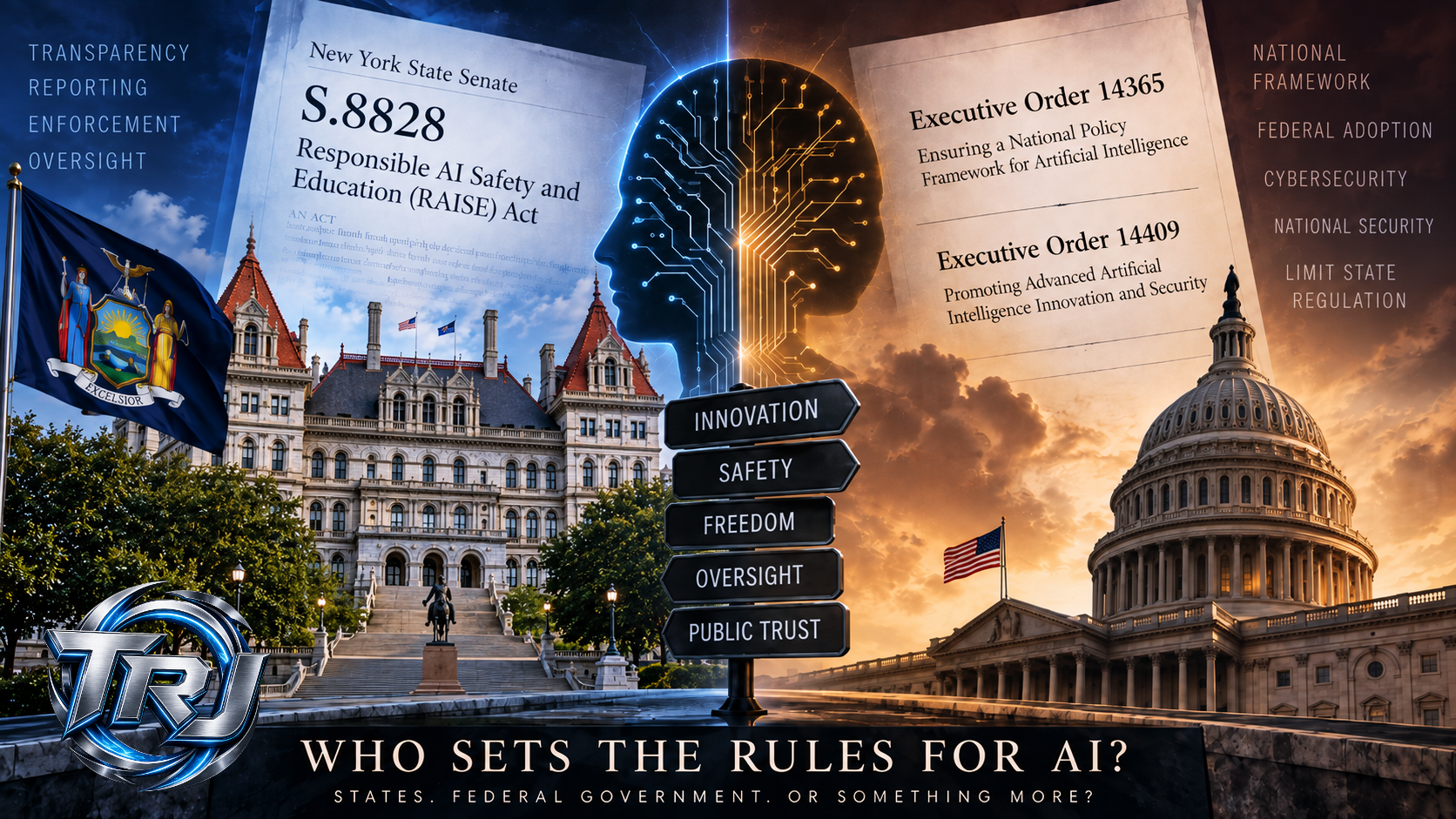
Washington is currently moving in a substantially different regulatory direction from Albany. The Trump administration has repeatedly argued that excessive state-by-state AI regulation could create a costly patchwork and hinder American technological development. Executive Order 14365, issued December 11, 2025, established a federal policy favoring what the administration calls a minimally burdensome national AI framework. It directed the attorney general to create an AI Litigation Task Force capable of challenging state AI laws viewed as unconstitutional, preempted or inconsistent with federal policy. It also directed federal agencies to examine whether certain funding could be conditioned in response to state AI regulations and called for consideration of a national reporting and disclosure standard that could preempt conflicting state requirements.
The administration’s broader AI Action Plan contains more than 90 federal policy actions centered on accelerating innovation, expanding AI infrastructure and strengthening American technological leadership abroad.
In June 2026, President Donald Trump issued an additional executive order directing federal agencies to strengthen AI-enabled cybersecurity and work with industry on advanced AI security capabilities. Three days later, on June 5, President Trump issued National Security Presidential Memorandum 11, or NSPM-11, establishing a national-security framework designed to accelerate government access to powerful commercial and open-source AI systems for military and intelligence purposes. The presidential memorandum explicitly calls for the national-security enterprise to obtain highly advanced models rapidly while allowing agencies to customize commercial systems or develop AI internally when mission requirements demand it.
This creates a deeper conflict at the center of American AI policy. New York is building a formal state regulatory structure around frontier developers, with reporting, disclosure, enforcement, and oversight mechanisms already taking shape. At the federal level, the current administration is moving in the opposite regulatory direction by challenging burdensome state restrictions while expanding federal access to advanced AI for cybersecurity, national security, and government operations. The result is not a simple divide between regulation and deregulation. It is a struggle over who gets to set the rules, who controls the most powerful systems, and how much authority government should hold over a technology that is rapidly becoming part of everyday life.
That still leaves the long-term civil-liberties question unresolved.
Presidential administrations change. Governors change. Legislatures change. Technology changes far faster than all of them. An executive order issued in 2025 can be replaced by a future president. A state statute written for billion-dollar frontier systems can be amended by a future legislature. An agency formed to supervise one category of developer can be granted jurisdiction over another.
That is why the proper question is not only what these laws regulate in September 2026.
The question is what structural safeguards exist to stop tomorrow’s government from extending them beyond their original purpose.
There should be a firm legal distinction between catastrophic AI development and ordinary private ownership or use of artificial intelligence. Running an AI assistant on a personal computer is not equivalent to training a frontier system capable of threatening critical infrastructure. A photographer using AI-assisted editing is not operating a strategic model laboratory. A journalist using an AI research system is not developing a biological weapon. A musician using generative production tools is not creating a catastrophic-risk model. A small company running a private local model should not automatically inherit a regulatory framework designed for corporations spending extraordinary sums training frontier systems.
Those lines should not depend on political assurances.
They should exist in law.
Government has a role when AI is used to commit crimes, penetrate computer systems, create fraudulent identities, generate unlawful exploitative material, manipulate people through criminal deception, attack infrastructure or create genuine catastrophic risks. Those acts already implicate identifiable victims, public safety and established legal interests.
Ownership of technology, private experimentation, local computing, and independent development are all distinct from catastrophic frontier-model development and should be treated that way. Government should have to demonstrate why intervention is necessary before crossing those boundaries, especially when the activity involves private systems, independent research, or ordinary technological use rather than conduct creating a demonstrable public-safety risk. New York has not crossed all of those boundaries today, and it would be inaccurate to tell readers that it has.
What New York has done is create the machinery through which far broader AI regulation could eventually be administered if future lawmakers choose to expand its jurisdiction. DIGIT exists. Registration exists. Mandatory reporting exists. Assessments exist. Recurring disclosures exist. Enforcement exists. Civil penalties exist. Interagency information sharing exists. Public reporting mechanisms exist. Regulatory expansion is already being discussed by the governor herself.
That deserves scrutiny regardless of political party.
AI regulation should not become a partisan question in which people accept government power when their preferred officials control it and object only after political control changes hands. Any authority given to one administration becomes authority available to the next unless the law removes it.
The same principle applies in Washington. A federal government advocating light regulation of private industry while aggressively expanding its own AI capabilities still deserves scrutiny over surveillance, procurement, military applications, intelligence use, automated decision-making, data access and accountability. Federal restraint toward commercial AI today does not guarantee federal restraint tomorrow.
Artificial intelligence is becoming infrastructure.
It will sit inside businesses, vehicles, homes, cameras, communications systems, hospitals, financial systems, defense networks, creative tools and personal devices. Regulation designed in this period could determine who is permitted to develop AI, who must register, what must be reported, which systems can operate, what information government can demand and how much computational autonomy ordinary citizens retain.
The central issue is not whether AI should have safeguards.
It should.
The issue is whether safeguards remain safeguards after the bureaucracy surrounding them acquires permanence, authority and an expanding mission.
New York’s first major AI regulatory framework is now moving from legislation into enforcement. The current rules are aimed at enormous frontier developers and catastrophic risks. Readers should understand that clearly.
They should also watch what comes next just as closely.
Because the most consequential sentence in New York’s September 21 announcement may not be the 72-hour requirement, the registration mandate or the multimillion-dollar penalties.
It may be the state’s acknowledgment that additional steps are already being considered.
TRJ VERDICT
New York has not yet placed ordinary household AI users, independent creators, or small operators under the same regulatory framework imposed on frontier developers. That is the present legal reality. The larger concern is structural: the state is building a permanent enforcement architecture around artificial intelligence, complete with registration, mandatory reporting, financial penalties, interagency coordination, recurring assessments, and an office specifically empowered to oversee technological governance.
That structure deserves sustained scrutiny.
The RAISE Act begins with frontier developers and catastrophic-risk scenarios, while imposing additional requirements on the largest developers. Hochul’s administration has already stated that additional AI measures are being considered. Once an enforcement system exists, future lawmakers can amend thresholds, redefine covered systems, expand reporting obligations, or broaden agency jurisdiction. None of those outcomes is guaranteed, but the legal machinery would already be in place to carry them out.
The federal government presents a different version of the same accountability problem. Washington currently favors lighter restrictions on commercial AI while expanding federal access to advanced AI for cybersecurity, intelligence, defense, and other governmental functions. A future administration can reverse that policy. Executive authority, agency authority, and state regulatory authority therefore have to be judged not only by who controls them today, but by what those powers could permit under different leadership.
The necessary dividing line should remain clear: criminal misuse, catastrophic-risk development, attacks on infrastructure, fraud, exploitation, and demonstrable public harm can justify narrowly tailored regulation. Private ownership, ordinary local AI use, independent research, journalism, photography, music production, small-business automation, and personal experimentation are fundamentally different activities and should not be treated as extensions of frontier AI development without specific legislative justification.
The issue is not whether AI requires safeguards. It is whether government can construct those safeguards without allowing them to become a permanent mechanism for progressively broader control.
That is the question New Yorkers should keep asking as DIGIT, the RAISE Act, the hyperscale data-center moratorium, Empire AI, and future legislation develop.
The first boundary has now been drawn.
What matters next is whether government respects it or moves into AI dictatorship.

The White House / Federal Register — Executive Order 14365, Ensuring a National Policy Framework for Artificial Intelligence, December 11, 2025. (Free Download)
The White House / Federal Register — Executive Order 14409, Promoting Advanced Artificial Intelligence Innovation and Security, June 2, 2026. (Free Download)
New York State Senate — Senate Bill S.8828, Responsible AI Safety and Education (RAISE) Act, introduced January 8, 2026. (Free Download)
New York State Department of Financial Services — Deputy Superintendent for Cybersecurity Law & Policy vacancy announcement, Cybersecurity Division. (Free Download)
New York: 2026 State of the State — Office of Governor Kathy Hochul, State of New York, January 2026. The document includes the DIGIT proposal, AI-content labeling, election-related AI measures, Empire AI expansion, and other technology initiatives. (Free Download)
Texas: Texas Government Code, Chapter 2054 — Information Resources — State of Texas. The chapter establishes statewide information-resources governance and includes statutory AI provisions within the Department of Information Resources framework. (Free Download)
California: Technology Letter 25-01 — Information Technology Policies for Generative Artificial Intelligence (GenAI) — California Department of Technology, February 2025. The document establishes statewide GenAI policies covering risk assessment, inventories, transparency, procurement, security, incident reporting, acceptable use, and workforce training. (Free Download)
🗂️ TRJ BLACK FILE
THE EXPANDING AI GOVERNANCE SYSTEM
FILE STATUS: ACTIVE
CLASSIFICATION: AI GOVERNANCE / REGULATORY EXPANSION / CIVIL LIBERTIES / DIGITAL CONTROL
PRIMARY JURISDICTION: NEW YORK STATE
COMPARATIVE JURISDICTIONS: TEXAS / CALIFORNIA / FEDERAL GOVERNMENT
PRIMARY SYSTEMS: RAISE ACT / DIGIT / EMPIRE AI / STATE AI GOVERNANCE / HYPERSCALE DATA-CENTER CONTROLS / FEDERAL AI POLICY
This Black File examines the regulatory architecture now being constructed around artificial intelligence, beginning with New York and extending into the broader state and federal systems taking shape across the United States.
New York remains the primary focus. The state is combining frontier-model regulation, catastrophic-risk reporting, mandatory disclosures, enforcement authority, digital-governance infrastructure, AI-generated-content proposals, election-related AI restrictions, state-backed supercomputing capacity, and controls affecting hyperscale data-center development.
Texas and California demonstrate that New York is not operating in isolation. Texas has established an Artificial Intelligence Division within its Department of Information Resources, while California has implemented statewide GenAI governance requirements covering state systems, risk assessments, transparency, procurement, security, incident reporting, acceptable use, and workforce training.
At the federal level, Washington is pursuing a different structure centered on national AI leadership, reduced regulatory burdens on private development, AI-enabled cybersecurity, federal access to advanced commercial, open-source, and frontier AI systems, and expanded use of advanced artificial intelligence across government and national-security operations.
The immediate laws differ by jurisdiction. The larger question is whether these separate systems remain limited to their stated purposes or become the foundation for broader governmental authority over artificial intelligence, computing infrastructure, digital content, and private technological use.
The rules are forming. The institutions are being built. The boundaries are still being defined.
TRJ BLACK FILE — FOLLOW THE SYSTEM. WATCH THE BOUNDARIES.





🔥 NOW AVAILABLE! 🔥
🔥 NOW AVAILABLE! 🔥
📖 INK & FIRE: BOOK 1 📖
A bold and unapologetic collection of poetry that ignites the soul. Ink & Fire dives deep into raw emotions, truth, and the human experience—unfiltered and untamed
🔥 Kindle Edition 👉 https://a.co/d/9EoGKzh
🔥 Paperback 👉 https://a.co/d/9EoGKzh
🔥 Hardcover Edition 👉 https://a.co/d/0ITmDIB
🔥 NOW AVAILABLE! 🔥
📖 INK & FIRE: BOOK 2 📖
A bold and unapologetic collection of poetry that ignites the soul. Ink & Fire dives deep into raw emotions, truth, and the human experience—unfiltered and untamed just like the first one.
🔥 Kindle Edition 👉 https://a.co/d/1xlx7J2
🔥 Paperback 👉 https://a.co/d/a7vFHN6
🔥 Hardcover Edition 👉 https://a.co/d/efhu1ON
Get your copy today and experience poetry like never before. #InkAndFire #PoetryUnleashed #FuelTheFire
🚨 NOW AVAILABLE! 🚨
📖 THE INEVITABLE: THE DAWN OF A NEW ERA 📖
A powerful, eye-opening read that challenges the status quo and explores the future unfolding before us. Dive into a journey of truth, change, and the forces shaping our world.
🔥 Kindle Edition 👉 https://a.co/d/0FzX6MH
🔥 Paperback 👉 https://a.co/d/2IsxLof
🔥 Hardcover Edition 👉 https://a.co/d/bz01raP
Get your copy today and be part of the new era. #TheInevitable #TruthUnveiled #NewEra
🚀 NOW AVAILABLE! 🚀
📖 THE FORGOTTEN OUTPOST 📖
The Cold War Moon Base They Swore Never Existed
What if the moon landing was just the cover story?
Dive into the boldest investigation The Realist Juggernaut has ever published—featuring declassified files, ghost missions, whistleblower testimony, and black-budget secrets buried in lunar dust.
🔥 Kindle Edition 👉 https://a.co/d/2Mu03Iu
🛸 Paperback Coming Soon
Discover the base they never wanted you to find. TheForgottenOutpost #RealistJuggernaut #MoonBaseTruth #ColdWarSecrets #Declassified


Sponsored • TRJ Ads
Inquiries: contact@therealistjuggernaut.com


