Thank you for reading or listening to The Realist Juggernaut. Independent journalism should be accessible to everyone.
How quantum memories, entanglement swapping, telecom photons, multiplexing, and repeater nodes could overcome the distance barrier separating today’s experiments from large-scale quantum networks
The Internet conquered distance by learning how to regenerate information. A signal weakened by miles of fiber does not have to remain the same physical signal that began the journey. Classical communications equipment can detect the information, reconstruct it, amplify it, and transmit it onward. That principle helped make global digital communications possible because the network does not need to preserve the original physical carrier from one endpoint to another. Quantum networking faces a fundamentally different problem. The quantum state itself can contain the information that matters, and an unknown quantum state cannot simply be measured, perfectly copied, amplified, and sent onward without changing or destroying the properties the network is attempting to preserve. NIST identifies this distinction as the reason a quantum repeater cannot operate according to the same physical principles as a classical repeater.
That restriction becomes severe as distance grows. Photons are excellent carriers of quantum information because they can travel through optical fiber, but fiber is not lossless. The probability that a photon survives transmission falls as the path grows longer. At metropolitan distances that loss can already become significant, and at continental distances direct transmission becomes an enormous engineering challenge. Sending more power through the line cannot solve the problem when the information is encoded in quantum states that must retain their quantum properties. The network needs a different architecture, one capable of dividing a long path into shorter segments, establishing entanglement across those segments, storing successful states while other segments catch up, and then connecting the shorter links into a longer quantum relationship.
That architecture is the quantum repeater network.
The concept has existed for decades. What has changed is the experimental evidence. In May 2026, researchers reported heralded entanglement between solid-state quantum memories separated by 14.5 kilometers in a metropolitan-scale quantum repeater experiment. The generated Bell state reached a fidelity of 78.6 percent, with an uncertainty of ±2.0 percent, and the researchers observed a CHSH Bell-inequality violation by 3.7 standard deviations. Their multiplexed architecture operated without requiring fiber-channel phase stabilization, addressing a practical difficulty that becomes serious when quantum links leave tightly controlled laboratories.
A separate 2026 experiment demonstrated long-lived remote entanglement between trapped-ion memories connected through 10 kilometers of optical fiber. The significance was not distance alone. The researchers confronted one of the central repeater problems: a memory is useful only if the entangled state survives long enough for the network to establish, verify, and use the connection. Their work demonstrated remote memory entanglement whose lifetime exceeded the average time required to generate it, moving one important relationship between communication time and memory lifetime in the direction a scalable repeater architecture requires.
These experiments do not constitute a global quantum network. They establish something more precise: several pieces of the repeater architecture that once existed primarily as theoretical requirements are becoming experimentally testable systems across meaningful physical distances.
THE DISTANCE WALL
Photon loss is one of the most unforgiving constraints in optical networking. In a classical system, a degraded signal can be restored because the information encoded in it can be measured and reproduced. Quantum communication cannot depend on unrestricted duplication of an unknown quantum state. Measurement can also destroy entanglement or collapse the state the network was supposed to preserve. NIST describes this combination of exponential signal loss, the no-cloning restriction, and destructive measurement as the central reason long-distance quantum networking requires a fundamentally different repeater strategy.
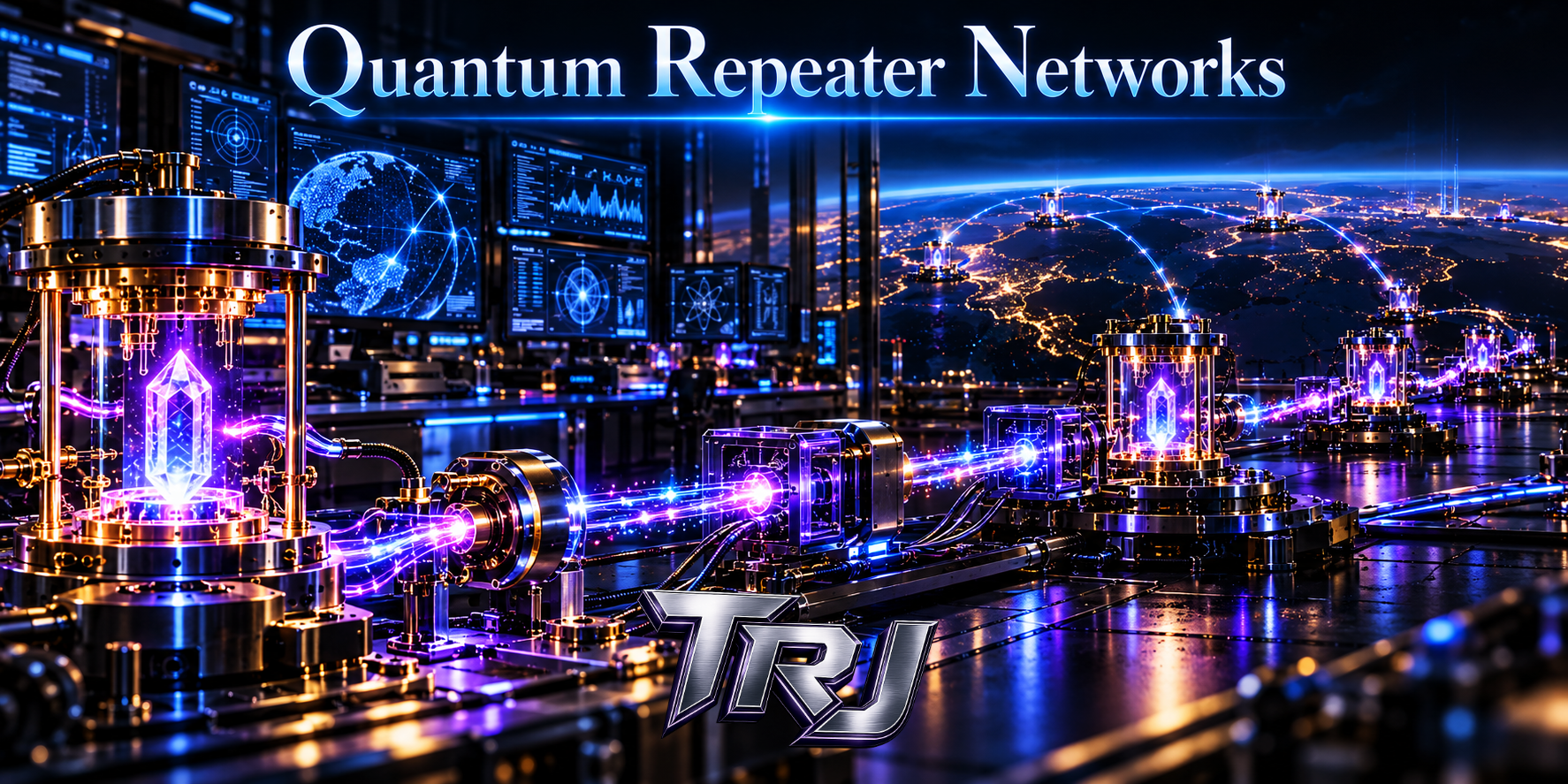
A quantum repeater addresses distance by breaking a long communication path into shorter elementary links. Instead of demanding that one photon or one entangled state survive the entire route in a single uninterrupted attempt, neighboring nodes establish entanglement across shorter segments. Once two adjacent segments have successfully established their resources, an operation called entanglement swapping can extend the entanglement across them. Repeating that process can, in principle, construct entanglement across distances far greater than an individual elementary link. First-generation repeater research combines entanglement generation, storage, swapping, and in some architectures entanglement distillation or purification to manage the errors accumulated across the chain.
The architecture changes the distance problem without eliminating it. Every link still has a probability of failure. Every memory has a finite coherence time. Every optical interface has losses. Every swapping operation introduces imperfections. The repeater must create useful entanglement faster than decoherence and accumulated errors destroy it. A chain containing many nodes therefore becomes a competition between successful entanglement generation, memory lifetime, operational fidelity, and the time required for classical heralding information to move through the network.
This is why quantum repeaters are not simple signal boosters. They are coordinated quantum systems that must know which links succeeded, preserve those successful resources, discard failed attempts, synchronize operations, and connect the surviving states into a larger entangled structure.
MEMORY CHANGES THE EQUATION
Without quantum memory, probabilistic networking becomes brutally inefficient. Imagine two neighboring links attempting to establish entanglement. The first succeeds, but the second fails. If the first successful state cannot be stored, both links may have to begin again. The second link could then succeed while the first fails, producing another wasted attempt. As distance and the number of segments grow, demanding simultaneous success across every part of the chain becomes progressively less practical.
Quantum memory allows the network to keep what it has already achieved. A successful elementary link can be stored while another link continues attempting entanglement generation. Once both required resources are available, the repeater can perform the next operation. Memory converts synchronization from a requirement for simultaneous success into a problem the network can manage across time. Reviews of repeater architectures identify this storage-and-wait capability as central to synchronizing entanglement swapping across multiple hops.
The memory does not need to preserve a state forever. It must preserve it long enough, with sufficient fidelity, for the rest of the protocol to succeed. That creates a demanding balance among storage lifetime, write and retrieval efficiency, bandwidth, optical compatibility, noise, and the rate at which the network generates entanglement. A spectacular storage lifetime has limited value if photons cannot be coupled efficiently into and out of the memory. NIST identifies efficient photonic coupling as one of the major remaining challenges in developing practical quantum memories.
Different physical systems attack this problem in different ways. Trapped ions can provide extremely long-lived quantum states and high-quality operations. Neutral atomic ensembles can interact with optical fields and serve as memories. Solid-state systems can offer compact architectures and integration possibilities. Rare-earth-ion-doped crystals remain important candidates for optical quantum memories because of their coherence and multimode properties. No single technology currently satisfies every requirement of a scalable global repeater network.
The repeater may ultimately be less a single device than a coordinated collection of specialized devices.
ENTANGLEMENT SWAPPING
Entanglement swapping is the operation that allows the repeater chain to grow beyond its elementary links. Suppose one entangled pair connects nodes A and B while another connects nodes B and C. A suitable joint measurement involving the particles at B can project the remote systems at A and C into an entangled state, even though those remote systems never directly interacted. The intermediate entanglement resources are consumed during the process, and classical information remains necessary for the protocol to be interpreted and completed.
Extend that procedure across additional links and a chain begins to emerge. Short-range entanglement is created first, memories preserve successful links, and swapping operations progressively extend the distance. The underlying idea is elegant. Executing it reliably is not.
Every swap can reduce the quality of the resulting state if operations and memories are imperfect. Repeater architectures may therefore incorporate entanglement distillation, in which multiple lower-fidelity entangled pairs are consumed to produce a smaller number of higher-fidelity pairs. Research comparing repeater architectures treats generation, swapping, distillation, loss, and memory errors as interacting parts of the same system rather than independent problems.
This produces a resource economy unlike ordinary networking. Entanglement can be created, stored, consumed, purified, swapped, or lost. A repeater network must manage those resources while continuously deciding which successful states remain useful enough to advance through the chain.
The network does not simply route packets. It manages quantum relationships.
MULTIPLEXING: MORE THAN ONE CHANCE TO SUCCEED
A repeater attempting one entanglement event at a time can spend enormous amounts of time waiting for successful outcomes. Multiplexing attacks that limitation by providing multiple temporal, spectral, spatial, or other distinguishable modes through which entanglement generation can be attempted. Instead of placing the entire network’s progress on one trial, the system gains multiple opportunities within the same operating interval.
The 2026 metropolitan-scale solid-state experiment demonstrated the importance of this approach. Researchers used a time-multiplexed protocol to distribute heralded entanglement between remote quantum memories across 14.5 kilometers. The architecture combined characteristics of single-photon and two-photon interference approaches and produced a Bell state with 78.6 percent fidelity while demonstrating Bell non-locality at metropolitan scale.
Multiplexing changes the repeater problem because successful modes can be identified and selected while unsuccessful attempts are discarded. Quantum memories capable of supporting multiple modes become particularly valuable in this architecture. Instead of functioning as a single waiting position, the memory can participate in a system with multiple opportunities for establishing usable entanglement.
This is another reason quantum-memory capacity cannot be described with the same language used for an SSD or hard drive. The relevant question is not how many conventional files fit inside the material. It is how many usable quantum modes can be stored, addressed, preserved, and retrieved with the fidelity and efficiency demanded by the protocol.
The objective is not bigger storage. It is more chances for the network to succeed before time runs out.
THE TELECOM PROBLEM
A quantum memory and a long-distance optical fiber do not automatically speak the same physical language. Many matter-based quantum systems interact naturally with photons at wavelengths that are not optimal for low-loss transmission through telecommunications fiber. Modern fiber infrastructure performs best in established telecom wavelength bands, particularly around 1.55 micrometers. A memory optimized for another optical transition may therefore require an interface between the wavelength used for storage and the wavelength used for transmission.
NIST identifies this as a central repeater engineering problem. Its quantum-network research includes non-degenerate photon-pair sources in which one photon is suitable for interaction with a memory while another occupies a telecom wavelength suitable for fiber transmission. Another approach uses quantum frequency conversion to change a photon’s wavelength while preserving the quantum information carried by that photon.
The conversion cannot be treated as an ordinary optical adapter. Added noise can corrupt the state. Loss reduces entanglement-generation rates. Spectral mismatch can prevent photons produced by independent nodes from interfering properly. Timing differences can destroy the indistinguishability required by many protocols. The interface must preserve the quantum properties that justified building the network in the first place.
Research in 2026 has pushed further into this interface problem. Experiments with memory-assisted microwave-to-optical transduction have demonstrated systems in which microwave excitations can be stored and converted into optical photons during retrieval. Other work has explored multimode memory-assisted transduction aimed at synchronizing quantum-repeater operations while improving entanglement-generation rates. These remain research systems, but they illustrate the direction of travel: future repeater nodes may need to translate quantum information among memories, processors, and transmission channels that operate in different physical regimes.
A global quantum network will require more than long-lived memories. It will require interfaces capable of making incompatible quantum systems cooperate.
OUT OF THE LAB AND INTO COMMERCIAL FIBER
The laboratory offers control. A deployed communications network does not.
Temperature changes. Fiber moves. Mechanical stress changes polarization. Equipment drifts. Environmental conditions fluctuate. Existing telecommunications infrastructure was never designed around the requirement that an individual photon’s quantum state remain pristine across every component it encounters.
That is why a 2026 NIST experiment matters beyond its raw distance. Researchers and collaborators distributed entangled photons through 62 kilometers, approximately 38.5 miles, of commercial optical fiber between NIST’s Gaithersburg campus and the University of Maryland in College Park. The route traversed real infrastructure rather than a laboratory spool of fiber. The team used active polarization stabilization to compensate for changing conditions in the link and preserve the entangled states during transmission.
This was not a complete memory-based quantum repeater chain. It demonstrated another requirement the eventual network must satisfy: quantum links have to survive the physical instability of infrastructure already exposed to weather, vibration, maintenance, aging, and ordinary network operations.
NIST subsequently published a wide-area quantum-link control protocol in August 2026 using data from the 62-kilometer fiber path. The work addresses adaptive control under time-varying noise, allowing hardware parameters to be adjusted as link conditions change. That development points toward a less glamorous but essential layer of quantum infrastructure: the network must continuously understand the condition of its own physical channels.
The quantum internet will not be built only from better qubits. It will need control systems capable of keeping fragile quantum hardware operational in an imperfect world.
THE REPEATER CHAIN BECOMES A NETWORK
Connecting two memories is an experiment. Connecting many repeater stations creates a systems problem.
At scale, the network must decide which links should attempt entanglement, which stored states should be preserved, when swapping should occur, when a degraded resource should be discarded, and how memory space should be allocated among competing connections. Classical signaling must announce successful events and coordinate operations. Routing algorithms must account for entanglement availability rather than treating every physical link as continuously usable.
The age of a stored entangled state can also matter. A memory that has already held a state for a significant fraction of its useful coherence time may be a poor candidate for another long sequence of operations. The network may need to consider fidelity, memory age, link quality, expected generation time, and swapping depth when deciding how to build an end-to-end connection.
This creates an unusual form of network traffic. Classical networks generally move information through resources that exist before the packet arrives. A quantum repeater network may need to create the entanglement resource before the intended quantum operation can proceed. The resource is generated probabilistically, can deteriorate while stored, and may be consumed when used.
Networking therefore becomes inseparable from physics.
The control plane cannot assume the resource exists. It must help create it.
FROM METROPOLITAN LINKS TO CONTINENTAL DISTANCES
The jump from a 10- or 14.5-kilometer memory-to-memory experiment to a network crossing a continent is enormous. Every additional segment introduces hardware, memory requirements, control traffic, optical loss, synchronization constraints, and operations capable of reducing fidelity. The engineering problem compounds as the chain grows.
NIST’s trapped-ion repeater research illustrates both the ambition and the current maturity of the field. NIST notes that trapped-ion memories can achieve very long lifetimes and that low errors in entanglement-swapping operations are possible, while identifying efficient coupling to telecom photons as a major remaining challenge. Its page assigns the trapped-ion practical repeater project a Technology Readiness Level of 1, while its EIT memory work is listed at TRL 3, proof of concept.
Those readiness levels are useful because they prevent laboratory performance from being confused with deployable infrastructure. A device demonstrating excellent memory lifetime does not automatically become a field-ready repeater. A successful elementary entanglement link does not automatically become a continent-spanning chain. Each component has to survive integration with the others.
Theoretical work continues to examine how generation times, swapping strategies, purification, memory lifetime, and network topology interact across first-generation repeater chains. The objective is not simply maximizing one laboratory metric. It is finding combinations that allow useful entanglement to reach the destination before accumulated loss, waiting time, and operational error erase the advantage.
The distance record alone will never tell the whole story.
A GLOBAL NETWORK WOULD NOT BE INSTANTANEOUS
Quantum entanglement does not create faster-than-light communication. That fact remains essential as repeater networks grow more ambitious. Entangled systems can display correlations that have no classical equivalent, but usable communication protocols still require classical information whose propagation remains constrained by relativity.
A repeater chain spanning thousands of kilometers would therefore experience physical latency. Heralding signals have to travel. Measurement results have to be communicated. Nodes have to learn whether operations succeeded. Teleportation requires classical information. Control systems have to coordinate events across distances where light itself takes measurable time to travel.
Longer distances can place additional pressure on memory because quantum states may have to remain useful while classical information propagates through the system. Memory lifetime, network diameter, protocol design, and communication latency become connected engineering variables.
The global quantum network, if built, would not eliminate distance. It would learn how to preserve quantum resources across it.
WHAT QUANTUM REPEATERS COULD ENABLE
The most immediate purpose of quantum repeaters is extending the distance over which useful quantum states and entanglement can be distributed. That capability could support several broader technologies if the network reaches sufficient scale and reliability.
Quantum key distribution is one application, although quantum networking extends beyond cryptography. Distributed quantum processors could use entanglement to perform operations across physically separated machines. Networks of quantum sensors could coordinate measurements with precision unavailable to independent classical instruments. Remote clocks could potentially be compared through quantum-enhanced protocols. Scientific facilities could share specialized quantum resources without requiring every capability to exist at every node. NIST identifies communications, distributed computing, and precision measurement among the major motivations for quantum-network development.
None of those possibilities establishes that a global quantum internet is imminent. The network still needs scalable memories, reliable repeaters, high-efficiency interfaces, detectors, sources, transducers, control protocols, routing methods, error management, standards, security, and manufacturing processes capable of producing systems that operate outside specialized laboratories.
The importance of the repeater is that nearly every long-distance version of this future eventually encounters the same physical obstacle: photons disappear.
The network needs a way around that wall.
THE SECURITY QUESTION
Quantum networking is often presented as though quantum mechanics automatically creates an invulnerable communications system. The repeater architecture itself shows why that conclusion is too broad. Quantum protocols can provide security properties grounded in physical principles, and certain attacks on quantum states can introduce detectable disturbances. The surrounding network still contains classical computers, software, authentication mechanisms, control channels, detectors, optical hardware, firmware, timing systems, and human operators.
A compromised repeater controller could disrupt service even if it could not secretly reproduce an unknown quantum state. A malicious node could refuse to establish entanglement. Classical control traffic could be attacked. Hardware could be manipulated. Detectors and sources can deviate from their theoretical models. A denial-of-service attack does not need to defeat quantum mechanics if its objective is simply to stop the network from functioning.
Repeaters therefore expand the infrastructure that must be trusted, monitored, authenticated, and secured. A future network will need methods for verifying node behavior, protecting classical control systems, detecting faulty hardware, and determining whether degraded performance results from environmental conditions, equipment failure, or deliberate interference.
Quantum security does not eliminate cybersecurity. It adds another layer to it.
THE INFRASTRUCTURE PROBLEM
A global repeater network would require physical infrastructure on a scale that laboratory diagrams rarely convey. Nodes would need power, environmental control, optical connections, calibration, monitoring, secure facilities, maintenance, and replacement schedules. Some memory technologies require cryogenic operation. Others require ultrahigh vacuum, laser stabilization, magnetic-field control, or complex optical preparation. Telecom conversion systems introduce additional equipment and losses.
The eventual architecture may therefore contain several classes of nodes rather than one universal repeater. Metropolitan systems could use one technology while long-haul routes use another. Specialized conversion stations could bridge incompatible wavelengths. Satellite links could eventually complement terrestrial fiber for certain routes. Data centers and research facilities could host large quantum-network gateways while smaller nodes serve local connections.
That future remains speculative at the infrastructure level, but the engineering direction is already visible. Researchers are no longer studying only whether two quantum systems can become entangled. They are studying how entanglement survives deployed fiber, how memories hold it long enough to be useful, how different wavelengths are connected, how nodes synchronize, how links adapt to environmental noise, and how repeater protocols behave when expanded into chains.
Those are the questions a technology begins confronting when it moves from an experiment toward a network.
TRJ VERDICT
Quantum repeaters exist because quantum information cannot cross unlimited distances under the assumptions that built the classical Internet. Photon loss grows with distance, unknown quantum states cannot be perfectly copied at will, and measurement can destroy the quantum properties the network is trying to preserve. The solution being developed is not a stronger amplifier. It is an architecture that divides distance into manageable links, establishes entanglement across them, stores successful quantum states, and connects those states through entanglement swapping.
The evidence has advanced significantly. In 2026, researchers demonstrated heralded entanglement between solid-state quantum memories across 14.5 kilometers and certified Bell non-locality in a metropolitan-scale multiplexed repeater experiment. Other researchers demonstrated long-lived remote trapped-ion entanglement across 10 kilometers of fiber, addressing the crucial requirement that memory survive longer than the time needed to establish the remote connection. NIST and its collaborators transmitted entangled photons through 62 kilometers of commercial fiber and developed adaptive control methods for operating quantum links under changing real-world conditions. These are distinct experiments solving different pieces of the same larger infrastructure problem.
The remaining distance between those achievements and a continental or global repeater network is substantial. Memories must become easier to integrate. Telecom interfaces must become more efficient. Remote entanglement rates must rise. Swapping operations must preserve higher fidelity across longer chains. Multiplexing must scale. Control systems must coordinate larger numbers of nodes. Error management, security, interoperability, and standards must mature alongside the underlying physics.
What makes the repeater important is not that it has already solved those problems. It gives quantum networking an architecture for confronting the distance barrier without violating the physical rules that created the barrier in the first place. Instead of copying an unknown quantum state at every stop, the network builds entanglement across shorter links and extends that relationship through coordinated operations.
If that architecture can be scaled, the future quantum network will not defeat distance by pretending distance no longer matters. It will divide the distance, preserve what succeeds, connect those successes, and continue the process until two remote endpoints share a quantum resource that no individual photon had to carry across the entire route.
That is the real promise of the quantum repeater: not an amplifier for the quantum age, but an entirely different way of crossing the world.





🔥 NOW AVAILABLE! 🔥
🔥 NOW AVAILABLE! 🔥
📖 INK & FIRE: BOOK 1 📖
A bold and unapologetic collection of poetry that ignites the soul. Ink & Fire dives deep into raw emotions, truth, and the human experience—unfiltered and untamed
🔥 Kindle Edition 👉 https://a.co/d/9EoGKzh
🔥 Paperback 👉 https://a.co/d/9EoGKzh
🔥 Hardcover Edition 👉 https://a.co/d/0ITmDIB
🔥 NOW AVAILABLE! 🔥
📖 INK & FIRE: BOOK 2 📖
A bold and unapologetic collection of poetry that ignites the soul. Ink & Fire dives deep into raw emotions, truth, and the human experience—unfiltered and untamed just like the first one.
🔥 Kindle Edition 👉 https://a.co/d/1xlx7J2
🔥 Paperback 👉 https://a.co/d/a7vFHN6
🔥 Hardcover Edition 👉 https://a.co/d/efhu1ON
Get your copy today and experience poetry like never before. #InkAndFire #PoetryUnleashed #FuelTheFire
🚨 NOW AVAILABLE! 🚨
📖 THE INEVITABLE: THE DAWN OF A NEW ERA 📖
A powerful, eye-opening read that challenges the status quo and explores the future unfolding before us. Dive into a journey of truth, change, and the forces shaping our world.
🔥 Kindle Edition 👉 https://a.co/d/0FzX6MH
🔥 Paperback 👉 https://a.co/d/2IsxLof
🔥 Hardcover Edition 👉 https://a.co/d/bz01raP
Get your copy today and be part of the new era. #TheInevitable #TruthUnveiled #NewEra
🚀 NOW AVAILABLE! 🚀
📖 THE FORGOTTEN OUTPOST 📖
The Cold War Moon Base They Swore Never Existed
What if the moon landing was just the cover story?
Dive into the boldest investigation The Realist Juggernaut has ever published—featuring declassified files, ghost missions, whistleblower testimony, and black-budget secrets buried in lunar dust.
🔥 Kindle Edition 👉 https://a.co/d/2Mu03Iu
🛸 Paperback Coming Soon
Discover the base they never wanted you to find. TheForgottenOutpost #RealistJuggernaut #MoonBaseTruth #ColdWarSecrets #Declassified


Sponsored • TRJ Ads
Inquiries: contact@therealistjuggernaut.com