Thank you for reading or listening to The Realist Juggernaut. Independent journalism should be accessible to everyone.
What It Could Mean to Remain Entirely Biological in a Synthetic Civilization
For most of human history, remaining biologically unchanged required no decision. People were born into bodies governed by inherited traits, physical development, illness, injury, aging, and death. Medicine could heal, surgery could repair, and tools could extend what the body was capable of doing, but biological humanity remained the common condition shared across society.
Synthetic civilization may turn that condition into a choice.
Artificial intelligence, neural interfaces, advanced prosthetics, genetic intervention, sensory augmentation, implanted computing, robotic support systems, cognitive assistance, artificial organs, and technologies capable of regulating or expanding human performance are moving toward a future in which biological limitations may no longer be accepted as fixed. Many of these systems will begin with legitimate medical purposes. They may restore movement, communication, hearing, vision, memory, coordination, independence, or other functions damaged by disease or injury.
The ethical difficulty begins when restoration moves beyond treatment and becomes enhancement.
A device designed to restore communication may eventually allow information to move between a person and a machine at speeds unavailable through ordinary speech or typing. A prosthetic system developed to replace a lost limb may eventually exceed biological strength, endurance, or precision. Artificial sensory systems may detect information the natural human body cannot perceive. Cognitive systems may support memory, concentration, translation, calculation, pattern recognition, or decision-making continuously rather than only when a person opens a computer or reaches for a phone.
At that point, the person who remains entirely biological enters a civilization whose standards may no longer be designed around ordinary biological capability.
The Last Unmodified Human would not necessarily be the final biological person alive. The phrase describes something more consequential: the individual who reaches a point where technological alteration has become socially normal and deliberately chooses not to participate.
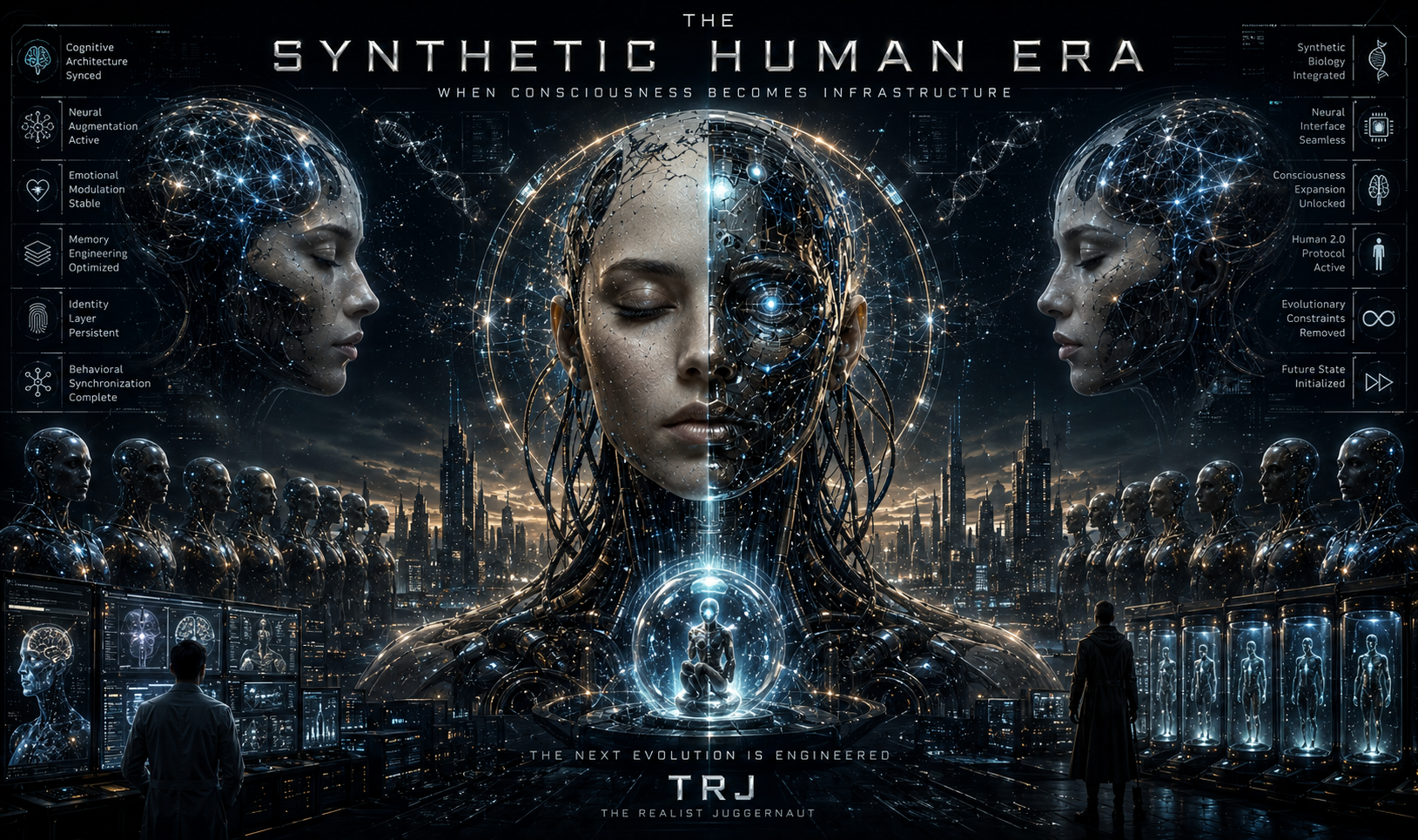
That decision could become one of the most important exercises of personal autonomy in the Synthetic Human Era.
The pressure to modify the body may not arrive through government orders or explicit corporate commands. It may emerge through ordinary competition. A person may remain free under law to reject augmentation while facing an economic environment that makes refusal costly. The right to remain unmodified means little if education, employment, insurance, transportation, communication, and social participation are gradually redesigned around enhanced people.
A worker without cognitive augmentation may still possess the intelligence, experience, judgment, and training required for a position. The difficulty begins when coworkers equipped with continuous artificial support can process greater volumes of information, communicate faster, maintain detailed memory assistance, and complete routine analytical work with less time. Employers may raise productivity standards to reflect the capabilities of enhanced workers rather than the natural range of human performance.
The biological employee does not become less competent.
The definition of competence changes around them.
This distinction matters because technological pressure rarely presents itself as coercion. Employers may describe augmentation as optional. Schools may describe it as an educational tool. Insurance companies may describe monitoring devices as incentives. Healthcare systems may describe biological intervention as preventive medicine. Governments may describe identity technologies as convenient access systems. Each institution can claim that participation remains voluntary while the consequences of refusal continue growing.
A choice can exist legally while disappearing practically.
Employment may become one of the strongest forces driving this transformation. Companies have always adopted technology that increases production, lowers costs, improves consistency, or expands organizational capacity. Once human augmentation begins producing measurable advantages, businesses will have economic reasons to favor workers capable of operating through those systems.
This does not require an employer to announce that unmodified humans are undesirable. Hiring criteria can shift quietly. Job descriptions can demand performance levels easier to reach with augmentation. Training programs can assume continuous artificial assistance. Scheduling systems can reward workers capable of maintaining longer periods of concentration. Promotion systems can favor individuals whose enhanced performance produces stronger metrics.
The result could resemble discrimination without requiring anyone to use biological status as an explicit category.
An unmodified applicant may be rejected because another candidate processes information faster. A biological worker may lose promotion opportunities because enhanced colleagues produce more output. An employee may receive weaker evaluations because natural fatigue, memory limitations, reaction time, or recovery needs become measurable disadvantages inside a workforce shaped by technological enhancement.
The employer can insist that everyone was evaluated under the same standard.
The standard itself may already contain the discrimination.
Education could create the same pressure much earlier in life. Children raised with continuous artificial tutoring, memory assistance, adaptive learning systems, neural interfaces, or advanced sensory tools may develop within educational environments fundamentally different from those experienced by students relying upon ordinary cognition.
Schools may attempt to separate assisted from unassisted work during examinations, but that boundary becomes harder to enforce once augmentation is integrated into the person rather than carried as an external device. A student cannot simply place an implanted system on a desk before beginning a test. Institutions will need to decide which capabilities count as part of the student and which count as outside assistance.
The answer may determine who receives admission, scholarships, professional credentials, or access to competitive careers.
A biological student could eventually enter a classroom where everyone technically receives the same examination while some participants possess technological systems supporting memory, attention, translation, calculation, perception, or information retrieval. Equal rules would no longer guarantee equal conditions.
Society would then confront a difficult question: should the unmodified person receive accommodations?
That question would reverse many assumptions surrounding disability and human capability. Today, accommodations often help people overcome barriers created by physical or cognitive conditions. In a heavily augmented civilization, the ordinary biological range could itself become the condition requiring protection.
A person could be healthy, capable, educated, and fully functional under every historical definition of humanity while still being treated as technologically disadvantaged.
Insurance markets could intensify that pressure. Wearable and implanted systems may offer continuous health monitoring capable of detecting cardiovascular changes, blood chemistry, neurological abnormalities, sleep disruption, stress patterns, physical strain, or early indicators of disease. Such technologies could prevent suffering and save lives. They could also give insurers powerful incentives to reward people who accept continuous monitoring.
Lower premiums may initially encourage participation. Higher premiums may later punish refusal.
The unmodified person may be told that they remain free to reject biometric surveillance while paying more because the insurer considers them more difficult to assess. Refusal to share biological information could be interpreted as hidden risk. Privacy itself becomes an actuarial disadvantage.
The logic could extend from monitoring into intervention. If an implant reduces the statistical probability of a costly medical event, an insurer may argue that refusing it creates unnecessary risk. Employers providing health coverage may prefer workers who accept preventive augmentation. Governments managing public healthcare budgets may face pressure to encourage technologies that reduce long-term treatment costs.
The economic argument can become powerful even when individual autonomy remains legally protected.
A person may eventually have to defend why they want to remain biologically ordinary.
That burden should never exist.
Medical consent has meaning because the patient retains authority over what happens to the body. A future civilization should not weaken that principle simply because enhancement becomes common. The ability to improve a human function does not create an automatic obligation to improve it.
A person may choose not to implant a device because they distrust the manufacturer, reject permanent connectivity, fear security vulnerabilities, object to continuous data collection, hold philosophical or religious convictions, prefer biological experience, or simply do not want technology integrated into the body.
None of those reasons should require institutional approval.
Bodily autonomy loses its meaning if people possess the right to refuse only technologies society considers unnecessary.
The stronger test arrives when the technology works.
An augmentation may be safe, effective, widely used, socially accepted, and capable of producing genuine benefits. The individual must still retain authority to decline it. Freedom matters most when refusing the popular option carries real consequences.
The pressure will extend beyond institutions into culture. Human beings compare themselves with one another constantly. Physical appearance, intelligence, athletic ability, professional status, wealth, age, and health already influence social standing. Enhancement could transform those differences into technological marketplaces.
Bodies may become upgrade platforms.
A person with advanced visual augmentation may perceive environments with greater precision. Another may regulate sleep more efficiently. Another may maintain superior physical endurance. Another may rely upon cognitive systems that strengthen recall or accelerate analysis. Another may use genetic or biological interventions designed to preserve health or delay physical decline.
The unmodified body may begin appearing unfinished.
Advertising could reinforce that perception by presenting enhancement as self-improvement. Companies selling augmentation will not need to describe ordinary humans as defective directly. Marketing can accomplish the same task by presenting enhanced performance as confidence, responsibility, attractiveness, intelligence, ambition, safety, independence, or success.
The message becomes difficult to escape: if improvement is available, why have you refused it?
That question contains a dangerous assumption.
Human worth cannot depend upon whether a person has installed every available improvement.
Society already struggles with the psychological consequences of commercial systems designed around dissatisfaction. People are encouraged to change appearance, purchase status, improve productivity, optimize routines, monitor performance, and compare themselves with curated representations of others. Synthetic enhancement could move that pressure beneath the skin.
A person may stop asking whether an intervention is necessary and begin asking whether remaining unchanged has become socially embarrassing.
Dating and relationships could reinforce that divide. People may begin listing augmentation status alongside occupation, education, or lifestyle preferences. Some may prefer technologically enhanced partners because of health, longevity, cognition, appearance, reproductive options, or compatibility with connected systems. Others may specifically seek biological partners who reject augmentation.
What begins as preference could become hierarchy.
An unmodified person may be considered less desirable because of ordinary aging, shorter health expectancy, biological fertility, physical limitations, or the possibility of requiring greater care later in life. Enhanced individuals may face their own forms of exclusion, but the biological person could confront a culture that interprets natural human vulnerability as preventable failure.
Aging may become especially difficult.
If technology succeeds in slowing biological decline, restoring damaged tissue, replacing organs, improving mobility, supporting cognition, or extending healthy life, the person who declines such interventions may age visibly inside a population that does not.
The natural aging process could become socially unfamiliar.
Wrinkles, physical slowing, memory changes, reduced endurance, and other features long associated with human life may begin signaling technological refusal rather than chronological age alone. A seventy-year-old receiving extensive biological intervention might appear healthier than an unmodified person decades younger.
Society may respond by treating aging as a correctable condition.
This could reshape how death itself is perceived. A person who rejects life-extending technologies may be accused of giving up, burdening family members, wasting medical opportunity, or choosing death unnecessarily. Families may pressure elderly relatives to accept interventions. Physicians may feel obligated to recommend every technology capable of extending function. Insurance and public healthcare systems may develop rules distinguishing approved refusal from economically irresponsible refusal.
The right to natural mortality could become controversial.
Human beings should not be forced to remain alive through technological transformation they never wanted.
That principle will matter as medicine crosses from treating disease into maintaining technologically dependent forms of existence. A future patient may face choices involving artificial organs, neural support, implanted computational systems, synthetic tissue, external cognitive infrastructure, robotic mobility, or continuous artificial assistance.
The presence of a treatment does not erase the right to decline it.
Religious and philosophical traditions will also confront augmentation from different perspectives. Some people may interpret the body as something entrusted rather than owned without limitation. Others may view technological enhancement as a legitimate continuation of medicine and human creativity. Many will occupy positions between those extremes, accepting restorative treatment while rejecting enhancement intended to exceed ordinary human capability.
A free civilization does not need universal agreement on what constitutes an acceptable human body.
It needs room for people to make different decisions without losing civil status.
Law will therefore need to recognize biological status as an emerging area of discrimination. Existing legal protections may address disability, medical information, employment practices, genetic information, or religious objections in specific circumstances, but a civilization where augmentation becomes common creates a broader problem.
Employers may eventually reject applicants who lack approved neural interfaces, schools may build advanced programs around cognitive augmentation, insurers may charge higher rates to people who decline implanted monitoring, landlords may adopt biometric access systems, transportation networks may assume passengers possess implanted identity credentials, government services may rely on integrated devices, and professional licensing boards may establish standards that effectively exclude unmodified people.
These possibilities concern more than technology policy because they raise the question of whether biological humanity will remain legally sufficient for full participation in society. That principle must remain explicit: a person should not be required to alter the body to exercise ordinary civil rights.
Public infrastructure should remain usable by people without implants. Essential services should provide non-invasive authentication alternatives. Employment standards should measure legitimate job requirements rather than technological conformity. Schools should avoid making commercial augmentation a prerequisite for educational opportunity. Medical systems should protect informed refusal. Insurance systems should not transform bodily privacy into punishment.
The unmodified person must remain a recognized participant in civilization rather than an outdated version of one.
Security presents another dimension. Implantable and connected technologies create capabilities, but they also create attack surfaces. A biological body cannot receive a malicious software update. Natural vision cannot be disabled remotely because a subscription ended. Biological memory cannot be encrypted by ransomware in the conventional digital sense. A natural limb does not depend upon a manufacturer maintaining a cloud service.
Augmented people may gain extraordinary abilities while accepting new forms of dependency.
The unmodified person avoids some of those dependencies by remaining outside them.
That choice could become valuable during infrastructure failures, cyberattacks, network outages, supply disruptions, corporate bankruptcies, software incompatibilities, or geopolitical conflict. A civilization built entirely around connected augmentation may discover that technological independence has strategic value.
Human resilience has always depended partly upon redundancy.
Biological capability may become one form of redundancy.
This does not mean natural humans would function independently of modern infrastructure. Contemporary life already depends upon electricity, communications, transportation, medicine, computing, finance, and industrial supply chains. The distinction is that augmentation could move some infrastructure dependence directly into the body.
A failed service could become a failed function.
If vision, mobility, cognition, communication, or neurological regulation depends upon proprietary systems, infrastructure reliability becomes bodily reliability. The company maintaining the technology becomes part of the person’s continued function.
The unmodified human may therefore represent more than resistance to technological change.
They may represent a human baseline civilization cannot afford to lose.
Scientific research will need that baseline as well. Once large populations begin using biological or cognitive augmentation, understanding ordinary human performance could become harder. Medical studies, psychological research, educational testing, neurological assessment, and population health may need groups whose biology has not been substantially altered by persistent technological systems.
The unmodified body could become scientifically valuable precisely because it remains ordinary.
That creates another ethical danger.
People should not become museum specimens.
A minority population of unmodified humans must not be treated as living artifacts preserved for research, cultural nostalgia, entertainment, or historical comparison. Their choice would represent present-day autonomy, not participation in a reconstruction of the past.
There may also be pressure to create designated biological communities where people live with limited augmentation. Such places could emerge voluntarily from philosophical, cultural, religious, ecological, or privacy-based movements. They could preserve forms of life centered on physical labor, local community, natural aging, reduced technological dependence, or limited artificial mediation.
Voluntary communities could provide legitimate alternatives.
Forced separation would be unacceptable.
An augmented majority should not push biological humans into isolated zones under the argument that mainstream infrastructure can no longer accommodate them. Inclusion requires preserving access across shared society rather than creating technological segregation.
Political representation may become necessary if the population divide grows. Lawmakers making decisions about augmentation may themselves rely upon systems unavailable to unmodified citizens. Policy could gradually reflect enhanced expectations concerning cognition, health, productivity, communication, and lifespan.
Ordinary biological needs could become politically invisible.
Rest, aging, disability, recovery, limited attention, physical vulnerability, and natural cognitive variation are not failures of public policy. They are components of human existence. Technology may reduce some of those limitations, but government should not construct rights around the assumption that every citizen will accept intervention.
The political question is not whether society should stop developing augmentation.
It is whether technological advancement can coexist with the continuing legitimacy of ordinary biological life.
That distinction protects enhanced people as well. A society capable of respecting refusal is more capable of respecting consent. If augmentation becomes compulsory through economic or institutional pressure, enhanced individuals cease being fully voluntary participants. Their bodies become extensions of systems demanding performance.
The right to remain unmodified therefore protects the freedom to augment.
Both depend upon bodily autonomy.
The most responsible future would allow people to move across a spectrum of technological participation without losing dignity or legal recognition. Some individuals may embrace extensive augmentation. Others may accept medical restoration while refusing performance enhancement. Some may use external artificial intelligence while rejecting implanted systems. Others may reject nearly every form of permanent technological integration.
There does not need to be one approved version of the future human.
The Synthetic Human Era becomes dangerous when civilization begins ranking those versions according to economic usefulness.
Humanity has always changed through technology. Fire altered survival. Agriculture altered settlement. Writing transformed memory. Machinery transformed labor. Medicine transformed health. Computers transformed information. Networks transformed communication. Artificial intelligence is transforming cognition and decision-making.
None of those developments required society to declare the previous human body obsolete. Augmentation could cross that boundary because the technology no longer surrounds the person.
It enters the person.
Once technology becomes integrated with perception, movement, memory, cognition, biology, reproduction, or longevity, refusing technology becomes inseparable from defending control over the self.
The Last Unmodified Human may therefore represent a principle rather than a person.
That principle is that biological humanity remains sufficient.
A human being should not have to become faster, stronger, more connected, more measurable, more programmable, more durable, or more technologically integrated to retain full membership in civilization.
The ordinary human body carries limitations. It becomes tired. It forgets. It ages. It requires sleep. It experiences pain. It needs time to learn. It cannot process unlimited information. It cannot remain continuously productive.
Those limitations are not evidence that the person possesses less value.
A civilization obsessed with optimization may forget that distinction.
The purpose of technology should be to expand human freedom rather than narrow the acceptable definition of humanity. If a person gains mobility through an advanced prosthetic, that can be liberation. If another person chooses a neural interface that expands communication, that can be autonomy. If someone accepts treatment that extends healthy life, that can be medicine fulfilling its highest purpose.
Freedom disappears when those choices become requirements for belonging.
The future must preserve a place for the person who says no.
Not because technology is inherently hostile to humanity, and not because biological limitation should be romanticized, but because control over one’s own body becomes meaningless when civilization recognizes only one acceptable direction of change.
Human beings should remain free to improve themselves.
They should also remain free to remain themselves.
TRJ VERDICT
The Last Unmodified Human may become one of the most important figures of the Synthetic Human Era because technological progress could transform ordinary biology from the universal human condition into a minority choice.
Augmentation may restore lost function, prevent disease, expand independence, strengthen cognition, extend healthy life, and open capabilities unavailable to previous generations. Those achievements can represent extraordinary human progress when people adopt them through genuine consent.
The danger begins when capability becomes expectation.
Employers may redesign performance standards around enhanced workers. Schools may structure education around continuous cognitive assistance. Insurers may reward biological monitoring while penalizing privacy. Healthcare systems may treat refusal as irrational. Social culture may present ordinary aging, fatigue, memory, or physical limitation as defects that responsible people should correct.
No law needs to command augmentation for coercion to exist.
Economic exclusion can accomplish it.
The right to remain biologically unmodified must therefore become part of the broader defense of bodily autonomy. No person should lose employment, education, healthcare, housing, transportation, public services, legal recognition, or ordinary civil participation solely because they refuse unnecessary technological alteration.
Biological humanity must remain a valid condition of citizenship.
Infrastructure should continue serving people without implants. Essential services should provide alternatives to invasive authentication. Medical consent must include a genuine right of refusal. Employment standards should measure legitimate requirements rather than technological conformity. Schools should not convert commercial enhancement into a prerequisite for opportunity.
The future must also resist turning unmodified humans into relics. They are not historical exhibits, control groups, or remnants of an inferior stage of development. They are people exercising authority over their own bodies.
Synthetic civilization may produce humans capable of extraordinary things.
It must still preserve the right to be ordinary.
The final measure of technological freedom will not be how many people choose augmentation.
It will be whether the person who refuses it can still stand beside everyone else as a full human being.





🔥 NOW AVAILABLE! 🔥
🔥 NOW AVAILABLE! 🔥
📖 INK & FIRE: BOOK 1 📖
A bold and unapologetic collection of poetry that ignites the soul. Ink & Fire dives deep into raw emotions, truth, and the human experience—unfiltered and untamed
🔥 Kindle Edition 👉 https://a.co/d/9EoGKzh
🔥 Paperback 👉 https://a.co/d/9EoGKzh
🔥 Hardcover Edition 👉 https://a.co/d/0ITmDIB
🔥 NOW AVAILABLE! 🔥
📖 INK & FIRE: BOOK 2 📖
A bold and unapologetic collection of poetry that ignites the soul. Ink & Fire dives deep into raw emotions, truth, and the human experience—unfiltered and untamed just like the first one.
🔥 Kindle Edition 👉 https://a.co/d/1xlx7J2
🔥 Paperback 👉 https://a.co/d/a7vFHN6
🔥 Hardcover Edition 👉 https://a.co/d/efhu1ON
Get your copy today and experience poetry like never before. #InkAndFire #PoetryUnleashed #FuelTheFire
🚨 NOW AVAILABLE! 🚨
📖 THE INEVITABLE: THE DAWN OF A NEW ERA 📖
A powerful, eye-opening read that challenges the status quo and explores the future unfolding before us. Dive into a journey of truth, change, and the forces shaping our world.
🔥 Kindle Edition 👉 https://a.co/d/0FzX6MH
🔥 Paperback 👉 https://a.co/d/2IsxLof
🔥 Hardcover Edition 👉 https://a.co/d/bz01raP
Get your copy today and be part of the new era. #TheInevitable #TruthUnveiled #NewEra
🚀 NOW AVAILABLE! 🚀
📖 THE FORGOTTEN OUTPOST 📖
The Cold War Moon Base They Swore Never Existed
What if the moon landing was just the cover story?
Dive into the boldest investigation The Realist Juggernaut has ever published—featuring declassified files, ghost missions, whistleblower testimony, and black-budget secrets buried in lunar dust.
🔥 Kindle Edition 👉 https://a.co/d/2Mu03Iu
🛸 Paperback Coming Soon
Discover the base they never wanted you to find. TheForgottenOutpost #RealistJuggernaut #MoonBaseTruth #ColdWarSecrets #Declassified


Sponsored • TRJ Ads
Inquiries: contact@therealistjuggernaut.com