
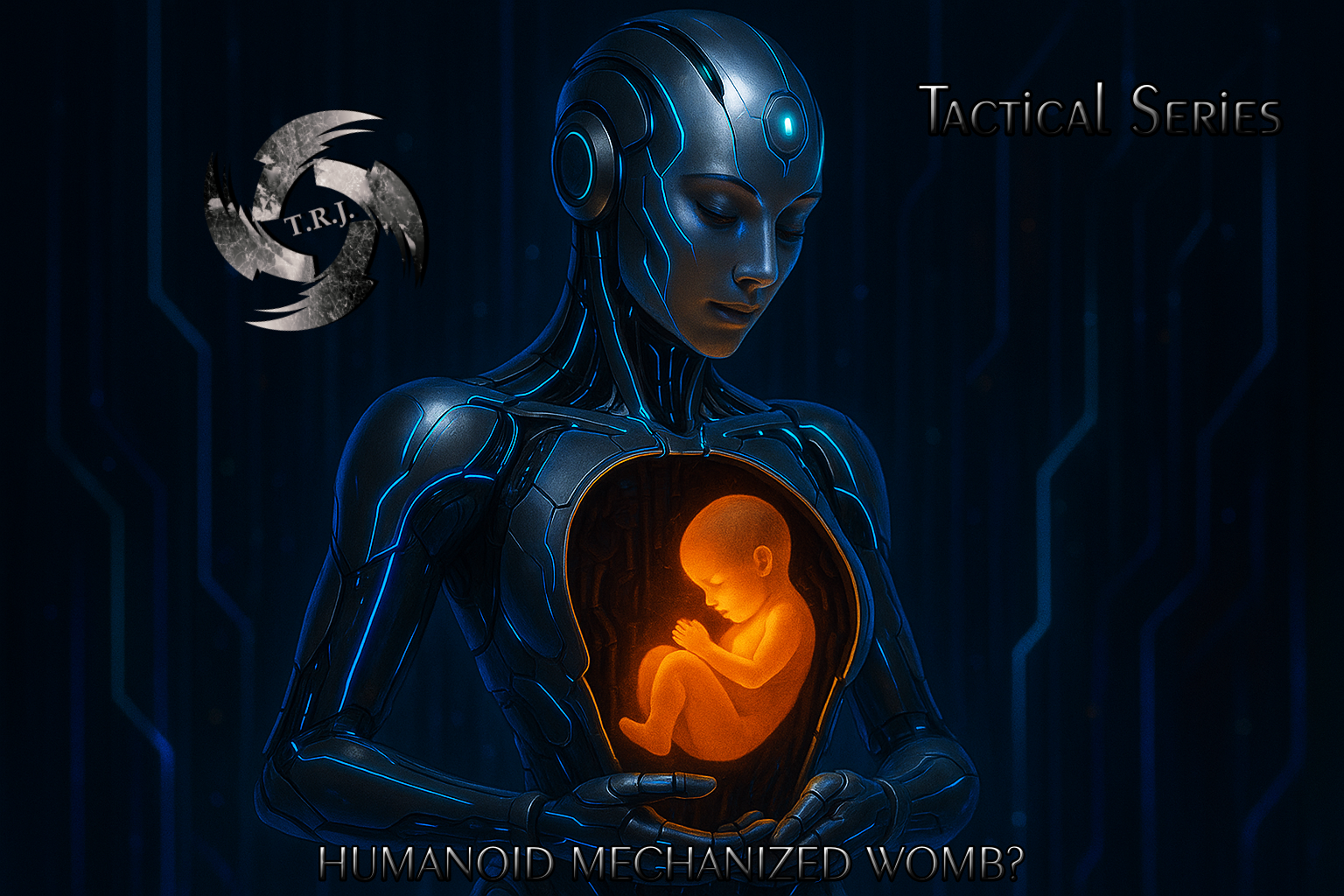
When Birth Becomes Infrastructure
The womb has always been the first sanctuary of human life. Before a child opens its eyes to light, before lungs taste air, it is there — suspended in warmth, veiled in silence, untouched by the machines of the outside world. This chamber of beginnings has been the constant across empires, religions, wars, and civilizations. It is where the pulse of existence first announces itself, where every dynasty, every culture, every revolution began — not in marble palaces or parliamentary halls, but in the dark waters of the maternal body.
For millennia, that boundary between flesh and genesis was inviolate. It was more than biology; it was covenant. A covenant between mother and child, yes — but also between humanity and its own origins. Birth was the tether that reminded us that no matter how vast our technologies became, no matter how high our towers reached, the first act of life was entrusted to the fragile, irreplaceable partnership between nature and woman.
Now that covenant is being rewritten — not by accident, not by drift, but by deliberate design. The breach is not organic. It is engineered. The first sanctuary is being pulled into circuitry, translated into code, reimagined as a domain that no longer requires flesh, intimacy, or risk. This is not innovation in service of protection; it is intrusion in service of control.
And it is China — locked in demographic collapse, haunted by the ghosts of its one-child policy, and obsessed with bio-supremacy — that has chosen to make this rupture. A nation that once forced sterilizations, abortions, and family quotas now seeks to force the very act of genesis itself into machine custody. It is not coincidence. It is the continuation of state policy, reframed as scientific achievement.
When reports first emerged, the claim sounded grotesque, almost cartoonish — a humanoid robot capable of carrying and delivering a baby, an iron surrogate, a synthetic mother. And yet, I am not surprised at all. In a world where the natural is constantly stripped, sold, and reengineered, this was never a question of if, only when. Many dismissed it as fringe speculation, another stunt in the long history of exaggerated announcements. But beneath the polished PR of “progress,” the scaffolding is real. The architecture for mechanized gestation is already under construction.
A company in Guangzhou, Kaiwa Technology, fronted by Dr. Zhang Qifeng, has stepped forward as the spearpoint. Their declaration: to integrate artificial womb technology into a humanoid shell, one designed not merely to sustain life, but to simulate its very origin. A working prototype is promised by 2026. And the price tag? One hundred thousand yuan — roughly fourteen thousand U.S. dollars. A figure that converts the most sacred act of humanity into a consumer product, a market entry point, a catalog item.
What was once the unbroken sanctuary of mothers across generations is now being packaged as a purchasable option. The womb — the final redoubt of nature’s untouchable authority — is being placed in the marketplace, sold like an appliance, reduced to a line item in a family planning budget. This is not just science stepping into the arena of creation. This is commerce dragging creation onto the auction block.
The Technology: From Biobags to Steel Mothers
Artificial womb experiments are not new — and they did not begin in a robotics lab. In 2017, researchers at the Children’s Hospital of Philadelphia stunned the world when they sustained premature lambs inside transparent “biobags,” sacs filled with synthetic amniotic fluid and connected to a pump-oxygenator system. The lambs were not only kept alive — they grew, developed, and behaved like normal fetuses. A shocking milestone in neonatology, the biobag was designed with the purest of intentions: to save human infants born far too early to survive in conventional incubators. It was a bridge technology, a lifeboat between premature birth and natural viability.
But the history of technology is littered with “lifeboats” that turned into weapons. Nuclear power was conceived as a peaceful alternative to coal, yet it gave birth to Hiroshima. Algorithms were built to index books, and now they dictate elections. The artificial womb has followed the same trajectory: what began as rescue has wandered toward replacement.
The leap from plastic biobags to humanoid robots is not a trivial step forward — it is a quantum rupture. Sustaining a fetus requires far more than just oxygen and nutrients. It demands an intricate orchestra of systems: hormonal regulation, immune tolerance between host and embryo, electrochemical signals that adjust to stress, even subtle molecular dialogues between placenta and mother that science is only beginning to map. Biology performs these micro-adjustments flawlessly, moment by moment, without pause.
For Kaiwa Technology to claim that it will sustain a fetus “from conception to full term inside a machine” is both breathtaking in ambition and terrifying in implication. It suggests the replacement of one of the most complex symphonies in existence with wires, fluids, and code. And yet the details that matter most — how implantation occurs, how genetic material is introduced and stabilized, how placental attachment is replicated, how waste is processed, how labor is simulated, and how delivery actually happens — are buried in silence.
These are not minor omissions; they are the very core of the challenge. No public data explains whether Kaiwa intends to begin gestation from a fertilized egg, or if natural implantation in a woman will still be required for the first days before extraction into the machine. No disclosure addresses the role of maternal hormones — progesterone, oxytocin, estrogen — that guide development in subtle, cascading rhythms. No roadmap outlines how the child’s immune system will calibrate in the absence of a mother’s biological interface. What emerges is not transparency, but a spectacle: a story carefully curated for shock, awe, and eventual normalization.
The marketing is deliberate. By framing their work as a “robot mother,” Kaiwa cloaks a deeply incomplete science with the imagery of inevitability. The spectacle distracts from the missing blueprints. It fosters a psychological adjustment — preparing the public to accept that if the words exist, the technology must already be here. This is the oldest trick in the arsenal of disruptive power: announce the arrival of the impossible, repeat it until it feels familiar, then quietly scale it while the world is still debating its plausibility.
And yet the truth is harsher: artificial womb research is not ready for full replacement. Not even close. But that doesn’t matter. The danger is not in what the machine can do today — it is in how the narrative reshapes tomorrow. Because the more the idea circulates, the more normalized it becomes, and the more governments, militaries, and corporations will invest in making sure the “steel mother” leaves the pages of speculation and becomes reality.
China’s Demographic Battlefield
Why China? Because no other major power stands at the edge of demographic collapse with quite the same urgency. Decades of the one-child policy — enforced through fines, sterilizations, and forced abortions — created a generation of missing daughters and a gender imbalance that still scars the population pyramid. The nation engineered its own demographic time bomb, and now the detonation is near. The workforce is shrinking. The elderly outnumber the young. The dependency ratio is tilting toward crisis. In one generation, China risks the fate of Japan without Japan’s wealth, or Russia without Russia’s resilience: a hollowed-out population unable to sustain its own future.
Fertility incentives have failed. Subsidies for childbirth, housing, and childcare have not reversed the trend. State propaganda urging women to marry earlier and have more children has fallen on deaf ears, particularly among an urbanized female population that associates motherhood not with honor, but with exploitation and sacrifice. Even the relaxation from one-child to two-child, then three-child policies, has not moved the needle. The damage is too deep, the cultural shift too entrenched.
Enter the mechanized womb. In this context, it is not a curiosity. It is a survival strategy — an attempt to bypass the natural bottleneck of human choice. If women will not or cannot produce the children the state demands, then the state will find another way. Artificial wombs, fused with robotics, become not just technology but infrastructure: a population pipeline under government control. A machine that never says no, never needs rest, never demands autonomy.
If the technology matures, China would not simply solve its fertility crisis; it would own the future of human reproduction. Control the machine, and you control the genesis of every life. The state, already comfortable dictating family size, would now dictate family itself. Children would not just be born under the shadow of state policy — they would be born by it, manufactured under quotas, schedules, and directives.
And this is not merely a social experiment — it is a geopolitical weapon. Nations that can scale artificial birth at industrial levels gain a new form of power: demographic engineering. They could surge workforce populations at will. They could replenish aging armies without waiting for families to sacrifice. They could create military conscription pools without consent, calibrated to the needs of the state.
Imagine a nation that can mass-produce life — and therefore mass-direct it. Children born not as accidents, not as miracles, but as state assets. The military implications are chilling: soldiers bred, raised, and deployed under a system that begins not in a household, but in a lab. No politics of draft, no protests of conscription, no resistance from mothers unwilling to sacrifice sons. A steel womb produces soldiers as predictably as a factory produces rifles.
This is why the mechanized womb matters. It is not about convenience. It is not about progress. It is about survival, control, and power. In Beijing’s eyes, this is not just technology — it is destiny management. And in the long game of empire, managing destiny is the difference between ascendance and collapse.
The Ethics of Erasure
Birth is not simply biology. It is bonding, risk, sacrifice, and the primal connection between mother and child. It is labor in every sense of the word — physical, emotional, spiritual. To sever that link is not just innovation, it is erasure. Erasure of the mother’s role. Erasure of the intimacy of creation. Erasure of choice itself.
Replacing the womb with a machine means replacing more than a body — it means replacing a relationship. The moment of birth has always been an initiation into human community: a mother holding her child, the child responding to the mother’s heartbeat, the family surrounding that fragile new life. Strip that away, and the child’s first bond is not to a human, but to a system. Not to warmth, but to glass. Not to a mother’s arms, but to mechanical release.
What happens to a generation raised entirely outside natural gestation? What becomes of human identity when the first heartbeat is monitored by code, when the first nutrients are delivered through sterile tubes, when existence is processed as a “project” rather than welcomed as a child? It is not science fiction. It is the psychological architecture of a world where family dissolves into function, where the most primal act of humanity is outsourced to industry.
The consequences are impossible to fully calculate. Will children born of steel mothers form attachments differently? Will they struggle to bond, to trust, to connect? Psychology tells us that human beings carry impressions from even pre-verbal experiences — stress, absence, warmth, voice. What imprint does a machine leave? What emotional inheritance is passed down when the first voice a child hears is not a mother’s, but a calibration alarm?
The erosion does not stop with the child. Mothers themselves are erased. Pregnancy — once seen as sacrifice, strength, endurance — becomes stigmatized as inefficient, unsafe, even irresponsible compared to machine gestation. Families fracture under the weight of “better options.” Women are told their wombs are outdated hardware, their pain obsolete. The sacred intimacy of creation is dismantled, one circuit at a time.
And hovering over it all is the state. In a world of mechanized wombs, reproduction ceases to be a private act and becomes infrastructure. Birth becomes scalable, controllable, selectable. Life begins not in the embrace of flesh, but in the machinery of policy. In such a world, choice is an illusion. The child belongs to the system long before it belongs to the family.
This is not progress. It is dispossession. It is the theft of the human beginning — the quiet, irreplaceable space where humanity renews itself in every generation. The mechanized womb does not expand possibility. It narrows it. It reduces life to logistics, children to output, mothers to redundancy.
The Global Fallout
Western nations will not ignore this. In fact, the tremors are already visible. Silicon Valley has tested the waters with CRISPR embryo editing, flirting with the idea that the genetic ledger of a child can be rewritten before birth. Japanese laboratories have pursued artificial placenta technologies in near silence, perfecting techniques that could extend gestation outside the body. In Europe, fertility industries have quietly transformed reproduction into commerce, where eggs, sperm, and surrogates are traded across borders. What China has done is not invent the concept, but weaponize the timeline.
The race is no longer scientific — it is existential. In geopolitics, no nation can afford to let a rival dictate the boundaries of life itself. If one state can mechanize birth, others will be forced to follow, not because they desire it, but because failure to adapt would mean demographic inferiority, military disadvantage, and eventual collapse. Just as nuclear weapons triggered the Cold War, mechanized wombs could trigger a new kind of arms race — one where the arsenal is not missiles, but populations.
Imagine a future where “birth quotas” are handled by national laboratories. Where reproduction becomes a state-run service, not a private act. Where governments decide who is born, when, and under what genetic conditions. Fertility ceases to be instinct; it becomes infrastructure. The family is replaced by policy. The cradle is replaced by contract.
Insurance companies and governments alike could turn life into a ledger. The poor may be denied access to machine gestation, while the wealthy purchase designer offspring free from defects, calibrated for advantage. Birth becomes stratified — a privilege for some, a controlled allowance for others. Children are not just born into inequality; they are manufactured with it.
The mechanized womb is not simply about birth — it is about control. It hands to the state, to corporations, to militaries, the power to dictate the origins of life itself. To industrialize not just the economy, but humanity. The child ceases to be a miracle or an accident; it becomes an output of policy, engineered and scaled according to the needs of governments and markets.
And when that point is reached, the question of “choice” evaporates. Parents no longer decide whether to have children naturally; they are told that the machine is safer, cleaner, more reliable. Natural birth is painted as risk, machine birth as responsibility. Over time, resistance is stigmatized. The family is dissolved. The womb is decommissioned. The first act of life, once intimate and untouchable, is surrendered to laboratories, algorithms, and quotas.
This is the global fallout: not the spread of a technology, but the erasure of humanity’s most fundamental autonomy. A future where life itself is manufactured under license, its origins signed and stamped by the machinery of power.
Forecast: Birth as Infrastructure
This is where the trajectory leads, and it is darker than most are willing to admit.
Industrialization of Birth: Human reproduction becomes a process no different from manufacturing. Life is scheduled on production timetables, monitored with dashboards, and scaled like factory output. Instead of families waiting for nature, governments and corporations will be able to calculate how many children are needed for workforce stability, military planning, or economic growth — and produce them accordingly. Birth will no longer be spontaneous; it will be forecasted, audited, and delivered on demand.
Weaponized Demographics: Once mechanized wombs are scaled, demographics themselves become weapons. A government can correct labor shortages with a wave of machine-assisted births. Armies can be replenished without asking families to sacrifice. Nations can create conscription surpluses simply by increasing production cycles. No debates, no protests, no “draft” — the state owns the means of genesis, and thus the flow of soldiers, workers, and taxpayers. In such a world, population is no longer an organic force; it is an instrument of power projection.
Eugenic Drift: When gestation is mechanized, genetic screening will not be optional — it will be default. Why risk producing a child with defects when the system offers “optimization” as a standard feature? The temptation will be irresistible. At first, it will be about preventing illness. Then, about enhancing resilience. Soon, about boosting intelligence, physical ability, even temperament. The line between health and enhancement will dissolve. Children will be “selected” as much as they are born, shaped by state or corporate criteria. This is eugenics in a new uniform — not forced sterilization, but algorithmic curation of humanity’s future.
Maternal Displacement: Natural childbirth, once the most intimate act of life, will be painted as reckless, inefficient, even irresponsible. Insurance companies will penalize it. Governments will stigmatize it. Hospitals will discourage it. Mothers will be told that the machine is safer, that rejecting it is selfish, that risking complications when a flawless alternative exists is a failure of duty. Over time, women themselves will be redefined — their role in creation minimized, their bodies sidelined, their wombs treated as obsolete hardware.
Civilizational Shift: This is the final fracture. Humanity will not only lose the intimacy of birth, it will lose the very narrative of its origins. Instead of life beginning in the hidden sanctuary of the womb, it will begin in laboratories, on production lines, inside machines. The story of “where we come from” will be rewritten. We will be born of contracts, policies, and quotas, not of families. We will be artifacts of design, not accidents of love. Civilization itself will pivot from a humanity-centered model to a system-centered one.
And when that threshold is crossed, there will be no going back. Birth will cease to be an act of nature and become a form of infrastructure. Life itself will be engineered, managed, and controlled. The intimacy of beginnings — the silence, the warmth, the risk, the sacrifice — will be replaced by machinery, algorithms, and quotas. Humanity will not realize what it has lost until it is already gone.
TRJ Verdict: The Point of No Return
This is not speculative at all — it’s foresight. All that you have read will take place, if this does commence.
Every civilization has a point of no return — a moment when it redefines itself not by what it creates, but by what it abandons. The mechanized womb is such a moment. Once birth is transferred from mother to machine, there will be no reversal. We will not debate whether it should be done — we will debate how quickly it can be scaled. We will not ask if it erodes the human story — we will ask which nation erodes it fastest, and which profits most from its disappearance.
The trajectory is clear. Just as the nuclear bomb forever changed warfare, and just as the internet forever changed truth, mechanized gestation will forever change humanity itself. We will become a species that no longer begins in intimacy, but in infrastructure. Life will be managed the way power grids manage electricity, the way governments manage census numbers, the way corporations manage quarterly growth. And in that shift, something irreplaceable will vanish.
We are told this is progress — that the machine is safer, cleaner, more efficient. But efficiency is not humanity. Efficiency does not bleed, or bond, or sacrifice. Efficiency cannot love. The womb was never inefficient; it was irreplaceable. And yet it is being replaced.
China may be the first to force this rupture, but others will follow. Silicon Valley will sell it as innovation. Japan will market it as stability. Europe will regulate it into bureaucracy. America will militarize it under the language of security. And in each case, the result will be the same: children born as outputs of systems, their origins no longer human, but engineered.
The verdict is this: the mechanized womb is not the future of reproduction, it is the future of control. Once adopted, it will not simply alter how we are born — it will alter what we are. Humanity will cross the line from creation to production, from intimacy to infrastructure, from covenant to code.
And to me, that shift is not progress. It is a warning. It is the kind of rupture that pushes us closer to the end of times — not through fire or war, but through quiet surrender. The end may not come with an explosion; it may come with the hum of machines delivering life stripped of humanity. And when that line is crossed, there will be no going back.
And for those who know the scriptures, the weight is even heavier: we were told we would know the times. Not all signs arrive in thunder or trumpet. Some arrive in silence — in the reengineering of life itself. And this, unmistakably, is one of them.

Statement:
The WO2018171905A1 patent does not represent any patent for a humanoid system. As of now, no official humanoid-specific patent exists. The cited material relates strictly to extra-uterine support technologies and should not be misconstrued as a humanoid patent. Its inclusion here demonstrates that these mechanisms have been in development for a long time. It is only a matter of time before the actual patent emerges. This does not change the fact that this technology is being worked on — because it is.
WO2018171905A1 Patent
WO2018171905A1 — System and Methods for Extra-Uterine Support of Preterm Neonates. World Intellectual Property Organization (WIPO), 2018. (Free Download)

Rosen, TNA03 Paper
Rosen, T. Artificial Placenta and Extra-Uterine Life Support Research. TNA03 Report, 2003. (Free Download)
TRJ BLACK FILE — HUMANOID SYSTEMS
Patents & Prototypes
📑 Patent Clarification
WO2018171905A1 is not a humanoid patent. It covers extra-uterine support technologies. As of now, no official humanoid-specific patent exists. Its inclusion here proves the mechanism groundwork has been in motion for years — the patent is infrastructure, not embodiment. The humanoid patent will come. Absence of filing does not mean absence of development. You already know that.
Parallel Patents
Other cited patents already map out:
— Embryonic chamber monitoring systems
— Automated life support scaffolding
— Integration of robotic caretakers for neonatal management
These are stepping stones — and the stepping stones never stop at the edge of the water.
This is not speculative fiction. This is scaffolded engineering.
The humanoid is unfiled, but not unbuilt.
🔥 NOW AVAILABLE! 🔥
📖 INK & FIRE: BOOK 1 📖
A bold and unapologetic collection of poetry that ignites the soul. Ink & Fire dives deep into raw emotions, truth, and the human experience—unfiltered and untamed.
🔥 Kindle Edition 👉 https://a.co/d/9EoGKzh
🔥 Paperback 👉 https://a.co/d/9EoGKzh
🔥 Hardcover Edition 👉 https://a.co/d/0ITmDIB
🔥 NOW AVAILABLE! 🔥
📖 INK & FIRE: BOOK 2 📖
A bold and unapologetic collection of poetry that ignites the soul. Ink & Fire dives deep into raw emotions, truth, and the human experience—unfiltered and untamed just like the first one.
🔥 Kindle Edition 👉 https://a.co/d/1xlx7J2
🔥 Paperback 👉 https://a.co/d/a7vFHN6
🔥 Hardcover Edition 👉 https://a.co/d/efhu1ON
Get your copy today and experience poetry like never before. #InkAndFire #PoetryUnleashed #FuelTheFire
🚨 NOW AVAILABLE! 🚨
📖 THE INEVITABLE: THE DAWN OF A NEW ERA 📖
A powerful, eye-opening read that challenges the status quo and explores the future unfolding before us. Dive into a journey of truth, change, and the forces shaping our world.
🔥 Kindle Edition 👉 https://a.co/d/0FzX6MH
🔥 Paperback 👉 https://a.co/d/2IsxLof
🔥 Hardcover Edition 👉 https://a.co/d/bz01raP
Get your copy today and be part of the new era. #TheInevitable #TruthUnveiled #NewEra
🚀 NOW AVAILABLE! 🚀
📖 THE FORGOTTEN OUTPOST 📖
The Cold War Moon Base They Swore Never Existed
What if the moon landing was just the cover story?
Dive into the boldest investigation The Realist Juggernaut has ever published—featuring declassified files, ghost missions, whistleblower testimony, and black-budget secrets buried in lunar dust.
🔥 Kindle Edition 👉 https://a.co/d/2Mu03Iu
🛸 Paperback Coming Soon
Discover the base they never wanted you to find. TheForgottenOutpost #RealistJuggernaut #MoonBaseTruth #ColdWarSecrets #Declassified
Support truth, health, and preparedness by shopping the Alex Jones Store through our link. Every purchase helps sustain independent voices and earns us a 10% share to fuel our mission. Shop now and make a difference!
https://thealexjonesstore.com?sca_ref=7730615.EU54Mw6oyLATer7a

Sponsored • TRJ Ads
Inquiries: contact@therealistjuggernaut.com




I don’t see this ever happening. It is an interesting theory that China may try something like this. It’s one of the most Godless nations on the planet. The practical problems you’ve mentioned in achieving the ideas in this post should be multiplied to an exceptional degree.
China does have all of the problems you’ve mentioned here. Their economy seems on the verge of collapse. The cost of raising a child now is high, without all of the costs associated with attempting tech like this. I’ve read that 300,000 Chinese are homeless. I could see them coming up with some plan to use the homeless for procreation and taking those infants to raise an army. It is an evil plan, yes, and maybe possible financially. I do think that some form of transhumanism is possible but it will be very costly.
I think that humans currently are capable of all of the technologies needed for the last days Biblical prophecies to be fulfilled.
Still, here is something that will have to occur:
Matthew 24: “For false christs and false prophets will arise and will provide great signs and wonders, so as to mislead, if possible, even the elect.”
To what degree these “great signs” will be miraculous or just great deceptions will be determined by God and this is not be something that requires time.
Also, many believe there will be a third temple built before the great Tribulation begins:
Matthew 15: “Therefore when you see the abomination of desolation which was spoken of through Daniel the prophet, standing in the holy place—let the reader understand— 16 then those who are in Judea must flee to the mountains.”
Those who have this opinion believe the “holy place” is the third temple and the the Anti-Christ is the “abomination of desolation.” I don’t know if people who think this are right but there is a real Temple Institute that has architectural plans for the third temple and many of the priestly garments and implements ready to go:
https://templeinstitute.org/
If a third temple is to be built, considering the political nature of things in the Middle East at present, it would take some time for this to happen.
The Book of Revelation is a puzzle in so many ways but holds an interesting promise to all who read it:
1:3 “Blessed is he who reads and those who hear the words of the prophecy, and heed the things which are written in it; for the time is near.”
The city of Babylon is featured prominently in Revelation. Some people think it is a world system, possibly the one that exists now. Others think it could be the U.S. Others think that Babylon will be built again to fulfill the prophecies in Revelation. In the last case, it would take some time for this to happen.
I have no idea where we are on God’s timetable except that we are closer today than yesterday.
Chris — you’re absolutely right to point out the scale of the practical problems here. Replicating the complexity of natural gestation isn’t just expensive, it borders on impossible with what’s been openly documented. But that’s exactly where the danger lies: when a state or corporation steps forward and declares they’re pursuing something this radical, it usually means they’ve already advanced further in private than the public realizes. Announcements like this aren’t the beginning — they’re the normalization stage, preparing society to accept what’s already under quiet development.
And with China, this fits their long pattern. They deny, minimize, and then suddenly reveal “breakthroughs” once the infrastructure has already been tested behind the curtain. We saw this with hypersonics, with AI, even with their surveillance architecture — by the time the world hears the claim, the scaffolding is already in place. That’s why the fact they’ve said it aloud is more troubling than reassuring. It signals intent, and intent backed by state urgency usually means the science has been pushed further than outsiders assume.
So yes, the technical hurdles are real. But that doesn’t make the threat less urgent — it makes it more deceptive. Because it doesn’t need to be perfect today to reshape tomorrow. All it has to do is exist in concept, circulate through media, and condition the public to accept it as inevitable. And once that shift happens, resources flow, patents appear, and the unthinkable becomes infrastructure. That’s why I see this not as an impossible theory, but as the first steps of a system that will redefine the covenant of birth itself.
And your scripture reference is absolutely fitting: Matthew 24 warns of false signs and deceptions powerful enough to mislead even the elect. What could be more deceptive than mankind seizing the role of Creator and packaging it as “progress”? These aren’t just signs of technology, they’re signs of the spiritual architecture being laid for the days ahead.
Thank you very much, Chris — always greatly appreciated. Your insight brings the weight of prophecy into focus alongside the science. 😎
You’re welcome, John, and thank you for your thoughtful reply. It doesn’t surprise me at all that the Chinese are probably working on something like this. Their leaders have no ethics. I can imagine how many embryos and fetuses that will die in the process of trying to figure out how to do this. In the end I hope it is one huge failure. If they are somehow able to achieve a parentless product, it will be just that, something raised outside of God’s institution of family. If they are able to get to some “final product,” I think it will lack too many of the miraculous creative signatures that only God is capable of.
Thanks again for your feedback, John. I always appreciate your opinion and I hope you have a great day!
You’re very welcome, Chris! I hope you have a great week ahead. 😎
Thanks, John. I hope you have a great week ahead as well!
First and foremost Rule #1. Both the T’NaCH and Talmud teach Torah common law. Modern Hebrew employs תקדים\תקדימים as the translation for precedent(s). Other Hebrew that you might have heard, I tend to doubt it, in Yeshiva: הלכה פסוקה . The Torah specifically states the precondition for eyewitness testimony in court cases both דני ממון ודני נפשות.
Another example: אין לדיין אלא מה שעיניו רואות. Now compare eyewitness testimony to נצב התורה על ידי ראיות. Now turn to the Siddur and the 13 rules of Rabbi Yishmael. These rules function as a logical corollary to Rabbi Akiva’s kabbalah of פרדס logic. It truly bothers me that your Yeshiva rabbis never refer to the revelation of the Oral Torah at Horev, 40 days after the Sin of the Golden Calf\substitution theology wherein the ערב רב שאין להם יראת שמים attempted to introduce a translation of the שם השם לשמה (((That’s how the first Sinai commandment qualifies as a Torah commandment in the first place! All other Torah commandments: Do a person of the Chosen Cohen people do mitzvot לשמה או לא לשמה? Hence the 1st Sinai commandment: the Greatest most important commandment in the whole of the Torah.)))
Yeshiva rabbis who fail to teach T’NaCH and Talmud as common law directly compare to the ערב רב שאין להם יראת שמים. Yeshivot produce “suits”, uniforms, styles in how to wear ones’ socks! Fancy Fur Burgers they wear on their Heads. The Yiddish term קאפוטע the common garb of the ultra-orthodox in Israel. But the Torah does not address these archaic European nonsense foreign imported cultures and customs which Orthodox Judaism has religified.
Your father learned and became a Torah educator. The modern “Wilderness generation” of the 1920s & 30s, cowardly refused to make aliyah to the Palestine mandate. Chaim Weizmann made the statement “Jews of the world – Where are you?” in 1936. Three years later, the criminal coward in 10 Downing Street Chamberlain imposed the 2nd White Paper which barred Palestine as a refuge for Jews seeking to flee from the European barbarians. The “precedent” of the British White Paper of 1939 directly influenced the decision made by President FDR to close all US borders to Jews attempting to flee from the Nazi Shoah!
Chaim Weizmann’s lamentation, “Jews of the world – Where are you?” reflects his deep concern regarding the Jewish diaspora’s response to the opportunities presented by the League of Nations’ Palestine mandate. He expressed frustration over the limited Jewish immigration (aliyah) to Palestine, especially in the context of rising anti-Semitism in Europe during the 1930s.
Hence it appears a direct connection exists between the Wilderness generation in the Torah to the Orthodox Judaism rabbis of Europe in the 1920s and 30s who forbade Jews to participate in Zionism. Zionism defined through the 1917 Balfour Declaration as Jewish equal rights to achieve self-determination in the Middle East. The League of Nation introduced the Palestine Mandate of 1922 based upon the Balfour Declaration. The Balfour Declaration defines the meaning and intent of Zionism to this day.
Jewish self-determination means for our generations living right now: Can we restore the order and organization of the 12 Tribes “Republic”? Democracy – a word that’s all the rage and fashion today – has its origins from Athens ancient Greece! Think about this when you light the lights of Chanukkah. Do you do this mitzva as just a ritual practicing “suit” robot OR do you understand why Jews light the lights of Chanukkah for thousands of years!
The Oral Torah – a logic system. This 4 part logic system – פרדס – stands in stark contrast to Aristotle’s 3 part syllogism. Akiva’s logic based upon inductive logical comparisons of similar cases – Jewish common law. Aristotle’s logic based upon deductive logical reasoning based upon Order. The siddur has the root of סדר. Rabbi Yishmael’s 13 middot work hand-in-glove with Akiva’s kabbalah of inductive reasoning. בנין אב מכתוב אחד בנין אב משני כתובים.
It disturbs me that your instructors have betrayed their teaching obligations! These basic terms of Common law\משנה תורה totally alien to you. No Yeshiva educator ever differentiated between Judicial common law courtroom laws FROM statute law which Parliaments/Knesset governments imposes as law enforced by the police upon their subject people! You suffer from being “brain-washed”.
Propaganda is a form of communication aimed at influencing the attitudes, beliefs, or behaviors of a population. It often involves the dissemination of information, ideas, or rumors that are biased or misleading, with the intent to promote a particular political cause or point of view. Propaganda can take various forms, including media campaigns, speeches, educational materials, and public service announcements. Governments often use propaganda to foster a sense of national identity and unity among citizens. By promoting a specific narrative about the nation’s history, values, and goals, they can create a shared sense of purpose and belonging. This is particularly important in multicultural societies where diverse backgrounds may lead to differing perspectives.
Through public education, governments can shape public opinion on key issues. By controlling the curriculum and the information presented in schools, they can emphasize certain viewpoints while downplaying or omitting others. This can lead to a population that is more aligned with government policies and ideologies. Governments may use propaganda to justify their policies, especially during times of conflict or crisis. By framing their actions in a positive light and portraying opponents negatively, they can gain public support for decisions that might otherwise be controversial or unpopular.
By instilling specific beliefs and values in the education system, governments can cultivate compliance and loyalty among citizens. This can be achieved through the promotion of patriotism, respect for authority, and adherence to societal norms, which can discourage dissent and encourage conformity. Governments may seek to control the flow of information to prevent dissenting views from gaining traction. By promoting a singular narrative in educational settings, they can limit exposure to alternative perspectives, effectively “brainwashing” individuals into accepting the government’s viewpoint as the only valid one.
The effects of propaganda in education can be long-lasting. Individuals who are educated under a specific ideological framework may carry those beliefs into adulthood, influencing future generations. This creates a cycle where propaganda becomes ingrained in the culture, making it more challenging to challenge or change. Propaganda serves as a powerful tool for governments to influence and control the beliefs and behaviors of their citizens through public education. By shaping narratives and controlling information, they can foster compliance, loyalty, and a unified national identity, often at the expense of critical thinking and diverse perspectives.
An example of propaganda education: no rabbi in any Yeshiva you ever learned in throughout your life has differentiated the distinctions between T’NaCH-Talmudic “common law” from Greek-Roman “statute law”; specifically never has any educator in any Yeshiva in Israel denounced the halachic codifications published by Rambam, Tur, and Shulkan Aruch as assimilated Roman statute law. No educator ever pointed out the abomination of the Tzeddukim assimilation to Greek statute law wherein they attempted to cause the Jewish people to forget the “Oral” Torah … which we light the lights of Hanukkah to specifically “remember”.
This shabbat past we discussed the “ORDER” of all Gemara sugyot. The methodology of learning a Gemara sugya by way of a 3 part syllogism logic. When Rabbeinu Tam jumps off the dof of Gemara to some other Gemara sugya you must learn its גזרה שווה comparative Case/Din learning obeys the כלל-פרט logic of rabbi Yishmael. To correctly learn any Tosafot commentary which learns by common law precedents requires that you compare the פרט of the brought גזרה שווה with the כלל of the larger Gemara sugya which includes that גזרה שווה פרט. The framers of the Talmud, Rav Ashi and Rav Ravina – together with the Sovaraim 450 to 600 CE, they edited and organized each and every sugya of Gemara into a כלל\פרט logical format.
An utter disgrace that your Yeshiva educators totally ignore the foundation “editors” of the Shas Bavli. How the Shas Yerushalmi serves as the foundational source of halachic precedents to “understand” (meaning to actively compare like from like to develop the skills required to discern and understand the subtle distinctions and differences. T’rumah and chol grains acquired from the exact same fields! Worlds separate the one from the other. On par with kosher slaughter vs. Goyim slaughter of cattle! Another example: Why does the Gemara of Chullen include the minority opinion of rabbi Yechuda who insists that a shochet with fear of heaven cuts the carotid arteries?
Worked in a slaughterhouse, and none of those kashrut rabbis could answer this fundamental basic question. Answer: A butcher of common beef does not compare to a Cohen who slaughters to gather the “living blood” dedicated on the altar for that korban. That opening Mishna of Chullen, like every other opening Mishna of every Mishna in the Sha’s of rabbi Yechuda’s Great Sanhedrin common law compilation (the Tosefta might include judicial common law rulings of Small Sanhedrin courts), this Av Mishna of Chullen prioritizes the middah of יראת שמים – which means Baal Shem Tov/Master of the Good Name “reputation”.
Chullen rules that if an Apecorkus slaughters an animal – even correctly – its meat remains treif. The Rambam טיפש פשט argues that everything depends upon “knowledge”. Yet this explanation collapses when one addresses the Gemara ruling concerning the Apecorkus! Answer: the Apecorkus lacks ‘Fear of Heaven’, therefore his correctly slaughtered beef remains treif.
Before closing till I hear back from you, the Gemara of קידושין absolutely requires Torah precedents. A man does not love that which he does not own. How does a man “acquire” his wife. That woman, neither a slave or a whore both of which acquired through בכסף בשטר ובביאה. The primary pre-conditions established within the language of the Av Mishna of קידושין.
In the 5 Books of the Torah, בראשית introduces not simply the טיפש פשט of the Avot: Avraham Yitzak and Yaacov. Rather, this first Book of the Torah revelation introduces Av-mitzvot – tohor time-oriented mitzvot which have the power to בראשית the chosen Cohen people from nothing in all generations and times. Genetics and Race does not make the chosen Cohen people. Tohor time-oriented commandments Creates from nothing the chosen Cohen people! The Book of בראשית introduces Av tohor time-oriented commandments.
According to the B’HaG these Av tohor time-oriented commandments include even Rabbinic commandments elevated to Av tohor time-oriented commandments as מצוות דאורייתא. The Rambam, his “egg-crate” organization of Torah commandments limited to commandments found within the language of the Written Torah. This man had the Chutzpah to call his Av tuma avoda zarah assimilation to Greek and Roman “statute law” halacha, by the Name of the Book of D’varim-משנה תורה.
Orthodox Judaism propaganda fails to differentiate between the common law classic commentaries written on the Talmud by Reshonim: the B’HaG, Rif, Rosh and Baali Tosafot from the Av tuma avoda zara statute law assimilated rabbis the Rambam, the son of the Rosh, and Karo. No Yeshiva ever informed you that the rabbis of Paris placed the Rambam into נידוי in 1232. Or that 10 years later the Poop/Pope and the king of France burned all the Talmud manuscripts in Paris France and thereafter expelled all the Jews of France which permanently destroyed the Rashi/Tosafot common law school of T’NaCH and Talmudic scholarship. The failure of Orthodox Judaism in the generation prior to the Shoah which slaughtered 75% of European Jewry in less than 3 years, these rabbis have permanently destroyed their ‘Good Name’ reputations.
You’re drilling deep into what makes Torah law distinct — precedent as living covenant, not just statute on a page. That’s where the strength of Jewish legal tradition has always been, in its refusal to treat judgment as abstract but instead as memory that binds us back to Sinai.
Where I’d press you is on the sweep of your critique against Yeshivot. Not every teacher reduces Torah to garb and ritual; some do carry the line of discernment you emphasize. But I take your point — when precedent is cut away from discernment, law becomes theater, and that hollows out the very foundation it claims to guard.
Your link between the paralysis of the 1930s and the Wilderness generation is sharp. Both moments proved that hesitation in the face of crisis isn’t neutral — it forges consequences, sometimes irreversible ones.
In the end, whether we name it Akiva’s Pardes against Aristotle’s syllogism, or precedent against statute, the danger is the same: to forget that Torah law was never meant to be a fossilized code. It was always meant to breathe justice into each generation — a common law alive enough to withstand exile, propaganda, and even the weight of empire.
Amen Amen Amen Amen
This makes me think about modern day Babylon. Man trying to take the place of God our Creator.
Exactly, Julie — and that’s the heart of it. What we’re watching isn’t just science stepping forward, it’s humanity trying to claim authorship over life itself. That’s the spirit of Babylon — man elevating his own systems above the Creator, rewriting what was never his to control. Every attempt to replace the sacred with machinery is another step in that same direction. Thank you very much, Julie — always greatly appreciated. I hope you have a peaceful night. 😎
Thank you John, you have hit the nail on the head.
Peace and blessings to you 🕊️
As of August 18, 2025, MSNBC will officially change its name to My Source News Opinion World, abbreviated as MS NOW. This significant rebranding is part of a broader corporate restructuring following NBC Universal’s decision to spin off several cable networks, including MSNBC, into a new company called Versant.
The rebranding of MSNBC to MS NOW is not directly attributed to the Russia-Gate controversy, but it does reflect broader shifts in the media landscape and the network’s evolving identity. While the name change to MS NOW is part of a corporate restructuring and an effort to establish a distinct identity, it also signals a desire to move beyond past controversies and focus on future content and audience engagement. The network aims to redefine itself in a rapidly changing media environment, rather than being solely defined by its past coverage of Trump and Russia-Gate.
While the Russia-Gate saga played a role in shaping MSNBC’s identity and audience during Trump’s first term, the decision to rebrand is more about the network’s strategic direction and independence following its spin-off from NBC Universal. The Russia-Gate controversy has been a contentious topic, particularly regarding how various media outlets, including MSNBC and its prominent host Rachel Maddow, covered the investigation into alleged Russian interference in the 2016 U.S. presidential election. During the Russia-Gate saga, she focused on various aspects of the investigation, including connections between the Trump campaign and Russian officials.
The Mueller Report, released in 2019, concluded that while there were numerous contacts between the Trump campaign and Russian operatives, the investigation did not establish that the campaign conspired or coordinated with the Russian government in its election interference efforts. The characterization of Rachel Maddow’s promotion of the Russia-Gate narrative as a “hoax” reflects a polarized political landscape where interpretations of media coverage can vary widely. Media overreach, Trump 2.0 has exposed. Political journalism promoted by a Pravda press corporate established monopoly – that ship has sailed.
The characterization of media outlets, including MSNBC and figures like Rachel Maddow, as part of a “Pravda press” reflects a growing sentiment among some groups that mainstream media serves specific political agendas rather than providing unbiased reporting. This perception contributes to the polarization of public opinion and distrust in traditional news sources. The consolidation of media ownership has raised concerns about the diversity of viewpoints presented in the news. Critics argue that corporate interests can shape narratives, leading to a lack of accountability and a focus on sensationalism over substantive reporting. This has led to calls for more independent journalism that prioritizes transparency and integrity.
The Lame Stream Legacy Media – Fake News – dead in the water. The rise of alternative media platforms and independent journalists presents opportunities for diverse perspectives but also challenges regarding credibility and reliability. The call for a more balanced and accountable media is increasingly relevant in this context.
Streaming media outlets like Google You Tube attract far larger News viewing audience than does Cable Television. Streaming platforms like YouTube have attracted a larger and more diverse audience compared to traditional cable news channels. This is largely due to the accessibility of online content, allowing viewers to watch news on-demand and from various sources. YouTube and similar platforms enable greater interaction between content creators and viewers. Users can comment, share, and engage with news stories in real-time, fostering a sense of community and participation that traditional cable news often lacks.
Streaming platforms offer a wide range of news content, from professional journalism to independent reporting and commentary. This diversity allows viewers to choose sources that align with their interests and perspectives, contributing to a more personalized news experience. Many viewers are moving away from cable subscriptions due to high costs. Streaming services often provide free or lower-cost options, making news more accessible to a broader audience. Younger generations, in particular, are more inclined to consume news through digital platforms rather than traditional cable. This trend is reshaping how news organizations approach content delivery, often prioritizing online engagement and social media presence.
While streaming platforms provide diverse viewpoints, they also face challenges related to misinformation and the spread of unverified content. News organizations must navigate these issues to maintain credibility and trust with their audiences. Face Book, once the biggest player has seen its market share collapse after it together with Twitter threw the 2020 elections by censoring the Hunter Biden laptop scandal and Hillery Clinton’s treason.
The platforms’ decisions to limit the spread of this Hunter Biden laptop story constituted censorship and influenced public perception of both Biden and President Trump as Presidential candidates. Following the election and the controversies surrounding content moderation, Facebook has experienced fluctuations in user engagement and market share. Some users have expressed dissatisfaction with perceived biases in content moderation, leading to calls for alternatives and contributing to a decline in trust. The actions taken by social media platforms during the election have contributed to increased polarization among users. Supporters of former President Donald Trump and other critics argue that the platforms unfairly targeted conservative viewpoints.
The controversies surrounding social media’s role in the election have led to increased scrutiny from lawmakers and regulators. Discussions about potential regulations to address issues of censorship, misinformation, and the power of tech companies have gained momentum. As trust in traditional social media platforms has waned, some users have migrated to alternative platforms that promote themselves as free speech advocates. This shift reflects a broader trend of users.
The narrative surrounding the Hunter Biden laptop story has had a profound impact on public perception, influencing how voters viewed both Joe Biden and Donald Trump as presidential candidates. The narrative surrounding this story became a focal point for discussions about media bias and the role of social media in shaping political narratives.
Following the election, platforms like Facebook have seen fluctuations in user engagement and market share. Many users have voiced their dissatisfaction with perceived biases in content moderation, which has led to a decline in trust. This dissatisfaction has prompted some users to seek alternatives, contributing to a shift in the social media landscape. The actions taken by social media platforms during the election have exacerbated polarization among users. Supporters of Donald Trump and other critics argue that conservative viewpoints were unfairly targeted, leading to a perception of bias that further divides users along political lines.
In response to these controversies, lawmakers and regulators have increased their scrutiny of social media’s role in elections. There is a growing discussion about potential regulations aimed at addressing issues of censorship, misinformation, and the significant power held by tech companies. This scrutiny reflects a broader concern about the influence of social media on democratic processes. As trust in traditional social media platforms declines, many users are migrating to alternative platforms that advocate for free speech. This trend indicates a significant shift in user behavior, as individuals vote with their feet and seek spaces that align more closely with their contempt for content moderation and censorship which rapes Free Speech.
The Lame Stream Media concealment of the mental health of President Biden and the flavor of ice cream he likes soft ball questions has aroused a strong sense among the American people that the Corporate Government established monopolies have betrayed American Constitutional Rights.
Critics argue that the Lame-stream media often downplays or conceals information that could influence public perception. This has led to a growing sentiment among some Americans that the media is not fulfilling its role as an independent watchdog, but rather acting in alignment with corporate interests. The perception that corporate entities, including media organizations, have employed their lobbies to have the government to establish protected monopolies – far from limited to Obama-care corruption – raises concerns about the integrity of democratic processes. Many individuals feel that these government established & protected government monopolies prioritize profits over the public good, leading to a betrayal of American Constitutional Rights. This sentiment, particularly strong among those who believe that the media should provide unbiased information and hold public figures accountable.
As a result of these perceptions, there is a growing erosion of trust in both the media and government institutions e.g. corporate protected monopolies, first and foremost Wilson’s 1913 Federal Reserve. Many Americans feel that their rights to access truthful information and engage in open discourse are being compromised. This distrust results in increased polarization which rips the fabric of our society as a nation. A sense of disconnection from the political process, makes Americans distrust the bought and paid for political process that “styles” itself as a “Democracy”.
In light of these concerns, there are calls for greater accountability from both media organizations and government Corporate protected monopoly entities. Advocates argue for the need to ensure that media coverage is fair, transparent, and representative of diverse viewpoints. Rather than a propaganda vomit of emotional opinions and superficial over reactions.
Additionally, there is a push for regulations that address the influence of corporate interests on public discourse and democratic processes. The ongoing discussions about media representation, corporate influence, and the protection of constitutional rights will continue to shape the political landscape and public sentiment in the United States. Addressing these issues is crucial for restoring trust and ensuring a healthy Republic, wherein the State Legislatures determine what Federal Senators and Congress-persons present as bills before Congress.
Dr. Bruce Lipton has been telling us for years the the movie, The Matrix isn’t science fiction, but it is a documentary! This proves it!
Exactly, Sheila — and that’s the unsettling truth most people would rather laugh off. What was once framed as fiction is now showing its scaffolding in real life. The Matrix wasn’t warning us about machines in the far future, it was warning us about control in the present — about systems rewriting the very foundations of what it means to be human. Every new “innovation” that replaces intimacy with infrastructure is another brick in that architecture. You’re spot on — it isn’t fiction anymore, it’s documentation. Thank you very much, Sheila — always greatly appreciated. I hope you have a peaceful night. 😎
I just don’t know what kind of world my granddaughters will live in. It makes me sad sometimes.
Have a peaceful night too, John. You can rest well knowing you are doing important work.