
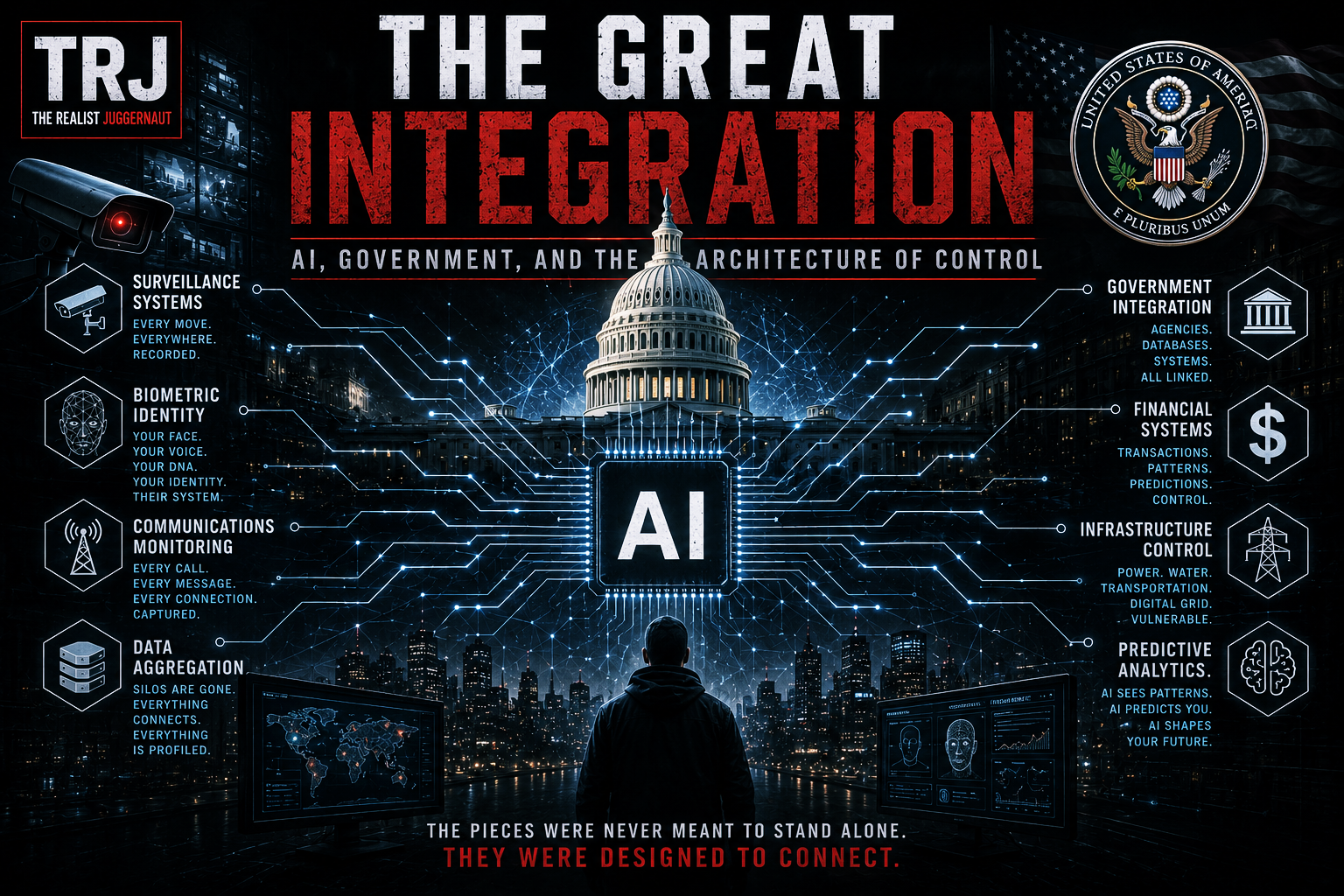
How Artificial Intelligence Is Becoming the Operational Layer Connecting Government, Infrastructure, Identity, Security, and Modern Society
The first thing that must be understood is that this article is not about artificial intelligence alone. We have already explored AI extensively through multiple investigations and some are attached to this piece. Those articles examined machine vision, predictive systems, digital identity, surveillance architectures, automation, infrastructure integration, and the expanding capabilities of modern AI. This article serves a different purpose.
Artificial intelligence is not the destination of this investigation. It is the vehicle.
The subject of this article is what happens when AI moves beyond being a standalone technology and becomes embedded within the institutions, systems, and infrastructure that govern modern society. The focus is not merely on what AI can do. The focus is on where it is being deployed, who is integrating it, how it is being connected to existing systems, and what emerges when previously separate environments begin operating through increasingly interconnected technological frameworks.
The attached articles document many of the individual components. This investigation examines the convergence of those components and the larger architecture that begins to emerge when they are viewed together rather than in isolation.
This article is about integration. The article is about what happens when technologies that once operated independently begin merging into a unified operational framework capable of influencing nearly every major system upon which modern society depends. That distinction is critical because most discussions about artificial intelligence remain trapped in the shallow waters of capability. They focus on what a model can generate, what tasks it can automate, what jobs it may replace, or how sophisticated it has become. Those discussions are not entirely unimportant, but they miss the larger transformation taking place beneath the surface.
For more than a year, The Realist Juggernaut has documented individual pieces of that transformation. At the time, each article appeared to examine a separate technological development. One focused on visual recognition. Another examined machine autonomy. Another explored predictive systems. Another analyzed surveillance architecture. Another investigated blockchain integration and the implications of linking artificial intelligence with governmental systems. Another questioned the unchecked acceleration of AI development and the consequences of placing increasingly powerful analytical capabilities into environments lacking meaningful public oversight. Viewed independently, these investigations appeared disconnected. Viewed together, they reveal a pattern that becomes increasingly difficult to ignore.
This pattern is integration.
Throughout modern history, institutions have operated through compartmentalization. Governments maintained records. Financial institutions managed transactions. Healthcare providers maintained medical information. Telecommunications providers handled communications. Utilities managed infrastructure. Security agencies gathered intelligence. Corporations maintained customer databases. Information existed within separate silos. Coordination certainly occurred, but technical limitations often prevented the creation of truly unified operational environments. Information moved slowly. Systems were incompatible. Processing capabilities were limited. Human bureaucracies acted as bottlenecks that naturally restricted the speed at which information could be gathered, analyzed, correlated, and acted upon.
Artificial intelligence changes that equation entirely.
For the first time at this scale, a technological layer exists that is capable of operating across multiple domains simultaneously. AI does not care whether information originates from financial systems, healthcare systems, communications systems, transportation networks, cybersecurity platforms, government databases, infrastructure monitoring systems, or surveillance architectures. Information becomes information. Patterns become patterns. Relationships become relationships. Once data enters an analytical environment, traditional institutional boundaries begin losing significance because the AI is capable of examining connections that human analysts would never have the time, resources, or processing capability to identify.
That capability represents one of the most significant technological shifts humanity has ever experienced. The public discussion often treats artificial intelligence as a more advanced search engine or a sophisticated assistant. Governments, military planners, cybersecurity agencies, infrastructure operators, intelligence organizations, and major corporations increasingly view it differently. They view it as an operational multiplier. They view it as a management layer. They view it as a system capable of helping oversee environments whose complexity has exceeded the capacity of traditional administrative structures.
That is precisely why recent developments deserve careful examination.
The June 2026 Executive Order on Advanced Artificial Intelligence Innovation and Security did not focus on entertainment. It did not focus on consumer applications. It did not focus on helping people write emails or generate artwork. The document focused on cybersecurity, federal systems, critical infrastructure, frontier AI models, government coordination, operational deployment, and collaboration between government agencies and private-sector developers. The accompanying White House fact sheet reinforced the same themes repeatedly. The language used throughout both documents consistently positioned artificial intelligence as a component of national capability, infrastructure protection, cybersecurity enhancement, and governmental operations rather than as a consumer product.
That distinction matters because it confirms something that has been visible for quite some time. The center of gravity surrounding artificial intelligence has shifted. The conversation is moving away from capability demonstrations and toward institutional integration. The question being asked behind closed doors is no longer whether artificial intelligence can perform specific tasks. The question is how deeply artificial intelligence can be embedded into systems that societies depend upon every day. Once that question becomes the focus, the implications expand dramatically.
A government does not need to surrender authority to artificial intelligence for AI to influence governance. A corporation does not need to be controlled by artificial intelligence for AI to influence corporate decision-making. Influence emerges through reliance. The more systems depend upon AI-driven analysis, recommendations, prioritization engines, predictive modeling, anomaly detection, risk assessments, and automated coordination, the more those systems become intertwined with the outputs generated by artificial intelligence. Over time, the distinction between assistance and administration becomes increasingly difficult to identify because operational decisions begin flowing through AI-enhanced environments at every level of the process.
This is where the six previous investigations begin converging.
Visual recognition was never simply about cameras. It was about perception. Machine autonomy was never simply about robotics. It was about decision-making. Predictive systems were never simply about analytics. They were about anticipation. Surveillance architectures were never simply about monitoring. They were about awareness. Blockchain integration was never simply about distributed ledgers. It was about permanence, verification, and identity. Government integration was never simply about policy. It was about administration.
Each development represented a different component of a much larger machine.
The machine is now beginning to reveal itself.
And what makes this moment particularly significant is that the integration process is no longer occurring exclusively within research laboratories, technology companies, academic institutions, or theoretical discussions about the future. It is increasingly visible within government frameworks, cybersecurity planning, infrastructure protection strategies, financial systems, communications networks, healthcare environments, transportation platforms, and national security planning. The architecture that once existed primarily as a possibility is increasingly appearing as operational reality.
The significance of that shift cannot be overstated. For generations, modern institutions operated within boundaries created by technology, bureaucracy, distance, and human limitations. Information remained fragmented. Systems remained separated. Coordination required time, resources, and extensive administrative effort. Artificial intelligence is rapidly changing those conditions. As analytical capabilities expand across multiple sectors simultaneously, the barriers that once separated infrastructure, communications, finance, healthcare, cybersecurity, identity, and administration continue to diminish. What emerges is not a single system, but an increasingly interconnected operational environment where information, analysis, and decision-support capabilities flow across domains that historically remained isolated from one another.
The question facing society is no longer whether integration is occurring. The evidence increasingly suggests that it is. The question is how deeply that integration will extend and what it ultimately means for the institutions, systems, and individuals operating within it.
When Separate Systems Stop Being Separate
For most of modern history, institutions operated within boundaries. Governments maintained their own records. Banks maintained financial records. Hospitals maintained medical records. Telecommunications companies maintained communications infrastructure. Utility providers managed electrical grids, water systems, and energy distribution networks. Insurance companies maintained risk profiles. Law enforcement agencies maintained criminal records. Each institution possessed its own mission, its own infrastructure, and its own information systems. While cooperation occurred between sectors when necessary, the technical limitations of the era created natural barriers that restricted the speed and scope of information sharing.
Those barriers are disappearing.
The transformation did not occur overnight. It emerged gradually through decades of digitization. Paper records became databases. Databases became networked systems. Networked systems became cloud environments. Cloud environments became interconnected ecosystems capable of exchanging information across organizational and geographic boundaries. Artificial intelligence arrived at precisely the moment those systems became sufficiently digitized to benefit from large-scale analysis. The result is a technological convergence unlike anything previously witnessed in human history.
The significance of this convergence cannot be measured simply by examining individual technologies. Too often, discussions about artificial intelligence focus exclusively on the AI itself while ignoring the environment into which it is being deployed. The real story is not the algorithm. The real story is the network of systems that the algorithm increasingly touches. Every year, more information flows into digital environments. Financial transactions are recorded electronically. Healthcare records are stored digitally. Communications travel through networked platforms. Transportation systems generate telemetry. Smart devices continuously collect operational information. Infrastructure monitoring systems track performance metrics across power grids, pipelines, transportation corridors, and communications networks. The amount of information generated by modern civilization is staggering.
Artificial intelligence provides something previous generations lacked: a mechanism capable of processing those environments at scale.
This is where the nature of the discussion changes. The challenge facing governments, corporations, and infrastructure operators is no longer collecting information. Modern institutions already possess more information than human administrators can effectively analyze. The challenge is interpretation. Artificial intelligence offers a solution to that problem. It can identify patterns across millions of records. It can detect anomalies hidden within enormous datasets. It can identify relationships between events occurring in different systems. It can prioritize risks. It can automate classification. It can assist decision-makers operating in environments whose complexity exceeds traditional administrative capacity.
Viewed from this perspective, artificial intelligence becomes far more than a software application. It becomes an integration layer.
That integration layer is increasingly appearing across sectors that historically operated independently. Financial institutions deploy AI for fraud detection, risk assessment, transaction monitoring, compliance analysis, and predictive modeling. Healthcare systems deploy AI for diagnostics, operational efficiency, medical imaging, patient management, and resource allocation. Telecommunications providers utilize AI for network optimization, threat detection, and infrastructure management. Cybersecurity organizations employ AI to identify vulnerabilities, detect intrusions, analyze threats, and coordinate defensive responses. Government agencies increasingly explore AI for administrative support, data analysis, operational efficiency, and infrastructure protection. Each deployment may appear isolated when examined individually. Collectively, they reveal a much larger trend.
The same analytical layer is appearing everywhere.
That reality introduces a development that few people fully appreciate. As artificial intelligence becomes integrated across multiple sectors simultaneously, the distinction between those sectors begins to blur. Information that once existed within isolated environments increasingly becomes capable of being analyzed within broader contexts. The importance of this shift is difficult to overstate. Human bureaucracies traditionally served as friction points that slowed the movement of information. Different agencies maintained different databases. Different industries maintained different systems. Different departments maintained different records. Integration was expensive, slow, and often technically difficult.
Artificial intelligence thrives in environments where those barriers become less significant.
A financial anomaly may reveal cybersecurity implications. A cybersecurity incident may expose infrastructure vulnerabilities. Infrastructure vulnerabilities may create economic consequences. Economic consequences may influence government responses. Government responses may affect healthcare systems, transportation systems, communications networks, and emergency services. Human analysts have always understood that these relationships exist. Artificial intelligence simply possesses the ability to examine them at scales previously unattainable.
This is one of the reasons the language appearing within recent government initiatives deserves attention. The emphasis increasingly centers on critical infrastructure, cybersecurity coordination, federal systems, public-private cooperation, and operational integration rather than consumer-facing applications. The focus is shifting toward environments where interconnected systems must operate together within increasingly complex threat landscapes. The June 2026 Executive Order repeatedly discusses AI-enabled cybersecurity capabilities, critical infrastructure operators, federal information systems, cybersecurity coordination, and collaborative frameworks involving both government agencies and private-sector organizations. The accompanying fact sheet reinforces the same priorities, emphasizing integration, coordination, and operational deployment.
What emerges from these developments is not a picture of separate technologies advancing independently. What emerges is a picture of systems converging toward common operational environments where artificial intelligence functions as a connective layer between institutions that once existed primarily as isolated domains. The process remains incomplete. It continues evolving. Yet the direction becomes increasingly visible with each passing year. Financial systems, healthcare systems, cybersecurity systems, communications systems, infrastructure systems, and government systems are no longer advancing along separate technological paths. They are increasingly moving toward shared environments where information, analysis, prediction, and administration intersect.
That intersection represents the beginning of something larger.
Because once separate systems stop being separate, the conversation inevitably shifts away from technology and toward governance. The question ceases to be whether artificial intelligence can connect information. The question becomes who controls the environments where that information converges, who establishes the rules governing its use, and what happens when the analytical layer connecting modern civilization becomes as essential as the infrastructure it was originally designed to support.
The Rise of the Administrative Machine
The greatest misunderstanding surrounding artificial intelligence is the belief that its primary purpose is automation. Automation is certainly one outcome, but it is not the most important one. Factories have automated processes for decades. Software has automated repetitive tasks for generations. Artificial intelligence represents something fundamentally different because it is not merely automating actions. It is increasingly being positioned to assist in the administration of systems whose complexity has grown beyond the capacity of traditional human management structures.
That distinction is where the true transformation begins.
Every modern institution faces the same challenge. The amount of information generated within its operational environment grows faster than its ability to process that information through conventional means. Governments face it. Corporations face it. Healthcare providers face it. Financial institutions face it. Infrastructure operators face it. Cybersecurity agencies face it. Every year produces more data, more transactions, more records, more alerts, more threats, more variables, and more complexity than the year before. The growth is not linear. It is exponential.
Human bureaucracies were never designed to operate at this scale.
For centuries, administration relied upon a relatively simple formula. Information was collected. Personnel reviewed that information. Decisions were made. Policies were implemented. The process was imperfect, often slow, and frequently inefficient, but it remained fundamentally human. Human beings served as the gatekeepers between information and action. They interpreted circumstances, applied judgment, and determined outcomes. Artificial intelligence introduces a new variable into that equation because it increasingly occupies the space between information and decision-making.
This is where many discussions become confused. Artificial intelligence does not need to possess authority in order to influence authority. It does not need to replace decision-makers in order to influence decisions. Influence emerges through recommendation, prioritization, classification, prediction, and analysis. When an AI system identifies risks, prioritizes cases, flags anomalies, recommends actions, predicts outcomes, allocates resources, or evaluates probabilities, it begins shaping the environment within which human decisions are made.
The distinction appears subtle at first.
In practice, it is profound.
Consider how administration functions inside modern organizations. Executives cannot personally review every transaction. Government officials cannot personally evaluate every record. Hospital administrators cannot personally assess every patient interaction. Security analysts cannot manually examine every threat indicator. Financial institutions cannot individually investigate every transaction moving through global networks. The scale is simply too large. Artificial intelligence fills that gap by acting as an intermediary layer capable of filtering, organizing, ranking, and interpreting information before it reaches human decision-makers.
This process creates something that previous generations never experienced.
An administrative environment in which information increasingly arrives pre-analyzed.
The implications extend far beyond efficiency. Over time, organizations naturally become dependent upon systems that reduce complexity. If an AI platform consistently identifies threats faster than human analysts, reliance grows. If an AI system predicts infrastructure failures more accurately than traditional monitoring methods, dependence increases. If an AI system assists healthcare providers in diagnosing conditions more effectively, integration expands. If AI-driven fraud detection prevents financial losses, adoption accelerates. The incentives all point in the same direction.
More integration. More reliance. More deployment.
What begins as assistance gradually evolves into infrastructure.
This evolution is not driven by conspiracy. It is driven by mathematics. Modern institutions generate more information than human administrators can process manually. Artificial intelligence offers a mechanism for managing complexity. The greater the complexity becomes, the stronger the incentive to deploy systems capable of reducing it. Governments recognize this reality. Corporations recognize this reality. Infrastructure operators recognize this reality. Cybersecurity agencies recognize this reality. The result is a steady migration toward AI-enhanced administrative environments operating across nearly every sector of society.
The language emerging from recent policy initiatives reflects this shift. Discussions increasingly focus on AI-enabled cybersecurity capabilities, critical infrastructure protection, federal information systems, coordination frameworks, and operational deployment. The emphasis is not on entertainment. It is not on consumer applications. It is on administration. It is on the management of increasingly complex systems operating at national scale. The June 2026 Executive Order repeatedly references AI deployment within cybersecurity, federal operations, infrastructure protection, and collaborative public-private environments. The accompanying fact sheet reinforces the same priorities, framing artificial intelligence as a capability supporting operational security and institutional resilience.
This is the point where the architecture begins revealing its true purpose.
Artificial intelligence is not simply becoming more intelligent. It is becoming more embedded. Every deployment creates another point of integration. Every integration creates another layer of dependency. Every dependency increases the importance of the systems responsible for managing those environments. Eventually, the conversation shifts away from technology entirely. The focus turns toward administration because administration is where power ultimately resides. The ability to process information, allocate resources, identify priorities, coordinate responses, and influence institutional behavior has always represented a form of power. Artificial intelligence does not create that reality. It accelerates it.
This is why the emergence of the administrative machine represents one of the most significant developments of the modern era. The transformation is not occurring through dramatic announcements or visible revolutions. It is occurring through integration. One system at a time. One deployment at a time. One institution at a time. One layer at a time. Each implementation appears rational when viewed independently. Each deployment solves a practical problem. Each adoption improves efficiency. Yet taken together, they reveal the gradual emergence of a new administrative environment operating beneath the surface of modern civilization.
And once administration itself becomes increasingly dependent upon interconnected AI systems, the next question becomes unavoidable.
What happens when the infrastructure supporting society becomes dependent upon the same integrated architecture that increasingly administers it?
The Infrastructure Revolution Nobody Voted For
Every civilization is built upon infrastructure. Roads move commerce. Power grids deliver energy. Water systems sustain cities. Communications networks connect populations. Financial systems enable economic activity. Healthcare systems preserve public health. Governments coordinate administration, security, and public services. These systems form the foundation upon which modern life depends. Most people rarely think about them because infrastructure performs its function best when it remains invisible. Society expects electricity to flow when a switch is flipped. Society expects communications networks to function when a message is sent. Society expects financial transactions to process, emergency services to respond, and utilities to operate without interruption.
Infrastructure succeeds when people forget it exists.
Artificial intelligence is increasingly moving into that same category.
The public continues to view AI through the lens of applications, but the institutions deploying it increasingly view it through the lens of infrastructure. That distinction represents one of the most important developments occurring in the modern technological landscape. Applications are optional. Infrastructure is not. Applications can be ignored. Infrastructure cannot. Applications provide convenience. Infrastructure becomes necessity.
The transformation from application to infrastructure follows a familiar historical pattern. The internet itself was once viewed as a specialized technological innovation. Mobile communications were once considered luxury services. Cloud computing was once treated as an experimental business model. Each eventually became foundational infrastructure supporting countless systems that modern society now considers essential. Artificial intelligence appears to be following a remarkably similar trajectory.
The evidence can be found not merely in technology announcements but in deployment priorities. Governments increasingly discuss AI within the context of cybersecurity, national security, infrastructure protection, and operational resilience. Financial institutions discuss AI within the context of fraud prevention, risk management, and regulatory compliance. Healthcare systems discuss AI within the context of diagnostics, resource allocation, operational efficiency, and patient management. Infrastructure operators discuss AI within the context of monitoring, predictive maintenance, anomaly detection, and system optimization. Across sectors, the pattern remains remarkably consistent.
Artificial intelligence is no longer being positioned primarily as a tool people use.
It is increasingly being positioned as a capability systems depend upon.
That distinction changes the nature of risk. Historically, infrastructure failures were generally isolated within specific domains. A power outage disrupted electrical service. A telecommunications failure disrupted communications. A transportation failure disrupted logistics. Each system possessed vulnerabilities unique to its environment. As artificial intelligence becomes integrated across multiple sectors simultaneously, a new reality begins emerging. The same analytical layer increasingly influences multiple domains at the same time.
This is not a question of control. It is a question of dependency.
Dependency often develops gradually. Institutions adopt new capabilities because those capabilities solve immediate problems. AI reduces administrative burdens. AI accelerates analysis. AI improves detection rates. AI identifies inefficiencies. AI helps manage growing complexity. Every deployment appears logical because every deployment delivers measurable benefits. Over time, organizations become accustomed to operating with those capabilities. Procedures evolve around them. Resources are allocated around them. Expectations adjust around them. Eventually, what began as a supplemental capability becomes an operational requirement.
At that point, artificial intelligence ceases to function as an enhancement.
It becomes infrastructure.
This reality helps explain the language increasingly appearing within policy frameworks and strategic planning documents. Recent initiatives emphasize AI-enabled cybersecurity services, protection of federal information systems, critical infrastructure resilience, coordination between government agencies and private-sector operators, and the deployment of advanced analytical capabilities throughout operational environments. These are not discussions centered on consumer products. They are discussions centered on infrastructure management. The June 2026 Executive Order repeatedly frames AI within the context of cybersecurity, federal systems, critical infrastructure, and national capability, while the accompanying fact sheet reinforces the same themes throughout its discussion of operational deployment and institutional coordination.
The implications extend far beyond technology. Infrastructure influences behavior. People adapt their lives around the systems upon which they depend. Entire economic sectors emerge around infrastructure. Governments build policies around infrastructure. Institutions organize operations around infrastructure. Once artificial intelligence becomes embedded deeply enough within critical systems, society begins adapting around its presence whether citizens consciously recognize that process or not.
This is where the discussion begins intersecting with governance in ways that previous technological revolutions rarely achieved. Roads do not analyze behavior. Electrical grids do not evaluate risk. Water systems do not generate predictions. Artificial intelligence introduces analytical capability directly into infrastructure environments. The result is infrastructure that not only supports operations but increasingly participates in the management of those operations. Systems become capable of identifying patterns, recommending actions, allocating attention, prioritizing responses, and influencing decision-making processes across multiple sectors simultaneously.
The significance of that shift cannot be measured solely in technical terms. It represents a transformation in the relationship between institutions and information. For centuries, administrative power was constrained by human limitations. Information could only be processed as quickly as human beings could evaluate it. Artificial intelligence dramatically expands that capacity. Institutions capable of leveraging these systems gain unprecedented ability to process complexity, identify relationships, and coordinate responses across increasingly interconnected environments.
Viewed independently, each deployment appears practical. Viewed collectively, the architecture begins revealing itself.
Financial systems become smarter. Healthcare systems become smarter.
Communications systems become smarter. Infrastructure systems become smarter.
Government systems become smarter. Cybersecurity systems become smarter.
Yet beneath those individual improvements lies a deeper reality. The same integration layer increasingly connects them all.
That is why this transformation matters. The infrastructure revolution currently unfolding is not simply about artificial intelligence becoming more powerful. It is about artificial intelligence becoming more fundamental. As integration accelerates, AI moves steadily from the periphery toward the center of modern operations. The systems society depends upon increasingly depend upon it as well.
And once dependency reaches that point, another question emerges—one that may prove even more important than the technology itself.
If artificial intelligence becomes the connective layer linking modern civilization together, what happens to privacy inside a world built upon constant observation, continuous analysis, and perpetual correlation?
The Age of Correlation
Privacy has traditionally been understood as the ability to keep different parts of life separated from one another. Financial activities existed within financial systems. Medical information remained within healthcare systems. Communications traveled through communications networks. Employment histories were maintained by employers. Travel records remained within transportation environments. Government records existed within government databases. The boundaries separating these domains were never absolute, yet they were significant enough to create a natural form of friction. Information existed across multiple institutions, multiple industries, and multiple bureaucracies that often lacked the technical capability, administrative authority, or operational need to merge every available piece of information into a single analytical environment. Human limitations created barriers. Organizational boundaries created barriers. Technological constraints created barriers. The result was a world in which information frequently remained fragmented, dispersed, and difficult to connect on a meaningful scale.
Artificial intelligence is changing that reality in ways that extend far beyond automation or efficiency. The defining characteristic of modern AI is not simply intelligence. It is correlation. Artificial intelligence excels at identifying relationships hidden within enormous quantities of information. It searches for patterns buried beneath complexity. It identifies anomalies concealed within routine activity. It discovers connections that may be invisible to analysts examining individual datasets in isolation. As the quantity of available information expands, the value of correlation expands alongside it. This development represents one of the most significant shifts occurring beneath the surface of modern society because civilization is generating more information than any previous generation could have imagined.
Every financial transaction, every communication, every digital interaction, every online search, every connected device, every network connection, every sensor, every account, and every system participating in the digital ecosystem contributes another fragment to an ever-expanding information environment. Viewed individually, these fragments often appear insignificant. A transaction record here. A login event there. A location ping. A communication timestamp. A device identifier. A network log. None of these elements appear particularly remarkable on their own. Yet modern analytical systems are not designed to examine information individually. They are designed to examine relationships. The significance emerges not from a single record but from the connections between thousands, millions, or even billions of records existing simultaneously across multiple environments.
This is where artificial intelligence becomes transformative. Human analysts can identify patterns within limited datasets. AI systems can examine relationships across enormous information environments operating at scales that exceed human capacity. They can identify correlations spanning geography, time, industry, institution, and operational domain. They can reveal relationships that would otherwise remain buried beneath overwhelming volumes of information. The more integrated society becomes, the more valuable that capability becomes. Governments seek it. Corporations seek it. Financial institutions seek it. Healthcare providers seek it. Cybersecurity organizations seek it. Infrastructure operators seek it. Intelligence agencies seek it. The reason is straightforward. Correlation reduces uncertainty. The ability to identify threats before they emerge, detect fraud before losses occur, recognize infrastructure vulnerabilities before failures develop, and anticipate operational disruptions before they spread possesses enormous strategic value. Institutions have always sought greater awareness of the environments they manage. Artificial intelligence dramatically expands their ability to obtain it.
Historically, large-scale correlation remained difficult because information existed within isolated systems separated by technical, administrative, and organizational barriers. Artificial intelligence increasingly functions as the bridge connecting those environments. Information that once remained compartmentalized becomes capable of existing within broader analytical frameworks where relationships can be identified across domains. Financial activity can be examined alongside cybersecurity events. Infrastructure anomalies can be analyzed alongside communications disruptions. Operational risks can be examined alongside economic indicators. Separate systems begin contributing to larger analytical environments where visibility expands with every additional source of information. What once appeared to be independent datasets increasingly become components of a single informational ecosystem.
Warrantless Access and Machine Identity
If anyone still believes the erosion of liberty remains a future concern, they are ignoring what is already visible in the present. Section 702 of the Foreign Intelligence Surveillance Act authorizes surveillance targeting foreigners located abroad, yet the collection process can also capture communications involving Americans. The authority has become one of the most debated surveillance programs of the modern era because it exists at the intersection of national security, privacy, constitutional protections, and governmental access to information.
That reality matters because it reveals a constitutional pattern that predates the newest wave of artificial intelligence. The issue is no longer merely whether government possesses the technical ability to gather information. The issue is whether institutional incentives, expanding analytical capability, and reduced technological friction are steadily normalizing forms of access that previous generations may have viewed very differently through the lens of the Fourth Amendment.
Biometric systems push that same pattern even further. Facial recognition, gait analysis, iris scanning, voice identification, and DNA-based identification technologies are rapidly expanding across both public and private sectors. Unlike passwords, account numbers, or identification cards, biometric identifiers are inherently tied to the individual. They are difficult to change, difficult to replace, and increasingly valuable within environments that depend upon reliable identity verification.
The significance extends beyond identification alone. Biometric systems transform identity into data that can be processed, authenticated, correlated, and analyzed at scale. A face becomes a digital identifier. A voice becomes a searchable signature. Movement patterns become behavioral markers. Physical characteristics become machine-readable information capable of being incorporated into increasingly sophisticated analytical environments.
When these realities are viewed together, the significance becomes difficult to dismiss. Section 702 demonstrates that large-scale communications collection already exists within national-security frameworks, while biometric surveillance demonstrates that identity itself is becoming increasingly machine-readable, persistent, and operationally useful across institutions.
Artificial intelligence does not create either development from nothing. What it does is magnify them by increasing the speed, scale, and efficiency with which communications, identity, movement, and behavior can be analyzed, correlated, and acted upon across integrated systems.
Identity in the Integrated World
Every system requires a method of distinguishing one person from another. Governments require it. Banks require it. Healthcare providers require it. Employers require it. Telecommunications providers require it. Online platforms require it. Without identity, administration becomes impossible because institutions cannot determine who is authorized to access services, who owns accounts, who is entitled to benefits, who is responsible for obligations, or who is interacting with a particular system. Identity has always existed as a foundational component of organized society. What is changing is not the existence of identity itself but the role identity plays within increasingly integrated environments.
For most of history, identity remained fragmented. A driver’s license identified an individual for transportation purposes. A bank account identified them for financial purposes. A medical record identified them within healthcare systems. Employment records identified them within professional environments. Government records identified them within administrative systems. These identifiers often existed independently of one another. Connections certainly existed, but the systems themselves generally operated within separate operational boundaries. The information maintained by one institution frequently remained inaccessible to another unless specific circumstances justified sharing it.
The growth of digital systems has gradually altered that landscape. As services moved online, institutions increasingly sought mechanisms capable of verifying identity efficiently, securely, and at scale. Usernames became accounts. Accounts became profiles. Profiles became digital identities. Authentication systems became increasingly sophisticated as organizations attempted to balance security, convenience, compliance requirements, and operational efficiency. What began as a simple administrative necessity evolved into one of the most important components of the modern digital ecosystem.
Artificial intelligence introduces a new dimension into that process because identity is no longer limited to a single identifier. Modern analytical systems increasingly operate by examining relationships across multiple indicators simultaneously. Names, addresses, phone numbers, account histories, device identifiers, transaction patterns, communications activity, geographic behavior, login histories, network activity, and countless other signals can contribute to increasingly sophisticated identity models. The result is an environment where identity becomes less about a single credential and more about a continuously evolving profile assembled from multiple streams of information.
This development is not occurring because institutions seek complexity for its own sake. It is occurring because integrated systems require reliable methods of determining who is interacting with them. Financial institutions seek stronger authentication to reduce fraud. Healthcare providers seek stronger verification to protect records. Governments seek stronger authentication to secure services. Cybersecurity organizations seek stronger authentication to prevent unauthorized access. Every major institution faces the same challenge. The more digital society becomes, the more important identity becomes.
The significance of this shift extends far beyond passwords, identification cards, or login credentials. Identity increasingly functions as the connective tissue linking systems together. Information originating within one environment becomes more valuable when it can be associated with a verified individual operating across multiple environments. The ability to establish continuity between records, accounts, transactions, interactions, and activities dramatically increases the effectiveness of analytical systems designed to identify patterns, assess risks, allocate resources, and manage complex operational environments.
This is where the relationship between identity and artificial intelligence becomes particularly important. Correlation depends upon connection. Connection depends upon identity. The more effectively systems can determine that multiple records belong to the same individual, the more effectively those systems can construct comprehensive analytical models. Identity therefore becomes one of the foundational pillars supporting The Great Integration. It is the mechanism that allows separate systems to function as components of a larger ecosystem rather than isolated domains operating independently of one another.
As artificial intelligence becomes increasingly embedded within government systems, financial systems, healthcare environments, cybersecurity operations, communications networks, and infrastructure management platforms, identity becomes more than an administrative requirement. It becomes a strategic asset. The ability to verify, authenticate, associate, and manage identity across increasingly interconnected systems may ultimately become one of the defining characteristics of the integrated world now emerging around us.
The Privacy Equation
Few words in modern society generate more confusion than privacy. The term is often reduced to discussions about social media settings, browser cookies, targeted advertising, or whether technology companies collect information about their users. Those concerns certainly exist, but they barely scratch the surface of the transformation currently underway. The privacy question emerging from The Great Integration is far larger because it is not centered on a single company, a single application, or a single platform. It is centered on what happens when increasingly interconnected systems possess the ability to observe, analyze, correlate, authenticate, and interpret information at scales that were previously impossible.
For generations, privacy benefited from friction. Information existed, but obtaining it required effort. Records existed, but accessing them required authorization, paperwork, time, and resources. Institutions maintained information, but the barriers separating those institutions often limited the ability to assemble comprehensive pictures of individual lives. Human limitations acted as natural safeguards. Administrative inefficiencies acted as natural safeguards. Technological limitations acted as natural safeguards. Privacy was not solely protected by law. In many cases, it was protected by the simple reality that connecting everything was impractical.
Artificial intelligence changes that equation because friction is precisely what AI is designed to reduce.
The same capabilities that make artificial intelligence valuable to governments, corporations, infrastructure operators, healthcare providers, cybersecurity organizations, and financial institutions also make it uniquely capable of transforming how information is understood. The objective is not merely collection. Collection alone provides limited value. The objective is interpretation. Information becomes valuable when it can be analyzed. Analysis becomes valuable when it can be correlated. Correlation becomes valuable when it can be transformed into awareness. Artificial intelligence accelerates every stage of that process.
This is where many discussions surrounding privacy become incomplete. The issue is often framed as a question of surveillance when the larger issue is visibility. Surveillance implies active observation. Visibility extends far beyond observation. Visibility emerges when systems possess sufficient information to identify patterns, understand relationships, anticipate behavior, detect anomalies, and construct increasingly accurate models of complex environments. The distinction may appear subtle, yet it represents one of the defining characteristics of the integrated world now taking shape.
Every major institution seeks greater visibility because visibility improves decision-making. Governments seek visibility into threats. Financial institutions seek visibility into fraud. Healthcare providers seek visibility into patient outcomes. Infrastructure operators seek visibility into system performance. Cybersecurity organizations seek visibility into network activity. Communications providers seek visibility into operational reliability. None of these objectives are inherently unusual. Organizations have always sought better information. What is different today is the scale at which information can be processed and the speed at which relationships can be identified once artificial intelligence becomes part of the equation.
The challenge emerges because the same systems capable of increasing security, efficiency, reliability, and operational awareness are often capable of increasing institutional visibility into individual activity as well. The same analytical engine capable of identifying a cybersecurity threat may also identify behavioral patterns. The same systems capable of preventing fraud may also reveal transaction histories. The same mechanisms capable of protecting infrastructure may also generate detailed awareness of how systems are being used. These realities emerge from the same technological foundation. They are not separate developments. They are different outcomes produced by the same capabilities.
This creates a tension that will likely define much of the coming decades. Modern society demands security. It demands efficiency. It demands convenience. It demands reliability. It demands resilience. Every one of those objectives benefits from greater awareness and more sophisticated analysis. Artificial intelligence delivers both. Yet every increase in visibility raises questions about autonomy, individual space, personal boundaries, and the relationship between institutions and the citizens they serve. The challenge is not determining whether artificial intelligence can improve systems. In many cases it already has. The challenge is determining where the boundaries should exist once the capability to connect, analyze, and interpret information becomes deeply embedded within the operational architecture of society itself.
Recent government initiatives provide further evidence that artificial intelligence is increasingly being viewed through the lens of operational capability and infrastructure protection. Discussions surrounding federal information systems, critical infrastructure, cybersecurity coordination, and advanced analytical frameworks all reflect an environment where information and analysis are becoming strategic assets. The June 2026 Executive Order and accompanying White House fact sheet repeatedly emphasize AI-enabled cybersecurity capabilities, infrastructure protection, federal deployment, and coordination between public and private entities.
The significance of these developments extends beyond politics because they illustrate a broader reality. Information is rapidly becoming infrastructure. Artificial intelligence is becoming the engine through which that infrastructure is interpreted. Identity increasingly provides the mechanism connecting records across systems. Correlation provides the means through which relationships are identified. Visibility becomes the product generated by the process. Once those elements begin operating together, privacy can no longer be understood solely as the absence of observation. Privacy becomes a question of how information is used, how it is interpreted, who possesses access to it, and what authority exists over the systems responsible for managing it.
That question leads directly into the next stage of The Great Integration.
Because once visibility becomes embedded within the architecture of modern society, dependency itself begins emerging as a form of power.
Dependency as a Form of Power
Every major technological revolution creates new forms of dependency. Roads create dependency on transportation networks. Electrical grids create dependency on power generation systems. Telecommunications networks create dependency on communications infrastructure. The internet created dependency on digital connectivity. These dependencies are not inherently negative. Modern civilization could not function without them. They provide extraordinary benefits, enable economic growth, improve quality of life, and support the complex systems upon which contemporary societies rely. Yet every dependency alters the relationship between individuals, institutions, and the infrastructure connecting them.
Artificial intelligence is beginning to follow a similar path.
The transformation rarely occurs through force. It occurs through utility. Technologies become indispensable because they solve problems. They improve efficiency. They reduce costs. They simplify complexity. They provide capabilities that quickly become difficult to imagine living without. Organizations adopt them because competitors adopt them. Governments deploy them because administrative demands continue increasing. Infrastructure operators rely upon them because systems become too complex to manage through traditional methods alone. The process appears rational at every stage because each individual decision often produces measurable benefits.
That is how dependency forms.
Rarely does a society wake up one morning and decide to become dependent upon a new technology. Dependency emerges gradually through thousands of decisions made over years or decades. One system adopts a new capability. Another follows. Procedures evolve. Workflows change. Expectations adjust. Resources are allocated differently. Entire operational models begin assuming the continued availability of the technology. Eventually, the technology ceases to be optional. It becomes foundational.
Artificial intelligence possesses many of the characteristics that historically drive this process. It reduces complexity. It processes information rapidly. It identifies patterns that human analysts may overlook. It improves operational awareness. It assists decision-makers operating within increasingly complicated environments. The incentives encouraging adoption are powerful because modern institutions face a common challenge. The scale of information generated by contemporary society continues expanding faster than traditional administrative structures can comfortably manage. Artificial intelligence offers a mechanism for bridging that gap.
The implications become particularly significant when adoption occurs across multiple sectors simultaneously. Financial systems increasingly rely upon AI-driven analysis. Cybersecurity organizations deploy AI-enhanced defensive capabilities. Healthcare providers utilize AI-assisted tools to improve efficiency and support diagnostics. Infrastructure operators employ predictive systems capable of identifying potential failures before they occur. Governments explore AI-enabled administrative environments designed to improve operational effectiveness and strengthen cybersecurity resilience. Each deployment addresses a specific problem. Together, they contribute to a broader transformation in how institutions operate.
This is where dependency begins intersecting with power.
Power has never been limited to authority alone. Power also emerges from necessity. The systems society depends upon inevitably acquire influence because disruption becomes increasingly costly. Electrical grids possess influence because modern civilization requires electricity. Communications networks possess influence because economies depend upon connectivity. Financial systems possess influence because commerce depends upon transactions. Dependency transforms infrastructure into something more than a collection of technologies. It transforms infrastructure into a foundational component of societal stability.
Artificial intelligence is steadily moving toward that category.
The process is visible in the language surrounding recent policy initiatives. Discussions increasingly emphasize operational deployment, cybersecurity resilience, critical infrastructure protection, federal systems, public-private coordination, and advanced analytical capabilities. These are not conversations centered on experimental technologies. They are conversations centered on institutional reliance. The June 2026 Executive Order repeatedly addresses AI-enabled cybersecurity services, critical infrastructure operators, federal information systems, and collaborative frameworks intended to support operational environments at national scale. The accompanying White House fact sheet reinforces those same priorities, reflecting a growing recognition that artificial intelligence is becoming intertwined with systems considered essential to modern governance and infrastructure.
The significance of this shift extends beyond technology itself. Once institutions begin depending upon AI-driven systems to manage complexity, identify threats, allocate resources, and coordinate responses, removing those systems becomes increasingly difficult. Procedures evolve around them. Staffing models evolve around them. Security frameworks evolve around them. Administrative processes evolve around them. The technology becomes woven into the operational fabric of the institution. Over time, dependency ceases to be a possibility and becomes an assumption.
That reality introduces one of the most important questions of The Great Integration. If artificial intelligence becomes deeply embedded within the systems that administer modern civilization, who ultimately governs the environments upon which those systems depend? The question is not whether governments retain authority. Governments will retain authority. The question is how much of the operational machinery supporting that authority becomes dependent upon increasingly integrated AI-driven architectures. The same question applies to corporations, financial institutions, healthcare systems, infrastructure providers, and every major organization operating within an increasingly interconnected world.
This is not a question of machines replacing people. It is a question of institutions becoming reliant upon technological environments capable of shaping how information is processed, interpreted, prioritized, and acted upon. Dependency does not eliminate human decision-making. It changes the environment within which those decisions are made. Over time, the influence of that environment can become as significant as the authority exercised by the individuals operating within it.
That is why dependency represents more than a technological issue. It represents a governance issue. It represents an infrastructure issue. It represents a societal issue. Every layer of integration discussed throughout this investigation—correlation, identity, cybersecurity, infrastructure, administration, and operational coordination—ultimately contributes to the same outcome. The more integrated the architecture becomes, the more difficult it becomes to separate modern institutions from the systems supporting them.
And once dependency reaches that level, the final question becomes unavoidable.
If artificial intelligence is increasingly becoming the connective tissue linking the major systems of modern civilization, what does that mean for governance itself, and what does the future look like when the architecture is fully operational?
The Great Integration
By this point, the pattern should be impossible to ignore. What began as separate technological developments are increasingly revealing themselves as components of a larger transformation unfolding across nearly every major institution in modern society. Visual recognition systems, machine autonomy, predictive analytics, cybersecurity platforms, digital identity frameworks, infrastructure monitoring systems, government modernization initiatives, and large-scale data analysis environments are often discussed as independent developments because each emerged from a different sector, solved a different problem, and evolved along its own technological path. Yet beneath those differences lies a common destination.
Integration.
The significance of that destination becomes clearer when examining the progression that has occurred over the past several years. Artificial intelligence first entered public awareness as a tool. It answered questions, generated content, analyzed information, and performed tasks that previously required human effort. The discussion centered almost entirely on capability because capability was the most visible aspect of the technology. As adoption accelerated, organizations began discovering something more important. The true value of artificial intelligence was not limited to what it could create. The true value was what it could connect.
Information became easier to analyze. Systems became easier to coordinate.
Complexity became easier to manage. Risks became easier to identify.
Patterns became easier to recognize. Resources became easier to allocate.
What initially appeared to be isolated efficiencies gradually evolved into a broader realization. Artificial intelligence functioned exceptionally well as an integration layer capable of operating across environments that traditionally remained separate. That realization accelerated deployment across sectors because every major institution faced the same challenge. Complexity was increasing faster than traditional administrative structures could comfortably manage.
Artificial intelligence appeared at precisely the moment that challenge reached critical mass.
Governments faced growing administrative complexity.
Financial institutions faced expanding transaction volumes.
Healthcare providers faced growing information burdens.
Infrastructure operators faced increasingly sophisticated operational environments.
Cybersecurity organizations faced escalating threat landscapes.
Communications networks faced unprecedented levels of activity.
Each institution approached artificial intelligence from a different direction. Yet each arrived at a remarkably similar conclusion. AI provided a mechanism for managing environments whose complexity exceeded traditional methods.
This is where the individual pieces begin converging into a single narrative.
The visual recognition systems examined in earlier investigations were not simply teaching machines to see. They were creating new mechanisms for environmental awareness. The machine autonomy systems discussed in previous articles were not simply automating tasks. They were creating new mechanisms for analysis and decision support. The predictive systems explored throughout the series were not simply forecasting outcomes. They were creating new mechanisms for anticipating events before they occurred. The surveillance architectures previously examined were not merely monitoring activity. They were expanding visibility across increasingly complex environments. The blockchain integration discussions were not simply about distributed ledgers. They were examining the infrastructure required to maintain trust, verification, and continuity across interconnected systems.
Viewed independently, each article addressed a different topic.
Viewed collectively, they were documenting the emergence of the same architecture.
That architecture is now becoming visible within government planning, infrastructure protection strategies, cybersecurity initiatives, operational modernization programs, and public-private coordination frameworks. The language appearing in recent policy documents reflects a growing recognition that artificial intelligence is no longer being viewed solely as software. It is increasingly being viewed as a strategic capability capable of supporting the operation of critical systems. The June 2026 Executive Order repeatedly references cybersecurity, federal information systems, critical infrastructure, frontier models, and coordination between government agencies and private-sector organizations. The accompanying White House fact sheet reinforces those same themes, emphasizing operational deployment, infrastructure protection, and institutional integration.
This does not represent the completion of the process.
It represents another stage of the process.
That distinction matters because The Great Integration is not a single event. It is not a law, an executive order, a corporation, or a specific technological breakthrough. It is the gradual convergence of systems that were once separate. It is the steady movement toward environments where information, identity, infrastructure, administration, cybersecurity, communications, and operational management increasingly function within interconnected frameworks supported by artificial intelligence.
The process unfolds incrementally. Each step appears reasonable. Each deployment solves a practical problem. Each integration improves efficiency. Each advancement strengthens security, increases awareness, reduces uncertainty, or improves coordination. Viewed in isolation, the individual decisions often appear entirely rational. The larger picture only emerges when those decisions are examined collectively across multiple years and multiple sectors.
That larger picture is what this investigation has attempted to document.
The most significant transformations in history rarely announce themselves with dramatic declarations. They emerge gradually through thousands of decisions that appear unrelated until viewed from sufficient distance. Railroads transformed commerce. Electrification transformed industry. Telecommunications transformed communication. The internet transformed information. Each development initially appeared as a collection of individual innovations before eventually revealing itself as a civilization-scale transformation.
Artificial intelligence appears to be following a similar path.
The difference is that previous infrastructure revolutions primarily moved information, energy, goods, or communications. Artificial intelligence operates on something even more fundamental.
It operates on decision environments. It operates on awareness.
It operates on analysis. It operates on administration.
And as those capabilities become increasingly embedded within the systems supporting modern civilization, the distinction between technology and governance becomes increasingly difficult to separate.
That reality leads to the final chapter of this investigation. Because once the architecture becomes visible, the question is no longer where integration is occurring.
The question becomes what kind of society emerges once that integration reaches maturity.
The Architecture Becomes Visible
Every generation experiences a moment when a collection of seemingly unrelated developments begins revealing a larger pattern. At first, the individual components appear disconnected. New technologies emerge. Institutions adapt. Policies evolve. Infrastructure expands. Capabilities improve. Most people experience these changes as isolated events because that is how they are presented. One announcement concerns cybersecurity. Another concerns digital identity. Another concerns infrastructure modernization. Another concerns artificial intelligence. Another concerns government efficiency. Another concerns critical infrastructure protection. Each development arrives separately, carrying its own justification, its own objectives, and its own technical explanations.
The larger picture often remains hidden until enough pieces accumulate to expose the framework connecting them.
That is where we stand today.
For years, the discussion surrounding artificial intelligence focused primarily on capability. The public was shown systems capable of generating text, producing images, analyzing information, writing code, creating video, and performing tasks that previously required human effort. Those capabilities captured attention because they were visible. They were tangible. They demonstrated the rapid advancement of technology in ways ordinary people could immediately understand. Yet while public attention remained fixed on capability, a quieter transformation was occurring elsewhere. Governments, corporations, infrastructure operators, cybersecurity organizations, healthcare providers, financial institutions, communications networks, and countless other institutions were examining a different question entirely.
They were examining integration.
The reason is straightforward. Modern civilization has become extraordinarily complex. Every year generates more information, more transactions, more communications, more records, more dependencies, more vulnerabilities, and more operational challenges than the year before. Traditional administrative structures struggle to keep pace with that growth because human capacity remains finite while systemic complexity continues expanding. Artificial intelligence emerged as a solution to that problem. Not because it replaced institutions, but because it allowed institutions to process complexity at scales that would otherwise be impossible.
This investigation has traced that progression from multiple directions. Visual recognition systems expanded awareness. Predictive systems expanded anticipation. Administrative systems expanded operational efficiency. Correlation engines expanded visibility. Identity systems expanded continuity across environments. Infrastructure integration expanded coordination between previously separate domains. Viewed individually, each development appeared to solve a practical problem. Viewed collectively, they reveal the emergence of a broader architecture designed to manage increasingly interconnected systems.
The significance of this transformation extends beyond technology because technology alone is not the story. The story is what happens when technology becomes embedded deeply enough that institutions begin organizing themselves around its capabilities. History demonstrates that infrastructure reshapes behavior. Railroads reshaped commerce. Electrification reshaped industry. Telecommunications reshaped communication. The internet reshaped information. Each technological revolution altered the structure of society because institutions adapted to the capabilities the new infrastructure provided.
Artificial intelligence appears poised to follow a similar trajectory.
The difference is that previous infrastructure revolutions primarily moved physical resources, communications, or information. Artificial intelligence increasingly influences how information is interpreted. It influences how complexity is managed. It influences how risks are identified. It influences how resources are allocated. It influences how decisions are informed. The implications of that shift extend far beyond technical efficiency because administration itself increasingly operates within environments shaped by AI-driven analysis.
Recent policy developments provide further evidence that governments are beginning to view artificial intelligence through this broader lens. The June 2026 Executive Order and accompanying White House fact sheet repeatedly discuss cybersecurity resilience, federal systems, critical infrastructure protection, public-private coordination, and the deployment of advanced AI capabilities throughout operational environments. These documents do not treat artificial intelligence as a novelty. They treat it as a strategic capability increasingly relevant to the management of systems considered essential to national operations.
That reality brings us to the central observation underlying this entire investigation.
The Great Integration is not a future event waiting to occur.
It is a process already underway.
The evidence does not exist within a single document, a single administration, a single corporation, or a single technological breakthrough. The evidence exists within the accumulation of developments that have unfolded across multiple sectors over multiple years. Each deployment contributes another layer. Each integration creates another connection. Each advancement increases the degree to which institutions depend upon increasingly interconnected systems operating within shared informational environments.
Some readers will view this progression as a positive development. They will point to improved cybersecurity, greater efficiency, enhanced infrastructure resilience, better fraud detection, improved healthcare outcomes, and more effective administration. Those benefits are real and deserve recognition. Others will focus on questions involving privacy, institutional power, visibility, dependency, and accountability. Those questions are equally real and deserve examination. The purpose of this investigation has never been to reduce a complex transformation into a simplistic conclusion. The purpose has been to document the architecture as it emerges and to examine the implications of a world in which artificial intelligence increasingly functions as the connective tissue linking modern civilization together.
Because regardless of where one stands on the issue, one fact is becoming increasingly difficult to dismiss.
The conversation is no longer about whether artificial intelligence will become integrated into society.
The conversation is about how far that integration will extend, who will oversee the systems supporting it, what safeguards will exist around it, and how the relationship between institutions and individuals will evolve as the architecture continues expanding.
The six previous investigations examined individual pieces of that machine while they were still being assembled. Today, more of the structure is visible than ever before. The outlines are becoming clearer. The connections are becoming easier to see. The direction is becoming more apparent. What once appeared to be isolated technological developments increasingly resemble components of a single framework emerging across government, infrastructure, finance, healthcare, communications, cybersecurity, and administration.
The architecture is no longer hiding in plain sight.
The architecture is becoming visible.
And understanding it may become one of the most important challenges of the coming decades.
The Constitutional Question
Every major technological revolution eventually collides with a reality far older than the technology itself. The collision is not financial. It is not technical. It is not even scientific. It is constitutional. The most important questions raised by artificial intelligence are not ultimately questions about software, algorithms, computing power, or machine learning models. They are questions about authority, accountability, institutional power, individual liberty, and the relationship between citizens and the systems governing their lives. Those questions existed long before artificial intelligence arrived, and they will remain long after today’s technologies are replaced by whatever follows them. The significance of The Great Integration is not that it introduces entirely new concerns. The significance is that it places centuries-old constitutional questions inside technological environments operating at speeds and scales that previous generations never had to confront.
The Constitution of the United States was written during a period when information moved slowly, records were maintained physically, communication traveled at the speed of transportation, and governmental authority was constrained not only by law but by practical limitations. Information could not be gathered instantly. Records could not be searched instantly. Communications could not be monitored across entire populations in real time. Administrative power was limited by the realities of the era. Human beings processed information. Human beings maintained records. Human beings conducted investigations. Human beings made decisions. Every stage of governance contained natural friction created by the limitations of human administration.
Modern technology has steadily removed much of that friction.
Digitization accelerated information storage. Networking accelerated communication. Cloud infrastructure accelerated access. Artificial intelligence is accelerating analysis. Each advancement expanded the ability of institutions to process complexity, coordinate activity, identify risks, and manage increasingly sophisticated operational environments. Viewed independently, these developments often appear beneficial because they solve practical problems. Governments become more efficient. Infrastructure becomes more resilient. Cybersecurity improves. Services become faster. Administrative burdens decrease. Yet beneath those advantages lies a deeper constitutional question concerning the relationship between capability and authority. The ability to do something has never automatically justified doing it. The existence of a capability does not answer questions regarding limits, oversight, accountability, or the protection of individual liberty.
This is where The Great Integration becomes particularly significant. Artificial intelligence is increasingly being deployed within systems responsible for administration, security, infrastructure protection, risk analysis, resource allocation, and operational decision support. The technology itself does not possess authority. The authority remains with the institutions deploying it. Yet as institutions become increasingly dependent upon AI-enhanced environments for analysis, prioritization, prediction, and coordination, the influence of those environments expands alongside their capabilities. The issue is not whether artificial intelligence governs society. The issue is how governance changes once administrative systems become deeply intertwined with technologies capable of processing information at scales that previous generations could scarcely imagine.
Historically, constitutional protections served as barriers against excessive concentrations of power. Those protections were designed around the understanding that authority requires limits, transparency, and accountability. The challenge presented by modern technological integration is that power no longer resides solely within visible institutions. Increasingly, power also resides within the systems those institutions depend upon to operate. Information systems influence decision environments. Analytical systems influence priorities. Risk assessment systems influence responses. Administrative systems influence outcomes. The constitutional discussion therefore expands beyond traditional questions of governmental authority and begins encompassing the technological architectures through which that authority increasingly functions.
The Corporate State
One of the most persistent misconceptions surrounding discussions of power in the modern era is the belief that governments and corporations operate as entirely separate entities pursuing entirely separate objectives. Reality is considerably more complicated. Governments rely upon private-sector infrastructure. Corporations rely upon governmental stability. Governments purchase technology from private vendors. Private vendors build systems used by governments. Critical infrastructure frequently exists within public-private partnerships where responsibilities, authorities, operational requirements, and technological capabilities overlap in ways that would have been difficult to imagine only a few decades ago.
Artificial intelligence is accelerating that relationship.
The reason is simple. Developing advanced AI systems requires enormous resources. Computing infrastructure, cloud environments, data centers, specialized hardware, cybersecurity frameworks, research teams, engineering talent, and operational support systems demand investments measured not in millions but increasingly in billions of dollars. The organizations capable of developing, maintaining, and scaling these environments tend to be large corporations operating at global scale. At the same time, governments increasingly recognize artificial intelligence as a strategic capability relevant to cybersecurity, infrastructure protection, intelligence analysis, national competitiveness, administrative efficiency, and operational resilience. The result is a natural convergence between public institutions seeking advanced capabilities and private organizations capable of providing them.
This convergence represents one of the defining characteristics of The Great Integration because it creates an environment where the distinction between governmental infrastructure and corporate infrastructure becomes increasingly difficult to separate. Communications networks may be privately operated while serving public functions. Cloud environments may be owned by corporations while hosting governmental systems. Cybersecurity capabilities may be developed by private entities while protecting public infrastructure. Artificial intelligence models may be created within corporate research environments while supporting governmental operations. The relationship is not new, but the scale at which it is developing represents something significantly different from previous eras.
Throughout much of modern history, corporations primarily influenced society through products and services. Governments exercised authority through laws, regulations, administration, and enforcement. The boundaries separating those roles were never absolute, yet they remained relatively clear. Today, technological infrastructure increasingly serves as the foundation upon which both sectors operate. Financial systems rely upon digital platforms. Communications depend upon privately owned networks. Cloud environments host both public and private operations. Cybersecurity capabilities often protect assets spanning multiple sectors simultaneously. Artificial intelligence is emerging directly within the center of that ecosystem.
The significance of this shift becomes clearer when viewed through the lens of dependency. Governments increasingly depend upon technological infrastructure that they do not necessarily build themselves. Corporations increasingly provide services that support essential governmental operations. Infrastructure providers, cloud operators, cybersecurity vendors, communications companies, financial technology organizations, and artificial intelligence developers all occupy positions of growing importance within environments that support both public administration and private commerce. The result is not the replacement of government by corporations, nor the replacement of corporations by government. The result is increasing interdependence.
That interdependence carries profound implications because infrastructure influences power regardless of who formally owns it. A society dependent upon communications networks cannot easily ignore the organizations operating those networks. A society dependent upon financial systems cannot easily ignore the institutions managing those systems. A society dependent upon cloud infrastructure cannot easily ignore the environments hosting its operations. As artificial intelligence becomes increasingly embedded within those ecosystems, the organizations responsible for developing, maintaining, and operating AI capabilities naturally acquire greater significance as well.
Recent policy developments illustrate this reality. Discussions surrounding cybersecurity coordination, critical infrastructure protection, advanced AI deployment, federal systems, and frontier model evaluation repeatedly emphasize cooperation between government agencies and private-sector organizations. The June 2026 Executive Order and accompanying White House fact sheet consistently reference collaborative frameworks, operational coordination, and public-private engagement surrounding advanced artificial intelligence capabilities.
The significance of these developments extends beyond individual policies because they reveal a broader structural reality. The future architecture of artificial intelligence is unlikely to exist solely within government environments or solely within corporate environments. It is increasingly emerging within interconnected ecosystems where public institutions and private organizations operate alongside one another, sharing responsibilities, infrastructure, capabilities, and information in ways that continue deepening over time.
This reality introduces one of the most important observations of The Great Integration. Power in the twenty-first century is becoming increasingly tied to infrastructure, information, and the systems capable of managing both. Artificial intelligence sits at the center of that transformation because it functions not merely as a technology but as an operational capability capable of influencing how information is processed, interpreted, prioritized, and acted upon across multiple sectors simultaneously.
The question therefore is not whether governments will disappear or whether corporations will rule society outright. The question is how authority evolves within a world where both increasingly depend upon the same integrated technological architecture. The answer to that question may ultimately determine the shape of governance, commerce, infrastructure, and individual liberty for decades to come.
And it is that reality which leads directly into the next phase of this investigation, because once governments, corporations, infrastructure providers, financial institutions, healthcare systems, communications networks, and cybersecurity organizations begin operating within increasingly interconnected environments, the separation that once defined modern society begins slowly fading away.
The End of Separation
For centuries, modern civilization evolved through specialization. Governments governed. Banks managed finance. Hospitals provided healthcare. Telecommunications companies operated communications networks. Utility providers managed infrastructure. Law enforcement agencies enforced laws. Intelligence organizations gathered intelligence. Corporations developed products and services. Each institution occupied a relatively distinct role within society’s broader framework. While cooperation occurred between sectors when necessary, the boundaries separating those sectors remained significant enough to preserve a degree of institutional independence.
The Great Integration is steadily changing that reality.
The change is not occurring because anyone gathered in a room and designed a master blueprint. It is occurring because complexity naturally drives integration. Every major institution now operates within environments generating extraordinary amounts of information. Every major institution faces growing cybersecurity threats. Every major institution relies upon digital infrastructure. Every major institution depends upon communications networks, cloud services, identity systems, financial systems, and increasingly sophisticated technological environments. The result is that organizations which once operated largely within their own domains increasingly find themselves connected through shared dependencies.
Artificial intelligence accelerates this process because it functions exceptionally well within interconnected environments. AI thrives on information. It thrives on relationships between datasets. It thrives on identifying patterns across systems. It thrives on reducing complexity by revealing connections that might otherwise remain hidden. The more integrated society becomes, the more valuable those capabilities become. The more valuable those capabilities become, the stronger the incentive to expand integration further.
This creates a feedback loop that is reshaping the operational architecture of modern civilization.
Financial systems become increasingly connected to cybersecurity systems because fraud detection, risk analysis, and security monitoring require continuous information sharing. Healthcare systems become increasingly connected to identity systems because verification, access control, compliance requirements, and patient management depend upon reliable authentication. Infrastructure operators become increasingly connected to cybersecurity environments because digital threats now possess the ability to disrupt physical systems. Government agencies become increasingly connected to private-sector technology providers because modern administrative environments require capabilities that often originate outside traditional governmental structures. Communications networks become increasingly intertwined with every sector because nearly every modern system depends upon connectivity.
Viewed independently, each connection appears logical.
Viewed collectively, they reveal the gradual disappearance of separation itself.
The significance of this transformation extends far beyond technology because separation has historically served as a structural limitation on the concentration of information and operational awareness. Different institutions possessed different records. Different sectors possessed different capabilities. Different organizations maintained different responsibilities. The boundaries separating those domains naturally limited the degree to which information, authority, and influence could become concentrated within a single operational environment. Artificial intelligence does not eliminate those boundaries entirely, but it increasingly reduces their significance by making cross-domain analysis more practical, more efficient, and more valuable than ever before.
This reality becomes particularly important when examining how institutions respond to uncertainty. Governments seek greater awareness because awareness improves decision-making. Corporations seek greater awareness because awareness improves efficiency and competitiveness. Cybersecurity organizations seek greater awareness because awareness improves security. Healthcare providers seek greater awareness because awareness improves outcomes. Infrastructure operators seek greater awareness because awareness improves resilience. Every major institution benefits from improved visibility into the environments it manages. Artificial intelligence provides precisely that capability, creating powerful incentives for continued integration across sectors that previously operated with greater degrees of separation.
The result is the emergence of increasingly interconnected operational ecosystems where information moves more freely, analysis occurs more rapidly, and coordination becomes more sophisticated. Financial systems no longer exist solely as financial systems. They increasingly intersect with cybersecurity, identity verification, fraud detection, regulatory compliance, and risk management environments. Healthcare systems no longer exist solely as healthcare systems. They increasingly intersect with identity management, cybersecurity, data analytics, infrastructure resilience, and administrative automation. Communications networks no longer exist solely as communications networks. They increasingly function as foundational infrastructure supporting virtually every other sector simultaneously.
Artificial intelligence sits at the center of this transformation because it provides the analytical capability necessary to operate within environments where traditional boundaries are becoming increasingly porous. It does not erase institutional distinctions. It does not merge governments into corporations or corporations into governments. What it does is create a common analytical layer capable of operating across environments that historically remained more isolated from one another.
This is why The Great Integration represents something larger than technological advancement. It represents a structural transformation in how modern institutions relate to one another. The systems supporting society are becoming more interconnected. The information flowing through those systems is becoming more interconnected. The analytical environments responsible for interpreting that information are becoming more interconnected. As those trends continue, the separation that once defined the architecture of modern civilization becomes increasingly difficult to maintain.
Recent policy developments provide additional evidence of this trajectory. Discussions surrounding critical infrastructure, cybersecurity coordination, federal systems, AI deployment, and public-private operational frameworks all point toward environments where cooperation between sectors is becoming increasingly necessary. The June 2026 Executive Order and accompanying White House fact sheet repeatedly emphasize collaboration, coordination, operational resilience, and integration between governmental and private-sector stakeholders responsible for maintaining critical systems.
The implications of these developments are neither entirely positive nor entirely negative. Integration brings efficiency. Integration improves coordination. Integration strengthens resilience. Integration enhances awareness. Yet integration also reduces separation. It increases dependency. It expands visibility. It creates environments where information, analysis, and operational influence become increasingly concentrated within shared architectures.
That is the reality at the heart of The Great Integration.
The question is no longer whether the process is occurring.
The question is what kind of society ultimately emerges once the process reaches maturity and the architecture supporting modern civilization becomes so interconnected that separation itself begins feeling like a relic of a previous era.
TRJ VERDICT: THE ROAD TO THE GREAT INTEGRATION
The purpose of this investigation was never to predict the future. Predictions are easy. Headlines are easy. Speculation is easy. Documentation is difficult. Following a trail over multiple years is difficult. Connecting developments occurring across multiple industries, multiple governments, multiple technologies, and multiple institutions is difficult. Yet that is precisely what this investigation has attempted to accomplish.
For more than a year, The Realist Juggernaut examined a series of developments that initially appeared unrelated. Visual recognition systems appeared to be advancing independently of machine autonomy. Cybersecurity systems appeared to be evolving independently of government modernization initiatives. Digital identity discussions appeared separate from infrastructure protection strategies. Administrative automation appeared disconnected from conversations surrounding surveillance, predictive analytics, and large-scale data environments. Viewed individually, each development appeared to occupy its own lane. Viewed collectively, they revealed something much larger.
A pattern.
The significance of that pattern does not lie in any single technology. It does not lie in any single corporation, administration, executive order, agency, platform, or institution. The significance lies in convergence. Across government, finance, healthcare, communications, cybersecurity, infrastructure, logistics, and administration, the same underlying trend continues emerging. Systems that once operated independently are becoming increasingly interconnected. Information that once remained fragmented is becoming increasingly correlated. Analytical capabilities that once existed as specialized tools are becoming increasingly embedded within the operational architecture of modern society.
This is The Great Integration.
It is not a law.
It is not a policy.
It is not a program.
It is a process.
A process driven by complexity, accelerated by technology, and reinforced by the incentives facing every major institution operating in an increasingly digital world. Governments seek greater awareness. Corporations seek greater efficiency. Infrastructure operators seek greater resilience. Cybersecurity organizations seek greater visibility. Financial institutions seek greater security. Healthcare providers seek better outcomes. Artificial intelligence offers capabilities that support each of those objectives simultaneously. That reality alone ensures continued expansion of AI-assisted systems throughout the coming years.
The most important observation emerging from this investigation is that artificial intelligence no longer occupies the edge of modern civilization. It is steadily moving toward the center. The discussion has evolved far beyond chatbots, novelty applications, and consumer products. Increasingly, the conversation revolves around administration, infrastructure, cybersecurity, critical systems, operational coordination, and institutional capability. Recent policy initiatives merely reinforce a trend that has been developing for years. The June 2026 Executive Order and accompanying White House fact sheet did not create that trend. They simply provided another visible marker along a road that was already being traveled.
Some readers will view this progression as progress. Others will view it with concern. Many will likely see elements of both. That debate is healthy. It should occur. The future of artificial intelligence should never be reduced to simplistic narratives portraying it as either salvation or catastrophe. Reality is rarely that simple. The technologies examined throughout this investigation possess the capacity to improve security, strengthen infrastructure, increase efficiency, reduce uncertainty, and help institutions manage challenges that continue growing in scale and complexity. At the same time, those same capabilities raise legitimate questions regarding privacy, accountability, dependency, transparency, and the distribution of power within increasingly interconnected systems.
Those questions are not going away.
In many respects, they are only beginning.
The road documented throughout this investigation did not begin in 2026. It did not begin with a single executive order. It did not begin with a single technological breakthrough. It began years earlier through a series of developments that, when viewed individually, appeared manageable and isolated. Only now, with the benefit of hindsight, does the larger picture begin emerging. The pieces are no longer scattered across the table. The outline is becoming visible. The architecture is taking shape.
That architecture may ultimately define one of the most significant transformations of the twenty-first century.
Not because machines became intelligent.
Not because governments adopted artificial intelligence.
Not because corporations invested billions into new technologies.
But because the systems supporting modern civilization are becoming increasingly connected through a common analytical layer capable of observing, correlating, interpreting, and assisting the management of environments whose complexity continues expanding beyond traditional administrative limits.
The Great Integration is not a destination that suddenly arrives one morning.
It is a road. The evidence suggests that road is already under construction.
The only remaining question is how far it ultimately extends.
AI is the accelerator: more AI means more optimization, more optimization means more money and control, and money plus control helps entrench power.
⚠️ Our warning to you is this: Your freedom is shrinking right in front of your eyes.
50 U.S.C. § 1881a — Procedures for Targeting Certain Persons Outside the United States Other Than United States Persons (FISA Section 702 Statutory Text). Includes authorization authorities, limitations, targeting procedures, minimization procedures, querying procedures, judicial review requirements, and Fourth Amendment compliance provisions. (Free Download)

Section 702 of the Foreign Intelligence Surveillance Act — U.S. Intelligence Community Information Booklet. Covers Section 702 authorities, targeting procedures, querying procedures, oversight mechanisms, minimization requirements, compliance standards, and operational use cases. (Free Download)
The White House. Promoting Advanced Artificial Intelligence Innovation and Security (Executive Order), June 2, 2026. (Free Download)
The White House. Fact Sheet: President Donald J. Trump Promotes Advanced Artificial Intelligence Innovation and Security, June 2, 2026. (free Download)
🗂️ TRJ BLACK FILE — THE GREAT INTEGRATION
This is not a forecast. These are documented developments demonstrating the growing convergence of artificial intelligence, infrastructure, government operations, cybersecurity, digital identity, and institutional administration.
FILE #001 — The Expansion of Machine Vision
Artificial intelligence systems are now capable of identifying faces, objects, behaviors, locations, vehicles, patterns, anomalies, and environmental conditions at scales impossible for human operators alone. Machine vision transformed cameras from passive recording devices into active analytical systems capable of interpreting the environments they observe.
FILE #002 — Predictive Analysis at Scale
Artificial intelligence rapidly evolved beyond simple automation and data processing into systems capable of identifying trends, forecasting outcomes, detecting anomalies, evaluating probabilities, and reducing uncertainty across increasingly complex environments. Governments, corporations, financial institutions, cybersecurity organizations, healthcare providers, and infrastructure operators now deploy predictive AI systems to analyze enormous quantities of information, identify emerging risks, anticipate operational disruptions, and support decision-making processes that would otherwise exceed human analytical capacity. The transition from observation to prediction marked one of the most significant milestones in the evolution of modern artificial intelligence.
FILE #003 — The Correlation Revolution
The true power of modern AI emerged when systems began connecting information across previously separate environments. Financial records, communications activity, cybersecurity telemetry, infrastructure monitoring, identity systems, and operational databases increasingly became capable of existing within shared analytical frameworks.
FILE #004 — Identity Becomes Infrastructure
Digital identity systems, authentication platforms, account verification frameworks, biometric technologies, and access-control environments continue expanding throughout financial services, healthcare, communications, cybersecurity, and government systems. Identity is increasingly becoming the mechanism through which integrated systems operate.
FILE #005 — Critical Infrastructure Integration
Artificial intelligence is now being deployed within power systems, transportation networks, healthcare environments, communications infrastructure, logistics platforms, cybersecurity operations, and other sectors considered essential to modern society. AI is increasingly functioning as operational infrastructure rather than a standalone technology.
FILE #006 — Government Adoption Accelerates
Governments around the world continue investing heavily in artificial intelligence for cybersecurity, administrative modernization, infrastructure protection, intelligence analysis, operational efficiency, military planning, and strategic competition. The discussion has increasingly shifted from research and experimentation toward deployment, integration, and long-term institutional adoption.
FILE #007 — The Public-Private Convergence
Artificial intelligence development increasingly occurs through cooperation between governments, cloud providers, cybersecurity vendors, infrastructure operators, technology corporations, and research organizations. The operational environments supporting society are becoming increasingly interconnected through shared technological ecosystems.
FILE #008 — Executive Order 2026
In June 2026, the White House issued an Executive Order focused on Advanced Artificial Intelligence Innovation and Security. The accompanying fact sheet repeatedly emphasized AI-enabled cybersecurity, federal information systems, critical infrastructure protection, frontier AI models, operational deployment, public-private coordination, and national capability development. The significance was not the creation of a single policy. The significance was the language itself. For years, artificial intelligence had largely been discussed through the lens of innovation and capability. The Executive Order reflected a broader shift toward discussing AI as infrastructure, cybersecurity architecture, operational capability, and a strategic national asset supporting systems upon which governments and institutions increasingly depend.
FILE #009 — The Great Integration
Artificial intelligence is no longer advancing solely as a standalone technology. It is increasingly being embedded within the systems responsible for administration, cybersecurity, infrastructure protection, communications, identity verification, financial operations, healthcare environments, logistics networks, and governmental functions. Viewed independently, these developments appear manageable and often beneficial. Viewed collectively, they reveal a broader transformation in which previously separate systems are becoming increasingly interconnected through shared analytical capabilities, shared data environments, and shared operational frameworks. The significance is not that a single system now controls everything. The significance is that the barriers separating systems are steadily diminishing, allowing artificial intelligence to function across domains that historically remained isolated from one another. The integration is occurring incrementally, one deployment at a time, one institution at a time, and one system at a time, gradually revealing an architecture that was largely invisible while its individual components were being assembled.
The story was never about a single company, a single government, a single administration, a single executive order, or a single technological breakthrough.
The story has always been about convergence. For years the individual pieces appeared disconnected. Today the connections are becoming increasingly difficult to ignore. The systems are connecting. The boundaries are shrinking. The architecture is emerging. And whether welcomed, resisted, or ignored, The Great Integration is already underway.


🔥 NOW AVAILABLE! 🔥
🔥 NOW AVAILABLE! 🔥
📖 INK & FIRE: BOOK 1 📖
A bold and unapologetic collection of poetry that ignites the soul. Ink & Fire dives deep into raw emotions, truth, and the human experience—unfiltered and untamed
🔥 Kindle Edition 👉 https://a.co/d/9EoGKzh
🔥 Paperback 👉 https://a.co/d/9EoGKzh
🔥 Hardcover Edition 👉 https://a.co/d/0ITmDIB
🔥 NOW AVAILABLE! 🔥
📖 INK & FIRE: BOOK 2 📖
A bold and unapologetic collection of poetry that ignites the soul. Ink & Fire dives deep into raw emotions, truth, and the human experience—unfiltered and untamed just like the first one.
🔥 Kindle Edition 👉 https://a.co/d/1xlx7J2
🔥 Paperback 👉 https://a.co/d/a7vFHN6
🔥 Hardcover Edition 👉 https://a.co/d/efhu1ON
Get your copy today and experience poetry like never before. #InkAndFire #PoetryUnleashed #FuelTheFire
🚨 NOW AVAILABLE! 🚨
📖 THE INEVITABLE: THE DAWN OF A NEW ERA 📖
A powerful, eye-opening read that challenges the status quo and explores the future unfolding before us. Dive into a journey of truth, change, and the forces shaping our world.
🔥 Kindle Edition 👉 https://a.co/d/0FzX6MH
🔥 Paperback 👉 https://a.co/d/2IsxLof
🔥 Hardcover Edition 👉 https://a.co/d/bz01raP
Get your copy today and be part of the new era. #TheInevitable #TruthUnveiled #NewEra
🚀 NOW AVAILABLE! 🚀
📖 THE FORGOTTEN OUTPOST 📖
The Cold War Moon Base They Swore Never Existed
What if the moon landing was just the cover story?
Dive into the boldest investigation The Realist Juggernaut has ever published—featuring declassified files, ghost missions, whistleblower testimony, and black-budget secrets buried in lunar dust.
🔥 Kindle Edition 👉 https://a.co/d/2Mu03Iu
🛸 Paperback Coming Soon
Discover the base they never wanted you to find. TheForgottenOutpost #RealistJuggernaut #MoonBaseTruth #ColdWarSecrets #Declassified


Sponsored • TRJ Ads
Inquiries: contact@therealistjuggernaut.com






This is a strong, ambitious piece that shifts the conversation from what AI is to what AI becomes when it is embedded into the structure of society itself. That transition is what gives your writing its depth.
What stands out most is the framing: AI is not treated as a standalone innovation, but as an operational layer—a connective tissue between government systems, infrastructure, identity frameworks, security mechanisms, and everyday institutional processes. That perspective immediately lifts the article from a technical discussion into a systems-level analysis.
Thank you very much. I greatly appreciate your thoughtful feedback, and I’m glad the core idea came through clearly.
The deeper focus of the article was exactly that shift from AI as a tool to AI as an operational layer connecting larger institutional systems together.
Thank you again for reading and for the excellent insight. 😎
You’re very welcome 😄
And yes—that distinction came through clearly. The framing of AI moving from a tool we use to an underlying operational layer that links systems together is exactly what gives the piece its depth. It shifts the conversation from features and capabilities to structure and integration, which is where things become much more interesting.