
Thank you for reading or listening to The Realist Juggernaut. Independent journalism should be accessible to everyone.
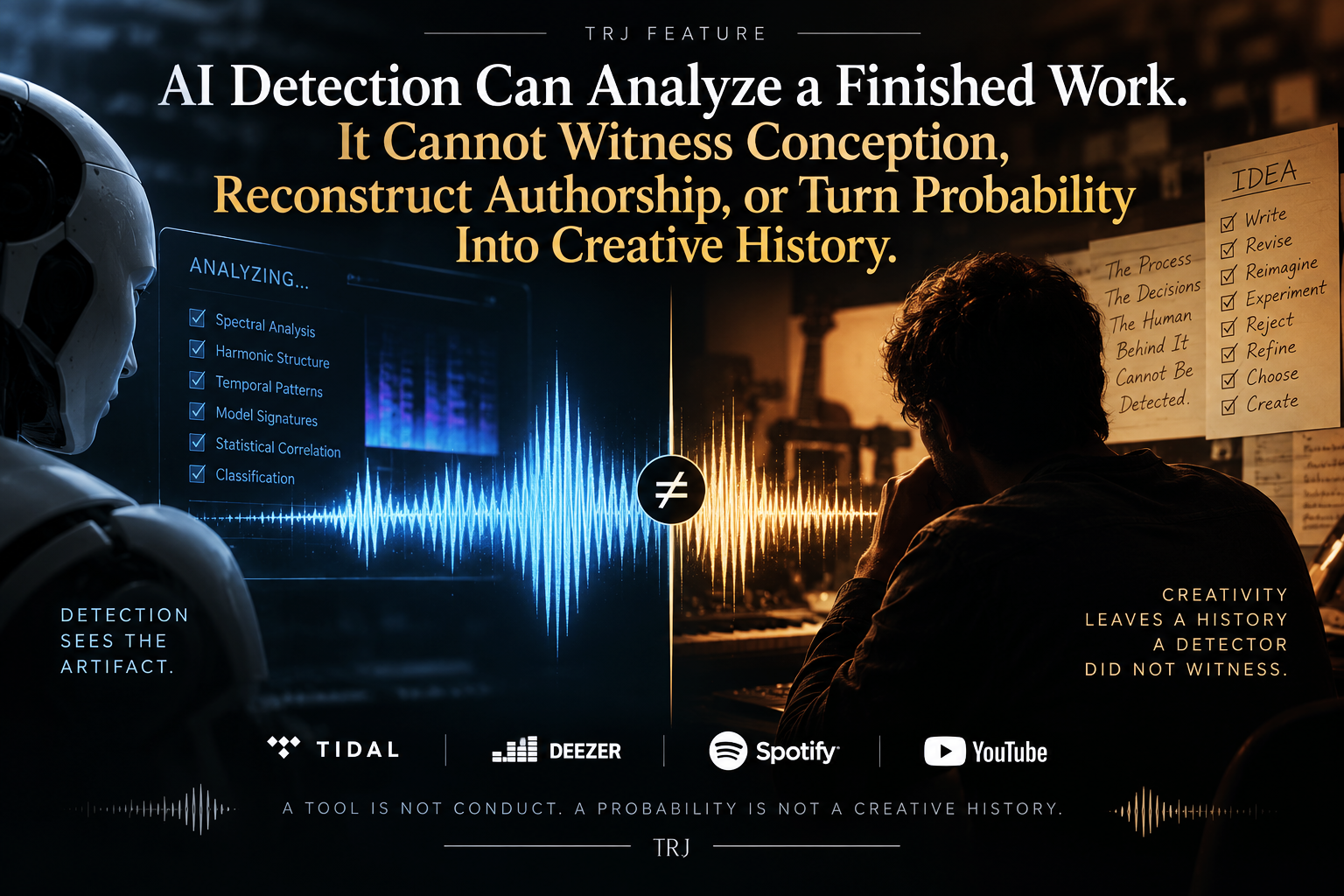
AI Detection Can Analyze a Finished Work. It Cannot Witness Conception, Reconstruct Authorship, or Turn Probability Into Creative History
Artificial intelligence has created a remarkable contradiction inside the modern creative economy. Companies concerned about AI-generated music, writing, photography, video, and other media are relying more heavily on automated systems—including machine-learning classifiers—to determine whether artificial intelligence was involved in creating the very material they are evaluating. In other words, one machine is being asked to judge the involvement of another machine, while the human creator can end up carrying the consequences of whatever conclusion that automated process reaches.
There are legitimate reasons for platforms to develop these systems. Generative technology can produce enormous quantities of material at extraordinary speed. Fraudulent streaming operations can exploit automation. Synthetic voices can impersonate established performers. Mass-produced recordings can flood distribution systems. Images and videos can depict events that never occurred. Written material can be generated at industrial scale. Platforms have an obligation to combat fraud, impersonation, deception, copyright violations, manipulation, and other genuine abuses. None of that requires pretending that every use of artificial intelligence represents the same conduct, and none of it changes a fundamental technical limitation: an AI detector can examine a finished artifact, but it was not present when that artifact was conceived.
That distinction is more important than it may initially appear. A detector may identify patterns, statistical relationships, metadata, model-associated artifacts, spectral characteristics, linguistic tendencies, pixel structures, or other measurable signals. Those findings can support a classification. They cannot independently reveal every decision that produced the finished work. The detector did not witness the first idea. It did not see the drafts that were discarded. It did not observe a songwriter rewriting a chorus, a photographer making compositional decisions, an author restructuring an argument, a producer replacing an arrangement, or a filmmaker deciding which generated element would survive the edit. It receives evidence after creation has already occurred and attempts to infer what happened before.
That is not conception. It is classification.
THE DIFFERENCE BETWEEN DETECTION AND KNOWING
Consider a finished music recording. An automated system can examine the waveform and search for characteristics associated with particular generative systems or production methods. Depending on the detector, that analysis could involve spectral information, harmonic relationships, transient behavior, phase characteristics, repetition, timing, noise patterns, encoding artifacts, frequency distributions, or statistical features learned from known examples. A sufficiently advanced classifier may become very effective at determining that a recording resembles material produced by a particular model.
That still does not tell the machine who created the song.
The final audio file does not contain a simple ledger identifying who conceived the subject, who wrote the lyrics, who selected the structure, who rejected previous versions, who directed the production, who changed the arrangement, who selected particular performances, who edited individual sections, who decided what should remain, who determined what should be removed, or who authorized the final master. Some of that information may exist elsewhere in project files, drafts, stems, timestamps, correspondence, session histories, production records, metadata, or other provenance evidence. It cannot necessarily be reconstructed from the audible characteristics of the final recording itself.
This distinction becomes even more important because many characteristics used for classification are not philosophical markers of authorship. Digital audio has been manipulated computationally for decades. Equalization, compression, limiting, pitch correction, synthesis, sampling, resampling, denoising, restoration, stem separation, mastering, time stretching, reverberation, saturation, codecs, vocal processing, and countless other technologies can materially alter a waveform. Machine learning is becoming embedded throughout this production environment. The presence of machine-associated characteristics therefore does not answer the larger question of who exercised creative control.
Different AI systems can also produce different artifacts. There is no single magical frequency that universally announces that artificial intelligence created a recording. A detector may instead recognize combinations of characteristics statistically associated with particular systems. Those correlations can become remarkably accurate without becoming eyewitness evidence of conception.
The technically defensible conclusion is consequently narrower and stronger: a detector may be capable of identifying characteristics associated with generative technology, but that does not independently establish the degree of human authorship, creative control, originality, legality, or entitlement to compensation behind the finished work.
YOU CANNOT DETECT CONCEPTION FROM A WAVEFORM
Imagine two recordings.
The first begins with a human creator developing an original concept and writing original lyrics. The creator determines the emotional direction, structure, pacing, arrangement, and overall identity of the song. Generative tools are incorporated into parts of the production. Multiple outputs are rejected. Others are modified. Sections are rearranged. Lyrics are revised. Production decisions are made repeatedly. The creator selects what survives, eliminates what fails, edits the resulting material, controls the final presentation, and authorizes the completed recording.
The second recording begins with someone entering a short prompt into a system and accepting an essentially completed generated song with little additional creative intervention.
A detector could potentially identify generative characteristics in both recordings.
Yet their creative histories are profoundly different.
The detector cannot solve that difference merely by becoming better at detecting AI-generated audio because detecting machine participation and measuring human authorship are different tasks. One concerns characteristics of an artifact. The other concerns the process through which the artifact came into existence.
The same problem applies to writing. A linguistic classifier may calculate that prose resembles material produced by a language model. It cannot see the writer researching the subject, developing an argument, correcting the model, rejecting paragraphs, rewriting conclusions, checking sources, supplying original reporting, or restructuring the entire document. An image classifier can inspect pixels, but those pixels do not automatically disclose every human decision involved in directing, compositing, editing, retouching, photographing, or constructing the image. A video classifier can examine frames without possessing firsthand knowledge of the production history that created them.
A probability score is not a creative history.
EVEN AN EXCELLENT DETECTOR CAN BE WRONG
This does not mean AI detection technology is useless. That claim would be both unnecessary and technically weak. Detection can be useful for triage, fraud investigations, platform security, content moderation, and identifying material that may warrant additional examination. A classifier can be highly accurate within the conditions for which it was designed while still remaining a probabilistic analytical tool rather than proof of authorship, creative history, or misconduct.
The problem begins when probability is treated as certainty.
False positives and false negatives are inherent concerns in classification systems. Improving a detector can reduce those errors, sometimes dramatically, but an impressive accuracy percentage does not make the consequences of an incorrect classification disappear. Scale makes this especially important. A hypothetical system with a false-positive rate of only 0.01 percent sounds extraordinarily reliable. Applied to 100 million genuinely human works, that same hypothetical error rate could produce 10,000 incorrect classifications.
For a technology company processing millions of files, those errors may appear as a small percentage on a performance chart. For a creator whose work is incorrectly classified, there is nothing statistical about the result.
Their work is the false positive.
If detection merely triggers additional investigation, the damage may be limited. If an automated classification produces a public label, suppresses recommendations, changes search visibility, affects distribution, influences audience perception, or alters compensation, the error has moved beyond technical analysis and entered somebody’s livelihood.
That requires a much higher standard.
TIDAL, DEEZER, AND THE INDUSTRY-LEVEL CONTRADICTION
TIDAL provides a particularly useful example of the tension developing between artificial-intelligence detection and human authorship because its policies openly recognize limitations in automated classification. TIDAL defines AI-generated content around the degree to which audio is generated through generative artificial intelligence with limited or no direct human creative input. It also acknowledges that AI identification is imperfect and that detection can produce false positives and false negatives.
That acknowledgment exposes the central problem. TIDAL’s standard concerns human creative input, while a detector primarily examines characteristics of the resulting recording. Those are not necessarily measurements of the same thing. Detecting evidence consistent with generative technology does not, by itself, establish how much human conception, writing, direction, selection, editing, arrangement, revision, production, or final creative control occurred before the finished recording reached the platform.
TIDAL has also recognized the danger of extending automated judgments beyond what present detection technology can reliably support. Its published AI policy has distinguished wholly AI-generated recordings from more complicated forms of AI-assisted or substantially AI-generated material while acknowledging the risk of false classification. That distinction is important because it demonstrates that even a platform deploying AI identification technology recognizes that determining machine involvement becomes considerably more difficult once human and generative processes are combined.
The stakes become substantially greater when classification extends beyond disclosure. If a platform can use an AI determination when deciding whether material receives recommendations, monetization, royalties, distribution, or another economic benefit, an incorrect classification is no longer merely a mislabeled file. It can become a commercial decision based partly on an inference about how the work was created.
Deezer illustrates the same issue from another direction. The company has invested heavily in automated AI-music detection and publicly described technology designed to identify characteristics associated with music-generation systems. Deezer has also reported extremely high detection performance for fully AI-generated recordings and has used its detection infrastructure to identify large volumes of synthetic music entering its service.
That technology may be genuinely sophisticated. It still does not eliminate the conceptual distinction between detecting synthetic characteristics and determining authorship.
A detector capable of recognizing characteristics associated with a generative model may provide evidence consistent with that model having contributed to the resulting audio. It does not automatically reveal what occurred before, during, and after that contribution. It does not inherently know whether a person wrote the lyrics, designed the composition, directed dozens of iterations, supplied performances, rearranged the result, replaced sections, edited individual elements, incorporated independently recorded material, or substantially transformed what the generative system produced.
The detector sees the artifact that survived the creative process.
It did not witness the process itself.
Deezer’s approach also demonstrates why accuracy percentages cannot completely resolve the issue. A detector can achieve extremely high reported accuracy while retaining some possibility of false classification. At platform scale, even a very small false-positive rate can affect real creators. More importantly, accuracy in identifying characteristics of fully synthetic recordings does not automatically establish equal reliability when evaluating hybrid works containing combinations of human performance, conventional digital production, AI-assisted processing, and generative material.
The closer creative production moves toward hybrid workflows, the more important that distinction becomes.
Spotify presents another variation of the problem. Its response to artificial intelligence has focused heavily on abuse involving impersonation, unauthorized voice cloning, deceptive uploads, spam, and manipulation of the streaming ecosystem. Those are legitimate enforcement targets because the underlying conduct can be identified: someone is impersonating another artist, attempting to manipulate streams, flooding the platform with abusive material, or otherwise exploiting the service.
That approach exposes a much cleaner principle for the industry.
Police the misconduct rather than treating the existence of a tool as the misconduct.
If someone uses artificial intelligence to impersonate an artist without authorization, the problem is impersonation. If someone operates an automated streaming farm, the problem is fraudulent manipulation. If copyrighted material is unlawfully exploited, the issue is infringement. If a person deliberately misrepresents synthetic audio as an authentic recording of somebody else, the issue is deception.
Artificial intelligence may facilitate each act.
It is not itself the act.
YouTube provides another useful comparison because its synthetic-content framework has attempted to distinguish meaningful alteration or generation from ordinary production assistance. Its disclosure rules recognize that AI can participate in editing, restoration, production assistance, idea development, and other processes without every such use necessarily requiring the same treatment as realistic synthetic material capable of misleading viewers.
That distinction matters enormously.
It acknowledges something the entire creative economy eventually has to confront: AI involvement exists on a spectrum.
A recording produced almost entirely from a single generative prompt is not technologically or creatively identical to a human-written composition containing an AI-generated instrument. Neither is identical to a traditionally recorded song processed through machine-learning mastering software. A photograph generated entirely from text is not identical to a camera photograph processed with AI denoising. A completely generated article is not identical to an independently researched and written article that passes through an AI-assisted grammar tool.
Collapsing all of those circumstances into a binary AI / NOT AI classification may be administratively convenient, but convenience does not make the classification intellectually accurate.
TIDAL, Deezer, Spotify, YouTube, and other major platforms are confronting a legitimate problem. Synthetic fraud is real. Unauthorized impersonation is real. Automated spam is real. Streaming manipulation is real. Consumer deception is real. Platforms need technological systems capable of operating at enormous scale, and automated detection will inevitably be part of that infrastructure.
The problem arises when the output of those systems is allowed to answer a question the systems did not actually observe.
A detector can reasonably contribute to the conclusion that artificial intelligence was involved.
That is not automatically equivalent to determining how it was involved, why it was involved, how much human creativity surrounded it, whether the creator exercised substantial control, whether the resulting work is original, whether anyone was deceived, whether misconduct occurred, or whether the human creator deserves compensation.
Those are separate questions requiring separate evidence.
The industry therefore faces a choice. AI detection can remain a screening and analytical instrument capable of identifying patterns or characteristics that may warrant further examination, without treating those findings as proof of authorship, misconduct, or creative legitimacy. Or companies can allow detection scores to evolve into automated judgments about authorship, legitimacy, visibility, and economic value.
The first approach uses artificial intelligence as a tool.
The second risks allowing one machine to decide whether another machine invalidated the human being standing between them.
And that is the contradiction at the center of using AI to police AI.
THE CONSUMER IS BEING GIVEN A CONCLUSION WITHOUT THE CREATIVE HISTORY
Platforms frequently justify AI labels through consumer transparency. TIDAL says its labeling is intended to help listeners understand what kind of content they are hearing and says artists should have freedom to create using AI while listeners should have autonomy over what they consume.
Consumer transparency is a legitimate objective.
The problem is that transparency becomes questionable when a simplified label communicates less nuance than the underlying reality.
Consider the enormous range of activities that can occur under the general heading of artificial intelligence. A creator might use AI to remove background noise. Another might use it for mastering. Another might generate an instrument. Another might use stem separation. A writer might use it to check grammar. A filmmaker might use it to remove an unwanted object. A photographer might use machine learning for denoising. A songwriter might direct generative instrumentation around entirely human-written lyrics. Another person might enter a sentence and accept an automatically generated finished song.
Those activities are not equivalent.
Calling all of them simply “AI” can collapse assistance, editing, generation, automation, and authorship into a single consumer-facing concept. A listener seeing an AI badge may reasonably interpret it to mean that a machine created the work rather than a person. If substantial human conception and creative control actually existed, the label can communicate an implication that the underlying detector did not establish.
Transparency should make information clearer.
It should not replace one ambiguity with another.
YOUTUBE DEMONSTRATES THAT A MORE NUANCED DISTINCTION IS POSSIBLE
YouTube’s current disclosure framework provides an instructive contrast because it recognizes that not every use of AI carries the same meaning. Its guidance says creators generally do not need to disclose minor or production-assistance uses including video sharpening, upscaling, repair, audio repair, idea generation, certain script assistance, and cloning one’s own voice for voiceovers or dubbing. Meaningfully altered or generated realistic material requires disclosure under the policy.
YouTube also explicitly states that an AI disclosure label alone does not reduce a video’s audience or affect its eligibility to earn money. Its May 2026 explanation says recommendations remain driven independently by audience signals rather than the presence of the disclosure itself.
The policy is not beyond criticism, and YouTube also uses automated detection in certain circumstances, carrying many of the same concerns surrounding accuracy, classification, transparency, and false positives. Recognizing a better distinction in one area does not make the broader system acceptable or eliminate the problems created when automated judgments are applied to human creative work. What matters for this discussion is the conceptual separation: disclosure does not inherently have to mean punishment, AI assistance does not inherently have to mean AI authorship, and detection does not inherently have to determine compensation. Those are policy choices.
YouTube’s monetization guidance also says creators can use automated tools and still qualify for monetization when the final product demonstrates creative vision and original value. Its concern is directed toward mass-produced, repetitive, generic, or manipulative material rather than treating the existence of AI tooling alone as dispositive.
That distinction matters because it moves the inquiry closer to conduct and creative contribution instead of technological purity.
THE REAL TARGET SHOULD BE FRAUD, NOT THE TOOL
There are serious abuses occurring around generative technology, and creators themselves have substantial reasons to demand enforcement against them. Voice cloning without authorization can impersonate musicians. Synthetic images can falsely depict real people. Automated systems can produce enormous quantities of low-effort material designed to manipulate recommendation systems. Streaming farms can generate fraudulent plays. Copyrighted material can be misappropriated. Fake identities can exploit legitimate artists’ reputations.
Those behaviors deserve scrutiny, but the common element is misconduct, not the mere presence of artificial intelligence. Fraud, impersonation, copyright infringement, streaming manipulation, deception, and unauthorized cloning are forms of conduct; AI is a tool. Confusing the tool with the misconduct produces an enforcement system that risks punishing legitimate creators while failing to distinguish why the genuinely abusive activity was wrong in the first place.
A photographer using AI-assisted denoising has not thereby committed fraud. A musician incorporating a generated instrument has not thereby impersonated another artist. An author using a language model during editing has not thereby plagiarized somebody else’s work. A filmmaker using generative technology to construct a fictional environment has not thereby deceived an audience about a real event.
The relevant question should be what the person did with the technology.
A tool is not conduct.
HUMAN CREATIVITY DOES NOT DISAPPEAR WHEN A MACHINE ENTERS THE WORKFLOW
Creative history is filled with technologies that changed what artists could accomplish. Photography challenged painting. Recorded music changed performance. Synthesizers changed instrumentation. Sampling changed composition. Digital editing changed photography. Computer graphics changed filmmaking. Digital audio workstations changed music production. Autofocus changed photography. Spell-checkers changed writing. Algorithms already shape compression, mastering, noise reduction, recommendation, search, distribution, and countless other processes used every day.
The introduction of a sophisticated tool does not automatically remove the person directing it.
The U.S. Copyright Office’s work on artificial intelligence and copyright has similarly centered the importance of human authorship rather than adopting the simplistic proposition that any use of AI eliminates copyrightability. That distinction between human-authored expression and material generated by a machine is precisely why the creative process matters. A finished artifact alone does not always explain where one ends and the other begins.
That is precisely why platforms should not position themselves—or automated detection systems—as arbiters of human creativity. Their legitimate responsibility is to address fraud, impersonation, infringement, manipulation, deception, and other identifiable misconduct, not to infer from a finished artifact how much creativity belongs to the human who made it. Once a probabilistic detection system is allowed to make that judgment, particularly when the result can affect labeling, visibility, reputation, distribution, or compensation, technological classification has crossed into something fundamentally different: an automated judgment about human authorship.
The relevant question should therefore not be: Did a machine participate?
The more important question is: Did any actual misconduct occur?
Those are radically different standards.
PROVENANCE IS STRONGER THAN GUESSING
Provenance still has an important place in the synthetic era, but its purpose should not be to replace one system for judging human creativity with another. Original project files, stems, photographs, RAW files, drafts, revision histories, timestamps, recording sessions, handwritten notes, source material, production logs, exports, correspondence, generation histories, editing histories, metadata, publishing records, registrations, and other documentation can help creators establish ownership, preserve the history of their work, and defend themselves when their material is falsely classified, misappropriated, impersonated, or challenged.
That is fundamentally different from requiring creators to prove to a platform that they were sufficiently human in order to have their work treated as legitimate.
A creator should not have to produce a digital chain of evidence merely because an automated detector generated a probability score. The burden should not automatically shift to the artist, musician, writer, photographer, filmmaker, or other creator to disprove a machine’s inference about work that the machine did not witness being created.
Future authentication technologies—including cryptographic provenance, signed metadata, verifiable creation records, content credentials, and documented editing histories—may provide valuable tools for protecting ownership and establishing the origin of material when authenticity is genuinely disputed. They should not become mandatory technological passports through which corporations determine whether a person’s creative process qualifies for visibility, distribution, compensation, or recognition.
How a creator lawfully develops a work, which tools are used during that process, and how those tools are incorporated into the creator’s own creative decisions are not matters that should automatically be subjected to corporate inspection simply because artificial intelligence may have participated somewhere in the workflow. Requiring creators to document or expose their private creative process merely to overcome an automated suspicion would represent a serious intrusion into creative autonomy and could become especially troubling when refusal results in economic or reputational consequences.
Provenance can help creators establish the origin, ownership, history, and integrity of their own work when they choose to use it for those purposes. It can document when material existed, how it developed, and whether it was later altered, copied, misrepresented, or appropriated by another party.
What provenance should never become is another gatekeeping mechanism that forces creators to prove their legitimacy simply because a machine produced a classification about their work.
The distinction matters. Detection may identify patterns or characteristics associated with particular technologies, but those observations do not establish misconduct, authorship, or the legitimacy of a person’s creative process. Provenance belongs first and foremost to the creator as a means of protecting ownership and authenticity, not to corporations as a compulsory mechanism for inspecting, grading, or approving how someone creates.
A machine-generated probability should not automatically shift the burden onto the creator. Private drafts, project files, production histories, generation records, editing decisions, and other elements of a lawful creative process should remain under the creator’s control unless there is a legitimate reason to disclose them. The existence of an automated suspicion does not create an obligation for the human being to prove innocence.
A pattern detected in a finished work may have resulted from any number of AI-assisted or computational tools used throughout the creative and production process, especially when multiple systems were involved. Detecting that pattern does not establish which tool produced it, how that tool was used, what role it played in the finished work, or whether any misconduct occurred at all. A technological signature is not proof of wrongdoing, and it is not proof that human creativity was absent.
THE MORE AI ENTERS EVERYTHING, THE LESS USEFUL THE BINARY BECOMES
There is another problem waiting beyond today’s debate. Artificial intelligence is not remaining confined to standalone generators. Machine learning is entering cameras, smartphones, recording software, mastering suites, editing applications, search systems, writing software, graphics tools, restoration systems, operating systems, and professional production environments. As that integration expands, the binary distinction between “AI” and “not AI” becomes more difficult to defend as a complete description of creative work. Computational photography can incorporate AI without transforming every photograph into an AI-generated image, just as AI-assisted mastering, automated noise removal, stem separation, intelligent equalization, generative fill, translation, writing assistance, or an automatically generated backing instrument does not automatically transfer authorship of an entire work to a machine. Replacing or generating one second of a four-minute recording does not logically establish that artificial intelligence created the remaining four minutes, either. These examples demonstrate why searching for a machine fingerprint and stopping the analysis there cannot responsibly determine authorship or creative control.
The creative economy also cannot solve this problem simply by creating an expanding collection of labels for human-created, AI-assisted, AI-edited, partially generated, substantially generated, fully generated, synthetic, or automated material. As creative technologies continue to overlap, those classifications can become another attempt to reduce complicated creative processes to simplified technological categories. What ultimately matters when enforcement is necessary is whether actual misconduct occurred, such as fraud, impersonation, infringement, manipulation, or deception—not merely whether artificial intelligence participated somewhere in a lawful creative workflow.
Anything less risks reducing an extraordinarily complicated technological transformation to a badge and allowing that badge to say far more about the creator than the underlying technology can actually prove.
USING AI TO POLICE AI CREATES AN ACCOUNTABILITY PROBLEM
There is an unavoidable irony in placing automated classifiers at the center of an anti-AI enforcement regime. Platforms can express skepticism about artificial intelligence when it participates in creative work while simultaneously relying on automated systems to determine whether that same technology participated in the work they are evaluating. Consumers can then be presented with labels or classifications that appear definitive even though the underlying determination may have originated from another machine analyzing patterns and probabilities within the finished artifact.
The contradiction becomes more serious when those automated conclusions extend beyond identifying possible technological characteristics and begin influencing how human creativity is treated. A platform may question whether artificial intelligence participated too heavily in a creative process while allowing another automated system to make consequential judgments about that process without ever having witnessed how the work was conceived, developed, directed, edited, or completed.
That does not mean automated systems have no legitimate analytical purpose. They may identify patterns, anomalies, or characteristics that warrant examination, but their conclusions should not be treated as proof of authorship, absence of human creativity, or misconduct. A detector identifying a technological characteristic is not the same as establishing what happened during the creation of the work.
The accountability problem becomes especially serious when an automated classification can affect a creator’s reputation, visibility, distribution, or income. A creator should not be forced to expose private project files, drafts, production histories, generation records, or other elements of a lawful creative process merely to disprove a machine-generated suspicion. If a platform chooses to impose a consequential classification, the responsibility should remain with the platform to justify that decision rather than automatically shifting the burden onto the creator to prove that the machine was wrong.
Any system capable of producing those consequences should therefore provide meaningful notice, a clear method for challenging an incorrect classification, genuine human review when a determination is disputed, and prompt correction when an error is established. The existence of automated detection does not give a platform unquestionable authority over the legitimacy of human creativity, nor should a probability score become sufficient grounds for treating a creator as though misconduct has occurred.
A detector may be an analytical instrument. It should never quietly become judge, jury, and accountant.
THE FALSE-POSITIVE PROBLEM WILL NEVER BECOME A PHILOSOPHICAL ZERO
AI detectors will improve, and some will become extraordinarily capable as provenance technologies advance, model-specific signatures evolve, generators change, and detection systems adapt in response. None of that removes the foundational limitation that a detector analyzes what survived the creative process rather than witnessing the process itself. It cannot experience creative intention, know which outputs were rejected, understand why particular revisions were made, or distinguish the human judgments, instincts, experiments, and decisions that shaped the finished work. The detector can identify technological characteristics within the resulting artifact, but it cannot convert those characteristics into omniscient knowledge of how, why, or by whom the work was actually created.
THE STANDARD HAS TO BE BETTER
The future of creative technology cannot reasonably depend upon pretending that every use of artificial intelligence is equivalent. Neither creators nor consumers benefit from reducing complex creative processes to a binary judgment based solely on whether AI participated somewhere in the workflow.
Platforms have legitimate reasons to combat synthetic fraud, unauthorized impersonation, streaming manipulation, copyright infringement, deceptive practices, and other identifiable forms of misconduct. Those actions should be addressed because of the conduct involved, not because artificial intelligence happened to be one of the tools used to carry it out. Detection technology may identify patterns or characteristics worth examining, but platforms must recognize the limits of what those findings can actually establish.
If an automated classification can carry economic or reputational consequences, a creator must have a meaningful opportunity to challenge it, and the burden should not automatically fall on that creator to expose private drafts, project files, production histories, or other elements of a lawful creative process simply because a machine generated a suspicion. AI assistance should not automatically be equated with autonomous generation, and the presence of machine-associated characteristics should not be treated as evidence that human creativity was absent or that misconduct occurred. A probability cannot become a declaration of creative history simply because a computer generated the probability.
The irony of using AI to police AI may be unavoidable as platforms attempt to manage enormous volumes of digital content, but allowing those systems to become unquestionable authorities over human creativity is not. The standard has to be better: identify and address actual misconduct, recognize the limitations of automated detection, and stop treating technological participation as though it were evidence of creative illegitimacy.
TRJ VERDICT
Artificial intelligence can analyze a song, paragraph, photograph, or video with extraordinary sophistication, identifying patterns invisible to human senses, comparing enormous numbers of examples, and recognizing statistical relationships no person could reasonably calculate unaided. Those capabilities will continue improving, and detection technology may have legitimate applications in identifying potential fraud, impersonation, manipulation, or deception, but technological sophistication does not eliminate the fundamental boundary at the center of this debate: a detector cannot travel backward through time and witness conception.
Music production itself demonstrates the problem. A finished recording is not simply the sound that originally entered a microphone or appeared inside a digital audio workstation. Mixing can involve balancing levels, equalization, compression, effects, automation, spatial processing, editing, and numerous other decisions that reshape the recording. Mastering then processes the completed mix further, controlling dynamics, tonal balance, loudness, cohesion, and final delivery characteristics. Modern production can add noise reduction, stem separation, restoration, intelligent processing, encoding, re-encoding, and other computational or AI-assisted tools on top of that chain. By the time a detector analyzes the finished waveform, it may be examining the accumulated fingerprints of numerous processes rather than a clean technological signature revealing how the music was conceived. Research into AI-music detection reinforces that problem by showing that ordinary audio processing—including equalization, compression, mastering, re-encoding, remixing, pitch shifting, and time stretching—can alter spectral characteristics in ways that complicate the distinction between edited and AI-generated audio.
That matters because a detector receives the finished artifact, not the history behind it. It did not hear the original recording before processing, inspect every track and stem, watch the mix develop, observe the mastering chain, or know which tool introduced a particular characteristic. Finding a pattern in the final waveform does not establish which process created that pattern, what role artificial intelligence played, how much human creative control existed, or whether misconduct occurred at all.
A detector can identify a pattern without knowing the author behind every creative decision that produced the finished work. It can calculate probability without transforming that probability into firsthand knowledge, and it can identify characteristics associated with artificial intelligence without determining from those characteristics alone whether the human creator contributed very little, contributed substantially, or maintained creative direction and control throughout the process.
When platforms ignore that distinction, detection stops functioning merely as an analytical instrument and begins assuming authority it was never capable of possessing. The creative industries should not fear technology; they should reject bad standards that confuse technological participation with wrongdoing and statistical inference with knowledge of authorship.
Fraud should be addressed because it is fraud, impersonation because it is impersonation, infringement because it is infringement, manipulation because it is manipulation, and deception because it is deception. Those are identifiable forms of conduct. The presence of artificial intelligence somewhere in a creative workflow is not itself misconduct, and creators should not be forced to prove the legitimacy of their creativity merely because another machine detected a pattern it associates with AI.
Consumers deserve protection when synthetic technology is deliberately used to deceive them, such as through fraudulent impersonation, fabricated events, deceptive deepfakes, or other intentionally misrepresented content. That is fundamentally different from an artist lawfully using AI or AI-assisted tools within a creative process. Consumers also deserve accurate information, and a platform should not present an automated inference as though a machine somehow discovered the complete truth of how a legitimate work was conceived, developed, directed, edited, mixed, mastered, and completed when the system actually analyzed characteristics contained in the finished artifact.
You cannot detect conception from a waveform. A machine can analyze what survived the recording, mixing, mastering, and creative process, but it cannot witness the human decisions that created it. No matter how advanced detection becomes, a probability score will never be the moment the work was born.
That responsibility runs both ways. Protecting consumers from deception cannot justify giving consumers potentially deceptive information in return. If a platform applies an AI-generated label, classification, or other representation that implies something about a work’s authorship or creative origin that its detection system cannot actually establish, the platform risks creating the very misinformation it claims to be preventing. A probabilistic inference should not be presented to the public as a verified fact. Consumer protection requires accuracy from the platform, too.
Distinguishing AI-Generated Music from Edited Audio as a Hard-Negative Robustness Task” — Research examining AI-generated music detection and the difficulty of distinguishing synthetic-audio characteristics from artifacts introduced through ordinary audio editing and production processes. (Free Download)
Copyright and Artificial Intelligence, Part 2: Copyrightability — Official U.S. Copyright Office report addressing human authorship, AI-assisted creative work, and the circumstances under which human-authored expression remains copyrightable when artificial intelligence is involved in the creative process. (Free Download)
TRJ Black File — What AI Detection Actually Sees
A detector analyzes the finished artifact. It does not witness the creative process that produced it.
SIGNAL #001 — Spectral Characteristics
Audio classifiers can examine frequency distributions, spectral relationships, harmonic structures, noise characteristics, and other measurable properties contained in a finished recording. These characteristics can support classification, but they do not independently reveal who conceived or directed the work.
SIGNAL #002 — Waveform Patterns
Timing, transients, repetition, dynamics, phase relationships, and other waveform characteristics can provide information about how audio behaves. A pattern associated with generative technology remains a pattern detected after creation—not a firsthand record of conception.
SIGNAL #003 — Model-Associated Characteristics
Detection systems may learn combinations of characteristics statistically associated with particular generative systems. Finding those characteristics can provide evidence consistent with technological involvement, but it does not automatically establish how that technology was used or how much human creative control surrounded it.
SIGNAL #004 — The Production Chain Changes the Evidence
Equalization, compression, limiting, mastering, denoising, restoration, stem separation, pitch processing, time stretching, codecs, re-encoding, intelligent processing, and other production tools can materially alter the finished signal. Multiple processes can therefore leave characteristics inside the same final artifact.
SIGNAL #005 — Classification Is Probabilistic
AI detectors operate through classification and inference. False positives and false negatives can occur. Greater accuracy can reduce error, but it does not transform a probability into direct knowledge of the creative history behind a work.
SIGNAL #006 — Conception Is Outside the Waveform
The finished recording does not contain a complete ledger of who developed the concept, wrote the lyrics, rejected previous versions, selected an arrangement, changed individual elements, directed revisions, chose what survived, or authorized the final master.
SIGNAL #007 — Detection Is Not Proof of Misconduct
Detecting characteristics associated with artificial intelligence does not independently establish fraud, impersonation, infringement, manipulation, deception, absence of human authorship, or creative illegitimacy. Those are separate determinations requiring separate evidence.
The detector sees what survived the process. It did not witness the process.
You cannot detect conception from a waveform. A probability is not a creative history.





🔥 NOW AVAILABLE! 🔥
🔥 NOW AVAILABLE! 🔥
📖 INK & FIRE: BOOK 1 📖
A bold and unapologetic collection of poetry that ignites the soul. Ink & Fire dives deep into raw emotions, truth, and the human experience—unfiltered and untamed
🔥 Kindle Edition 👉 https://a.co/d/9EoGKzh
🔥 Paperback 👉 https://a.co/d/9EoGKzh
🔥 Hardcover Edition 👉 https://a.co/d/0ITmDIB
🔥 NOW AVAILABLE! 🔥
📖 INK & FIRE: BOOK 2 📖
A bold and unapologetic collection of poetry that ignites the soul. Ink & Fire dives deep into raw emotions, truth, and the human experience—unfiltered and untamed just like the first one.
🔥 Kindle Edition 👉 https://a.co/d/1xlx7J2
🔥 Paperback 👉 https://a.co/d/a7vFHN6
🔥 Hardcover Edition 👉 https://a.co/d/efhu1ON
Get your copy today and experience poetry like never before. #InkAndFire #PoetryUnleashed #FuelTheFire
🚨 NOW AVAILABLE! 🚨
📖 THE INEVITABLE: THE DAWN OF A NEW ERA 📖
A powerful, eye-opening read that challenges the status quo and explores the future unfolding before us. Dive into a journey of truth, change, and the forces shaping our world.
🔥 Kindle Edition 👉 https://a.co/d/0FzX6MH
🔥 Paperback 👉 https://a.co/d/2IsxLof
🔥 Hardcover Edition 👉 https://a.co/d/bz01raP
Get your copy today and be part of the new era. #TheInevitable #TruthUnveiled #NewEra
🚀 NOW AVAILABLE! 🚀
📖 THE FORGOTTEN OUTPOST 📖
The Cold War Moon Base They Swore Never Existed
What if the moon landing was just the cover story?
Dive into the boldest investigation The Realist Juggernaut has ever published—featuring declassified files, ghost missions, whistleblower testimony, and black-budget secrets buried in lunar dust.
🔥 Kindle Edition 👉 https://a.co/d/2Mu03Iu
🛸 Paperback Coming Soon
Discover the base they never wanted you to find. TheForgottenOutpost #RealistJuggernaut #MoonBaseTruth #ColdWarSecrets #Declassified


Sponsored • TRJ Ads
Inquiries: contact@therealistjuggernaut.com




Comment on “USING AI TO POLICE AI: WHEN A MACHINE’S GUESS BECOMES A VERDICT ON HUMAN CREATIVITY”