Thank you for reading or listening to The Realist Juggernaut. Independent journalism should be accessible to everyone.
ARIA can count a stream, sale, or download. Just as Apple and other platforms cannot, ARIA cannot listen to a finished recording and determine who conceived it, wrote it, directed it, revised it, arranged it, produced it, integrated its elements, approved it, or authorized its release. Australia’s official chart organization is moving beyond measuring consumer activity and claiming authority over which forms of human-directed creation deserve recognition. The same institutional system is already spreading into films, screenplays, acting performances, awards, grants, and professional development programs.
On August 25, 2026, the Australian Recording Industry Association announced that recordings it classifies as AI-generated will no longer qualify for the ARIA Charts. The restrictions take effect with the chart dated August 31, 2026, published August 28.
ARIA may reject or remove a recording, alter chart positions, withdraw accreditations, revoke a No. 1 Award, demand the return of that award, and declare the recording ineligible for an ARIA Award. Albums will be examined track by track, and any recording ARIA considers ineligible will not contribute to the album’s chart performance. Anyone who considers this a positive development is supporting another expansion of corporate control over independent creativity. Human beings have once again done what powerful institutions have repeatedly done: construct another barrier that makes it harder for ordinary people to create opportunities, earn money, and compete against those already protected by wealth, influence, and industry connections.
This is not a minor technical adjustment. ARIA is no longer measuring what Australians choose to hear and purchase. It is deciding which lawful consumer choices deserve to count based upon an institutional judgment about how much technology an artist is permitted to use.
That judgment cannot be established from a finished audio file, and no institution should be permitted to present such a judgment as verified fact.
A completed recording does not reveal who originated the concept, wrote the lyrics, selected the genre, established the emotional direction, requested changes, rejected unwanted results, rearranged the structure, edited the sections, shaped the production, applied effects, approved the master, owned the release, or made the final decision to publish it.
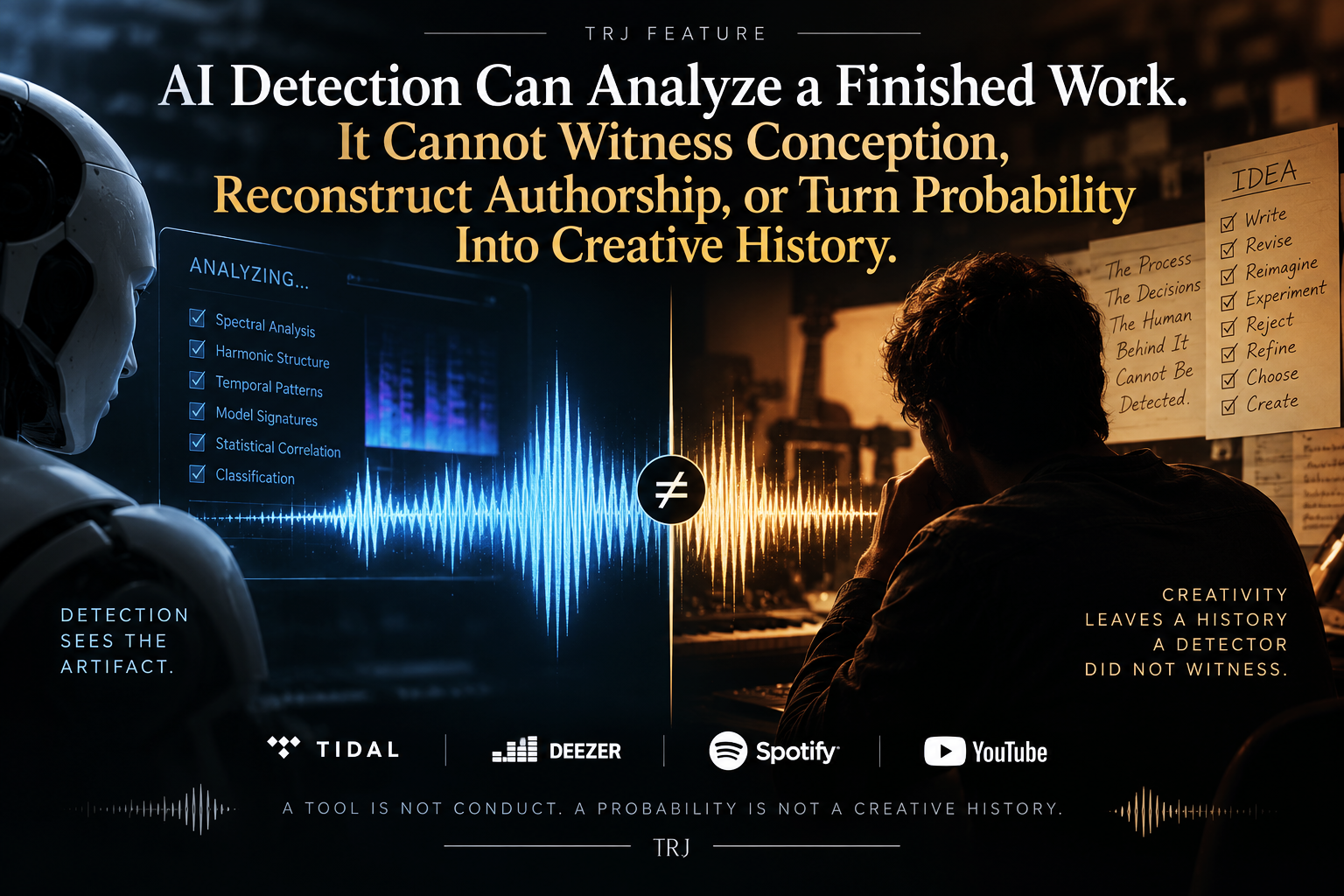
A waveform contains audio information. It does not contain a complete creative history.
ARIA defines an AI-generated recording as one in which generative artificial intelligence produced the entirety or primary portion of the creative elements. Its official examples include an AI-generated lead vocal, an AI-generated key instrumental performance, or entirely prompt-generated music.
Under that rule, a musician could write every lyric, develop the entire concept, choose the genre, direct the sound, revise the structure, reject multiple versions, edit the recording, arrange its sections, integrate original material, mix the audio, approve the master, own the rights, and authorize the release. ARIA may still classify the finished recording as ineligible because a generated voice performed the lead vocal or a generated system supplied what ARIA considers a key instrumental performance.
That policy does not protect human authorship. It disregards human authorship that does not fit ARIA’s preferred production model. Official policies, technical specifications, platform disclosures, copyright guidance, and published research documented throughout this continuing investigation repeatedly establish that AI-assisted production and human authorship are not mutually exclusive.
Human creativity is not confined to physically singing into a microphone or manually performing every primary instrument. Songwriting is human creation. Lyrics are human expression. Creative direction is human judgment. Selection and rejection are human decisions. Arrangement, revision, editing, integration, production, and final authorization are human acts.
The principle is straightforward: even when a person writes the lyrics, selects the genre and creative pathway, and directs an AI system to generate the remaining musical elements, the resulting track contains human authorship, intention, and creative control. No institution can accurately characterize that process as entirely AI-generated when the concept, lyrics, direction, selections, and authorization originated with a human creator. It is a human-directed creative work.
The same principle applies when AI-powered software transforms a human vocal performance. The software may recreate, modify, extend, or generate variations of the voice, but the underlying performance, direction, selections, and production decisions remain human contributions. Labeling the entire recording as AI-generated because AI transformed the vocal would erase the human performance that entered the system and the human judgment that controlled the finished result.
Our artist name has changed from ECLIPSERA to ISCREEM. Long before any platform imposed an AI label upon our catalog, we openly disclosed that artificial intelligence contributed to portions of our music. That disclosure should remain the responsibility of the artist, not a corporation. ISCREEM recordings combine AI-assisted elements with human-recorded tracks, and every finished work reflects substantial investments of time, judgment, direction, authorship, editing, and production. Some tracks contain human vocals, AI-generated vocals, or both. That transparency does not authorize any corporation to falsely characterize the entire catalog as wholly AI-generated, erase the human contributions within it, or use an inaccurate classification to deny recognition or compensation.
All contain human-written lyrics and are shaped through human-selected genres and creative direction. I have combined original beats with AI-generated material, deconstructed and rearranged individual elements, rebuilt them into unified compositions, and added original vocals, effects, edits, and production decisions. These recordings did not conceive, create, complete, own, authorize, or release themselves. They are human-directed works produced and controlled by their lawful rights holder.
No corporation should be permitted to use that production process as justification for withholding payment or interfering with royalties generated by lawful purchases and genuine streams. I will continue fighting public labels that mischaracterize my music, damage its commercial value, or undermine the human authorship embodied within it. That harm does not stop with an individual recording. It extends to the name, reputation, credibility, and commercial interests of The Realist Pix Corp., The Realist Pix Music, ISCREEM, The Realist Juggernaut, Tethered Realities, and every connected property operating under the same ownership and public identity.
The mainstream music industry has created another system capable of protecting established corporate interests while placing independent artists at greater risk. Major labels possess direct platform relationships, attorneys, internal production records, established distributors, and the influence necessary to challenge or prevent unwanted classifications. Independent artists are left to navigate automated forms, undisclosed standards, private reviews, and institutional appeals after the damage has already begun. The same industry that developed, marketed, licensed, and sold AI-powered creative tools is now constructing penalties around the independent creators who used those tools exactly as they were encouraged to use them.
The Realist Pix Music will pursue all available legal remedies against any company that applies unsupported classifications to our catalog and then uses those classifications to deny compensation generated by our work. A platform cannot collect subscription revenue, make our recordings available to paying listeners, benefit from the streams those recordings generate, and then declare that the lawful rights holder receives nothing. If a company commercially benefits from our music while withholding, excluding, or reallocating compensation that rightfully belongs to us, we will seek removal of the disputed classifications, a complete accounting, restoration of all compensation, damages arising from the conduct, and every other remedy available under applicable United States, foreign, and international law.
Artificial intelligence does not independently enter a studio, choose an artistic concept, establish a commercial identity, approve a finished recording, claim ownership, sign a distribution agreement, or release music to an audience. A human initiates the process, supplies direction, makes choices, and decides whether the resulting material becomes part of a finished work.
ARIA’s policy undermines those contributions by isolating selected AI-assisted elements—including vocals, instrumentation, composition, arrangement, and other expressive components—and treating them as more determinative than the complete human-controlled creative process that conceived, directed, assembled, revised, produced, authorized, and released the finished work.
The contradiction becomes clearer in ARIA’s own published examples. One thing to realize here is that each of these companies has very different rules concerning how it labels AI-contributed songs.
ARIA accepts AI mastering, stem separation, reverb, AI drum machines, short generated samples, instrument patches played by people, backing vocals, and certain voice transformations. It says these uses can remain eligible because AI functioned as assistance or production technology.
ARIA therefore acknowledges that artificial intelligence can alter a recording, separate its components, process its sound, generate rhythmic material, transform vocals, supply background elements, and contribute to the final master without eliminating human creativity. Its contradiction appears when the same organization treats AI involvement as compatible with human authorship in approved production roles but uses it to override or disregard human authorship when ARIA decides that the contribution was “primary.”
The technology does not suddenly erase the human creator because ARIA disapproves of where it was used. ARIA adds another expectation through its dispute process. It states that when it questions a recording, the artist or representative will be contacted and given an opportunity to “respond with evidence supporting the recording’s eligibility.” ARIA will then make its assessment, followed by possible review through the ARIA Chart and Marketing Committee and the ARIA Board.
That process shifts the burden onto the creator to defend a private production history because ARIA raised a concern. ARIA and other institutions do not own an artist’s project files, stems, prompts, software configurations, recording sessions, drafts, generation history, or proprietary production methods. Those materials belong to the creator and may contain trade secrets, unreleased work, confidential techniques, contractual information, and intellectual property. No company should be permitted to pressure a creator into surrendering those materials as the price of avoiding an unsupported classification. The creation belongs to its lawful rights holder—period.
ARIA then draws its own institutional boundary. AI may participate in selected portions of a recording, but if ARIA decides that it supplied a primary creative element, the completed work may be excluded. ARIA creates the definition, raises the concern, requests the evidence, evaluates the creator’s private process, imposes the classification, and controls every stage of the internal appeal.
That boundary does not arise from the listener’s decision, the rights holder’s ownership, the legality of the release, or proven misconduct. It arises from ARIA’s opinion about which production functions deserve institutional acceptance.
An AI drum machine can provide the central rhythm of a song. A generated backing vocal can carry its defining hook. A mastering system can transform the sound of an entire recording. Stem separation can make a remix possible. Vocal processing can alter tone, texture, pitch, identity, and expression. Synthesizers and software instruments can produce nearly every sound an audience hears.
ARIA accepts these technologies while declaring that another generated element may disqualify the work. That is not a reliable measurement of humanity. It is a hierarchy of approved and disapproved tools.
The same contradiction exists throughout the music industry and is now spreading into other creative industries as well.
Technology companies sell musicians AI-powered instruments, session performers, stem separators, mastering systems, vocal processors, mixing assistants, drum generators, noise-removal systems, harmony tools, sound generators, and synthetic voices. These products are marketed as professional creative tools that help artists build, process, and complete recordings.
Once an independent artist uses generative technology to produce a finished track, another industry organization may decide that the technology performed too much of the process. The tool sold as creative empowerment becomes grounds for exclusion.
Corporate AI remains innovation.
Artist-directed AI becomes disqualification.
A credible concern is not proof. A report, suspicion, algorithmic estimate, sonic resemblance, metadata dispute, or accusation from another party cannot reconstruct a production history.
Once the concern is raised, the artist is placed in the position of defending the work. The creator may be expected to produce information about private project files, stems, drafts, vocal sessions, software, revisions, production decisions, or proprietary materials to preserve recognition generated by actual listeners.
ARIA says artists may contest a decision through its Chart and Marketing Committee and then its Board. An internal appeal does not eliminate the original problem. ARIA creates the classifications, defines the threshold, receives the declaration, evaluates the evidence, imposes the consequence, conducts the review, and makes the final decision.
How is that fair? Post Malone has publicly acknowledged performing with Auto-Tune on more than one occasion. During his April 24, 2020 Nirvana tribute livestream, he joked about performing without Auto-Tune and acknowledged his limitations as a singer. He made a similar joke before a Governors Ball audience in 2021, again openly referencing his reliance on Auto-Tune. His use of vocal-processing technology is not the problem, and this is not an attack on him. For years, critics have openly mocked or criticized his reliance on Auto-Tune, yet his recordings remain commercially accepted, charted, monetized, and treated as legitimate music. The comparison raises a legitimate question: why should one technologically assisted production method remain fully accepted while another can trigger investigation, disclosure demands, exclusion, or loss of recognition?
The problem is whether a major-label artist’s technologically processed vocals remain accepted while an independent artist using comparable or more advanced production tools is investigated, forced to disclose proprietary methods, or excluded. If our recording performs better, ARIA should count what listeners actually chose—not protect one production method while punishing another according to corporate influence, private classifications, or the institutional power behind the artist.
These organizations appoint themselves rulemaker, investigator, decision-maker, enforcement authority, and appellate body. They create the classifications, define the thresholds, demand the evidence, determine whether that evidence is sufficient, impose the consequences, and ultimately decide whether they were right. That is not independent review. It is institutional power policing itself.
ARIA also says it will not publish a list of recordings it has assessed or excluded and will not comment publicly on individual decisions. That prevents artists and the public from comparing outcomes across major-label releases, independent music, electronic genres, experimental work, processed vocals, remixes, and other technology-driven production styles.
A system cannot demonstrate consistent enforcement while concealing the individual decisions through which consistency would be evaluated.
ARIA acknowledges that independent artists fear the rules could be used to keep them off the charts. Publishing a rule does not guarantee equal practical treatment.
Major record companies possess attorneys, direct platform relationships, established production teams, internal documentation, professional distributors, and the financial resources to contest an unwanted classification. Independent creators frequently work alone, use consumer software, collaborate remotely, subscribe to production tools, and distribute through automated systems.
The same evidentiary demand can place a much greater burden upon an independent artist than an institutionally protected performer.
ARIA’s charts are calculated from Australian sales and streaming activity reported by participating retailers and digital platforms. Recordings distributed through DistroKid to Apple Music, Spotify, YouTube Music, Deezer, and other participating services can reach Australian listeners and generate genuine consumer activity. Those listeners, subscriptions, streams, downloads, and purchases remain real regardless of the production tools used to create the recording. ARIA’s decision to exclude a human-directed work does not make its audience artificial, erase its legitimate consumption, or invalidate the public’s choice because ARIA disapproves of part of the creative process.
Fraudulent streams, automated manipulation, false purchases, impersonation, infringement, deception, and unauthorized cloning are separate allegations that must be established through reliable evidence and handled under applicable law, contractual rights, and independent due process. They cannot be presumed from the presence of AI, determined from a finished recording alone, or used as justification for labeling, excluding, suppressing, or withholding compensation from human-directed creative work.
A lawful stream from a genuine listener is not fraudulent because the recording contains generated elements.
ARIA’s policy changes the function of the chart. Instead of measuring which recordings received the most Australian consumption, it first decides which creative methods qualify for entry. Popularity is measured only after ARIA excludes production methods it refuses to recognize.
That is not an unfiltered account of what Australians consumed. It is an institutionally filtered account of which consumption ARIA decided deserved recognition.
The consequences extend beyond a weekly position. Charts and awards affect publicity, discovery, licensing, booking opportunities, advertising, professional reputation, historical recognition, and future commercial negotiations.
ARIA claims that its rules do not determine royalties, radio airplay, or distribution. That disclaimer contradicts the practical authority ARIA gives itself to remove recordings from its charts, alter chart positions, revoke accreditations and awards, and exclude tracks from album performance calculations. Chart recognition directly affects visibility, reputation, promotion, commercial leverage, audience discovery, and earning potential. ARIA cannot impose those consequences and then pretend its decisions exist separately from the commercial market surrounding the music.
A recording can remain available while losing chart recognition. A listener can pay for access while the artist’s success is removed from the official measurement. A lawful work can generate genuine activity while the institution declares that the activity will not be awarded or fully counted.
The policy also affects historical recognition. ARIA may adjust chart positions, withdraw accreditations, revoke No. 1 Awards, request their return, and exclude affected recordings from ARIA Awards. A re-recorded version replacing generated components with human performances may qualify as a new recording, but it will not retain the chart history of the earlier release.
ARIA is effectively telling creators that they may rebuild their work using institutionally approved methods, sacrifice the history earned by the original, and begin again.
That is technological gatekeeping.
ARIA’s policy forms part of a wider international initiative led by the International Federation of the Phonographic Industry. IFPI announced global chart-eligibility principles on July 30, 2026, and is applying or promoting them across official charts in multiple regions and more than 20 additional chart programs.
IFPI’s framework requires qualifying recordings to be substantially human-made, free from manipulation concerns, compliant with applicable laws, properly disclosed, and produced using AI services considered lawful and authorized.
ARIA has not yet adopted IFPI’s authorized-service requirement. It says the licensing status of major generative-music tools remains unsettled and may be reviewed later.
That creates another potential layer of control. Future chart eligibility may depend not only upon what the artist created but which software company supplied the tool, what licensing arrangements exist between corporations, and whether an industry organization approves the service.
An independent artist may lawfully subscribe to a commercially available product, follow its terms, create original material, direct the finished recording, and still face institutional exclusion because industry relationships changed after the work was completed.
The framework is already spreading beyond music.
For the 98th Academy Awards, the Academy of Motion Picture Arts and Sciences stated that generative AI and other digital tools would neither help nor harm a film’s nomination chances. Voters could consider the degree to which a human remained at the center of creative authorship, but AI use alone did not disqualify the film.
That position has hardened for the 99th Academy Awards.
For films released during 2026, the Academy has appointed itself to decide which acting performances and screenplays are sufficiently human to qualify for recognition. It demands that acting roles be demonstrably performed by humans with their consent, requires screenplays to be human-authored, and claims authority to request additional information about AI use and private creative processes. The Academy does not own those films, performances, scripts, production methods, or creative histories. It therefore does not deserve unchecked authority to demand proprietary evidence, redefine authorship, or exclude lawful human-directed work because artificial intelligence contributed to its creation.
The Academy’s Nicholl Screenwriting Fellowship goes further. A screenplay containing dialogue, characters, or scene descriptions generated through artificial intelligence is ineligible.
A human could conceive the story, establish its themes, create the world, direct the system, select the results, reject unwanted material, rewrite sections, arrange the narrative, integrate every element, and complete the final screenplay. Generated dialogue, characters, or scene descriptions can still disqualify the submission.
The Student Academy Awards state that artificial intelligence should enhance a film rather than replace human creativity. That wording allows the Academy to decide where enhancement ends and replacement begins. The Academy retains final authority over eligibility disputes.
Sundance has introduced comparable controls. Its 2027 Development Track requires applicants to disclose whether generative AI was used in application materials and whether they intend to use it in any part of a film’s story or artistic vision. The Sundance Collab Micro-Series Challenge prohibits generative AI from being used to create, develop, or revise submission materials.
These are not isolated technical requirements. Together they form an institutional system for examining private creative workflows and deciding how much machine assistance a creator may use before the work loses access to recognition, awards, grants, fellowships, competitions, or professional development.
The same fundamental problem remains: a finished film cannot reveal its complete production history.
An institution cannot watch the final edit and determine who originated every concept, revised every scene, selected every image, directed every performance, rejected every unwanted result, shaped every visual element, edited every sequence, controlled every sound, or made every final expressive decision.
A film may contain AI-assisted editing, color correction, sound restoration, visual effects, crowd generation, synthetic environments, dubbing, voice transformation, animation, de-aging, object removal, generated imagery, reconstructed footage, or automated post-production. Those tools can materially alter what the audience sees and hears. Their presence does not prove that the filmmaker disappeared from the process.
Studios, production companies, software manufacturers, streaming platforms, and technology corporations can develop AI, sell AI, license AI, integrate AI into professional production systems, and reduce their own costs through automation. Independent filmmakers, screenwriters, musicians, and artists are then required to disclose their use, defend their humanity, and accept the possibility of exclusion.
Corporate AI is treated as infrastructure.
Creator-directed AI is treated as a threat to authenticity.
This institutional campaign threatens more than individual creators. It threatens the commercial future of creative artificial intelligence.
A technology cannot sustain a creative market if companies sell it as a pathway to production while award organizations, charts, festivals, platforms, and professional programs punish people for using the resulting tools.
If creators cannot sell the work, receive royalties, qualify for awards, enter competitions, obtain recognition, gain distribution, or build careers from what they create, they will eventually stop purchasing the systems marketed to them.
The companies developing creative AI cannot expect people to finance the technology while surrounding industries declare its lawful output professionally contaminated.
The industry cannot sell creators the future and then block them from participating in it.
This is how a technological market is strangled: corporations collect money from creators at the entrance, institutions remove opportunity at the exit, and the individual who performed the creative direction is left with a product that may be distributed but denied legitimacy, recognition, or compensation.
Artificial-intelligence companies are part of this conflict whether they admit it or not. If they remain silent while their customers are labeled, excluded, demonetized, and disqualified, they are allowing the creative markets supporting their products to be dismantled.
Artificial intelligence does not independently enter a film festival, submit a screenplay, sign a distribution agreement, release a motion picture, publish a song, operate a production company, or claim an award. Human beings initiate, direct, select, revise, integrate, authorize, and submit the work.
Institutions are not protecting human creativity by erasing those acts. They are replacing human creators with their own institutional definition of what a human was permitted to create.
The music and motion-picture industries encouraged creators to enter a digital future. They sold them software instruments, automatic processing, synthetic voices, generated accompaniment, mastering assistants, stem technology, editing systems, visual effects, image generators, and subscription-based production tools.
They cannot sell creators those tools and then erase their accomplishments for using them.
ARIA did not sit beside the producer during the creative process, the Academy did not witness every screenplay revision, and Sundance did not observe every decision made during development; none of these institutions witnessed the original idea, rejected versions, rewritten lyrics, altered scenes, structural changes, arrangements, effects, integrations, edits, or final approval, and none can reconstruct that complete history from a finished waveform, screenplay, or motion picture.
A declaration may contain information, a project file may preserve part of a production history, a detector may produce an estimate, and a committee may issue an institutional opinion, but none gives an organization ownership of the creator’s identity, authority over proprietary creative methods, or the ability to convert a private classification into objective proof of authorship. These policies attempt to reduce human creativity to an institutionally approved performance test by treating human creation as insufficient whenever technology performs a lead vocal, produces an instrumental element, develops dialogue, generates a character, or supplies imagery, even when a human conceived, directed, selected, rejected, revised, arranged, integrated, produced, owned, authorized, and released the finished work.
Human authorship does not disappear because technology carried out part of the expression, human control does not vanish because software generated sound, language, or imagery, and creative ownership does not transfer to a machine incapable of possessing intent, approving a release, entering a distribution agreement, or exercising legal rights. A stream is not fraudulent because AI contributed to the music, a sale is not artificial because a voice was synthesized, a film is not inhuman because software generated part of an image, a screenplay does not lose its human contributions because a program assisted with dialogue or description, a listener’s choice does not become invalid because ARIA disapproves of a recording’s production process, and an audience’s response does not become meaningless because an institution disapproves of the creator’s tools.
Corporations developed artificial intelligence, marketed it, integrated it into professional systems, sold it to creators, and encouraged the public to use it; they cannot legitimately build an exclusion system around that same technology, appoint themselves rulemaker, investigator, decision-maker, enforcement authority, and appellate body, and declare that only institutionally approved users retain recognition or commercial legitimacy. The human directed the tool, made the creative decisions, completed and authorized the work, controls the resulting human-authored contributions and applicable rights, and deserves recognition and compensation for every lawful commercial use.
Human beings have once again turned possibility into permission. A technology that could lower barriers and give independent creators greater access is being surrounded by new classifications, private standards, disclosure demands, and institutional controls. Those already protected by money, influence, lawyers, labels, studios, and direct platform relationships will navigate those systems. Everyone else will be expected to prove that they deserve entry. That is how opportunity is narrowed, competition is distorted, and another generation of creators is told that the future is available to them only on terms written by the people who already control the gate.
TRJ VERDICT
ARIA, the Academy, Sundance, streaming platforms, chart organizations, and other private institutions do not own the creator, the work, or the private production process behind it. They did not conceive the original idea, write the lyrics, choose the creative direction, reject failed versions, rebuild arrangements, integrate human and AI-generated elements, perform the edits, approve the final result, or authorize its release. They cannot extract that complete history from a finished waveform, screenplay, or motion picture.
These organizations are appointing themselves rulemaker, investigator, decision-maker, enforcement authority, and reviewing body. They create the classifications, define the thresholds, demand proprietary information, decide whether the creator’s evidence is sufficient, impose the consequences, and review their own decisions. That is not independent accountability. It is institutional power policing itself.
A stream does not become fraudulent because AI contributed to a recording. A purchase does not become artificial because a vocal was synthesized or transformed. A screenplay does not lose its human authorship because software assisted with part of the language. A film does not become inhuman because technology generated or altered part of an image. Genuine listeners, lawful purchases, audience responses, creative decisions, and human contributions remain real.
The corporations developed artificial intelligence, marketed it, integrated it into professional software, sold it to creators, and promoted it as the future of production. They cannot legitimately encourage the public to create with that technology and then construct classification systems that stigmatize, exclude, suppress, or deny compensation to the people who used it.
The human conceived the work. The human directed the technology. The human selected, rejected, revised, arranged, edited, integrated, produced, completed, owned, approved, and released the finished creation. No badge, detector, committee, chart organization, festival, academy, distributor, or streaming platform can erase those facts.
Human-directed creative work remains human creation. Genuine consumer activity must remain counted. Lawful commercial use must be compensated. The creator’s private production process belongs to the creator—not to the institutions attempting to place themselves above it.
U.S. Copyright Office. “Copyright and Artificial Intelligence, Part 2: Copyrightability.” A Report of the Register of Copyrights, January 2025. (Free Download)
Alexandru-Ștefan Moroșanu, Valerian Cecan, Ștefan-Daniel Achirei, and Laura Erhan. “Distinguishing AI-Generated Music from Edited Audio as a Hard-Negative Robustness Task.” arXiv:2608.14916, August 14, 2026. DOI: 10.48550/arXiv.2608.14916. (Free Download)
Australian Recording Industry Association. “Chart AI Definition.” ARIA, 2026. (Free Download)
Australian Recording Industry Association. “ARIA Chart Changes FAQs: AI and the ARIA Charts—What You Need to Know.” ARIA, August 2026. (Free Download)
Sundance Institute. “Submitting Your Project to the 2027 Sundance Film Festival: Frequently Asked Questions.” Sundance Institute, June 2026. (Free Download)
Academy of Motion Picture Arts and Sciences. “99th Academy Awards of Merit: Complete Rules.” Academy of Motion Picture Arts and Sciences, 2026. (Free Download)
The AI Classification Blackfile — When Institutions Decide What Counts as Human
These powers are documented within official institutional rules.
File #001 — ARIA Excludes Recordings From Its Charts
ARIA defines a recording as AI-generated when generative AI produced the entire recording or what ARIA considers the primary portion of its creative elements. ARIA identifies an AI-generated lead vocal, a key AI-generated instrumental performance, or entirely prompt-generated music as grounds for chart ineligibility.
File #002 — ARIA Can Alter Chart Results
ARIA may reject or remove a recording, alter chart positions, exclude individual tracks from an album’s chart performance, withdraw accreditations, revoke an ARIA No. 1 Award, demand the return of that award, and make the recording ineligible for an ARIA Award.
File #003 — ARIA Accepts Selected Uses of AI
ARIA permits AI mastering, stem separation, AI drum machines, short generated samples, instrument patches played by people, reverb, backing vocals, selected non-primary instruments, and certain voice transformations. ARIA therefore admits that AI can generate, separate, alter, process, and contribute to a finished recording without eliminating human creativity.
File #004 — ARIA Demands Evidence From Creators
When ARIA questions a recording, it may contact the artist or representative and request evidence supporting eligibility. ARIA creates the definitions, evaluates the evidence, imposes the consequences, conducts the internal review, and makes the final decision through its Chart and Marketing Committee and Board.
File #005 — The Academy Defines Eligible Human Performance
The Academy of Motion Picture Arts and Sciences states that only credited acting roles demonstrably performed by humans with their consent qualify for acting-award consideration. Its rules also require eligible screenplays to be human-authored.
File #006 — The Academy Can Investigate Human Authorship
The Academy claims authority to judge the degree to which a human remained at the center of creative authorship and may request additional information concerning the nature of AI use and human participation. Its general eligibility rules place final authority with the Academy and permit no general appeal.
File #007 — Sundance Requires AI Disclosure
The Sundance Institute states that it currently places no restriction on the use of artificial intelligence in projects submitted for 2027 Festival consideration. It still requires disclosure of every use of AI and warns that nondisclosure may result in disqualification.
File #008 — The Same Institution Controls the Entire Process
These organizations appoint themselves rulemaker, investigator, decision-maker, enforcement authority, and reviewing body. They define the classifications, establish the thresholds, demand information, judge the creator’s evidence, impose the consequences, and determine whether their own decisions were correct.
File #009 — A Finished Work Cannot Reveal Its Complete History
ARIA did not witness the recording process. The Academy did not observe every screenplay revision or performance decision. Sundance did not witness every stage of development. A finished waveform, screenplay, or motion picture cannot reveal every idea, rejected version, revision, arrangement, integration, production choice, edit, or final authorization.
🧪 File #010 — Detection Remains Probabilistic
Published research shows that edited, remixed, compressed, re-encoded, pitch-shifted, mastered, and otherwise processed audio can produce spectral characteristics that overlap with evidence used by AI-music detectors. A detector can produce an estimate. It cannot reconstruct a complete production history or establish authorship as fact.
File #011 — Human Direction Does Not Disappear
Human authorship can remain present through lyrics, concepts, prompts, genre selection, arrangement, revision, rejection, editing, integration, performance, production, ownership, final approval, and authorization for release. Technology does not erase the person directing and controlling the finished work.
File #012 — Genuine Consumer Activity Remains Genuine
A stream is not fraudulent because AI contributed to the music. A purchase is not artificial because a voice was synthesized. A film is not inhuman because software generated part of an image. Institutional disapproval does not erase genuine listeners, lawful purchases, audience responses, human contributions, or the creator’s right to compensation.
The corporations developed artificial intelligence, marketed it, integrated it into professional systems, and encouraged creators to use it.
They cannot legitimately sell creators the tool and then use that same technology to classify, exclude, stigmatize, or deny recognition and compensation to the people who created with it.
The human directed the tool. The human made the decisions. The human completed the work. The human authorized its release. The creator deserves recognition and compensation.





🔥 NOW AVAILABLE! 🔥
🔥 NOW AVAILABLE! 🔥
📖 INK & FIRE: BOOK 1 📖
A bold and unapologetic collection of poetry that ignites the soul. Ink & Fire dives deep into raw emotions, truth, and the human experience—unfiltered and untamed
🔥 Kindle Edition 👉 https://a.co/d/9EoGKzh
🔥 Paperback 👉 https://a.co/d/9EoGKzh
🔥 Hardcover Edition 👉 https://a.co/d/0ITmDIB
🔥 NOW AVAILABLE! 🔥
📖 INK & FIRE: BOOK 2 📖
A bold and unapologetic collection of poetry that ignites the soul. Ink & Fire dives deep into raw emotions, truth, and the human experience—unfiltered and untamed just like the first one.
🔥 Kindle Edition 👉 https://a.co/d/1xlx7J2
🔥 Paperback 👉 https://a.co/d/a7vFHN6
🔥 Hardcover Edition 👉 https://a.co/d/efhu1ON
Get your copy today and experience poetry like never before. #InkAndFire #PoetryUnleashed #FuelTheFire
🚨 NOW AVAILABLE! 🚨
📖 THE INEVITABLE: THE DAWN OF A NEW ERA 📖
A powerful, eye-opening read that challenges the status quo and explores the future unfolding before us. Dive into a journey of truth, change, and the forces shaping our world.
🔥 Kindle Edition 👉 https://a.co/d/0FzX6MH
🔥 Paperback 👉 https://a.co/d/2IsxLof
🔥 Hardcover Edition 👉 https://a.co/d/bz01raP
Get your copy today and be part of the new era. #TheInevitable #TruthUnveiled #NewEra
🚀 NOW AVAILABLE! 🚀
📖 THE FORGOTTEN OUTPOST 📖
The Cold War Moon Base They Swore Never Existed
What if the moon landing was just the cover story?
Dive into the boldest investigation The Realist Juggernaut has ever published—featuring declassified files, ghost missions, whistleblower testimony, and black-budget secrets buried in lunar dust.
🔥 Kindle Edition 👉 https://a.co/d/2Mu03Iu
🛸 Paperback Coming Soon
Discover the base they never wanted you to find. TheForgottenOutpost #RealistJuggernaut #MoonBaseTruth #ColdWarSecrets #Declassified


Sponsored • TRJ Ads
Inquiries: contact@therealistjuggernaut.com